Why Q235 steel plate fits many load bearing structure scenarios
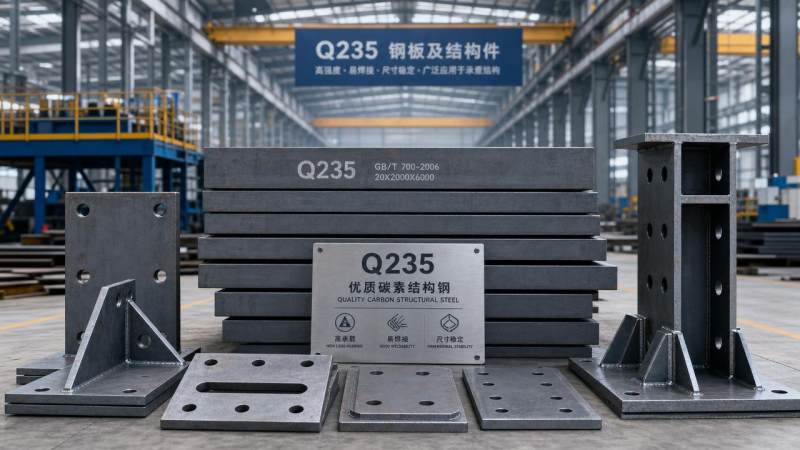
Q235 steel plate is widely used in load bearing structures because it balances strength, weldability, and cost.
For construction and industrial projects, material choice affects safety, fabrication speed, and long-term budget control.
This guide explains how Q235 steel plate performs in real structural scenarios and how to judge fit before ordering.
Hongteng Fengda supplies structural steel products for global projects, with production aligned to ASTM, EN, JIS, and GB standards.
That matters when a project needs stable quality, consistent dimensions, and reliable delivery for structural steel applications.
How project context changes the value of Q235 steel plate
Not every load bearing structure needs the same steel performance level.
A low-rise warehouse, a machinery platform, and a bracket system can share similar loads but require different fabrication decisions.
Q235 steel plate is often selected where moderate strength and easy processing are more important than high alloy performance.
In practical terms, that means it suits many beams, base plates, stiffeners, gusset plates, frames, and support components.
The key is not asking whether Q235 steel plate is good in general.
The better question is whether it matches the actual load path, welding method, service environment, and code requirement.
Scenario 1: Building frames and secondary structural supports
Q235 steel plate is a common choice for secondary members in building structures.
Typical uses include connection plates, bracing components, column foot plates, and light to medium support assemblies.
Its main advantage here is fabrication efficiency.
Cutting, drilling, bending, and welding are usually straightforward, which helps reduce workshop delays and site adjustments.
This scenario works best when design loads are clear and the structure does not require elevated yield strength grades.
If the project involves corrosive exposure or heavy dynamic loading, extra checks are needed before final selection.
Key judgment points for building support use
- Load level and safety factor required by the design code
- Thickness tolerance needed for plate connections
- Welding volume and heat input during fabrication
- Surface treatment plan for indoor or outdoor use
Scenario 2: Industrial platforms, equipment bases, and factory structures
Industrial facilities often need steel plates for walkways, machine frames, support tables, and access platforms.
In these settings, Q235 steel plate offers an effective balance between performance and material cost.
It is especially suitable when repetitive fabrication and large quantity purchasing matter.
Many factory structures also combine plate, angle steel, channel steel, and beams into one system.
For related reinforcement or downstream forming needs, some projects also source Wire Rod together with structural materials.
Common grades include GB1499.2 HRB400, HRB500, ASTM A615 Grade 60, and BS4449 460B for building material applications.
Such products are valued for formability, weldability, and wide use in structural steel bar and industrial manufacturing work.
For platform structures, Q235 steel plate remains the main choice when the plate itself carries the primary structural function.
When this scenario is a strong match
It fits projects that need fast fabrication, predictable supply, and practical welding performance.
It is less ideal when impact toughness at low temperature becomes a critical design condition.
Scenario 3: General fabricated components for transport and utility structures
Q235 steel plate is also used for general fabricated parts in transport, utility, and municipal support systems.
Examples include enclosures, brackets, frame covers, mounting plates, and non-extreme support structures.
This scenario benefits from the plate’s availability in common thickness ranges and its compatibility with standard shop processes.
However, engineers should separate static support use from fatigue-sensitive service.
Repeated vibration, shock, or severe weather exposure can change the material decision significantly.
How Q235 steel plate requirements differ by application
Practical selection advice before specifying Q235 steel plate
A good specification starts with the actual service condition, not only the nominal grade name.
Q235 steel plate can perform very well when the specification includes the right thickness, delivery condition, and inspection scope.
Checklist for better material matching
- Confirm whether the member carries static, dynamic, or impact loads.
- Check if the design standard accepts Q235 steel plate for the intended structural role.
- Review welding procedure compatibility and heat affected zone demands.
- Define coating, galvanizing, or painting needs for the service environment.
- Request mill test documentation and dimensional consistency for critical assemblies.
These steps help avoid over-specifying expensive grades or under-specifying structural safety.
Common mistakes when using Q235 steel plate in load bearing structures
One common mistake is treating all load bearing structures as equal.
A plate used in a lightly loaded support frame is very different from one used in a vibration-prone equipment base.
Another mistake is focusing only on price per ton.
If flatness, thickness tolerance, or weldability are poor, downstream costs can rise quickly.
Some projects also ignore corrosion exposure during early selection.
Q235 steel plate may still be suitable, but the protection system must be planned from the start.
Finally, imported material decisions should consider standard equivalence carefully, especially across GB, ASTM, and EN references.
What to do next for a better Q235 steel plate sourcing decision
If a project uses Q235 steel plate in load bearing structures, start by mapping each component to its real service condition.
Then compare structural role, welding demand, environmental exposure, and certification requirements before finalizing the order.
Hongteng Fengda supports global structural steel supply with stable production, quality control, and customized solutions for varied project needs.
A clear technical review helps ensure Q235 steel plate delivers the expected value in performance, fabrication efficiency, and total project cost.
Please give us a message


Please enter what you want to find