Choosing between Q235 steel and Q345 can directly affect strength, cost, and project performance. For buyers comparing Q235 steel with alternatives like S235JR steel in structural applications, understanding their mechanical properties, weldability, and common uses is essential. This guide explains the key differences clearly to help engineers, purchasers, and project managers make informed steel sourcing decisions.
In real procurement work, the choice is rarely only about yield strength. It also involves fabrication method, welding process, structural load, compliance standard, lead time, and total delivered cost. For construction firms, machinery manufacturers, distributors, and project owners, selecting the wrong grade can increase steel tonnage, slow processing, or create avoidable inspection issues during installation.
As a structural steel manufacturer and exporter from China, Hongteng Fengda supports global buyers with standard and customized steel products for building, industrial, and infrastructure projects. With production aligned with ASTM, EN, JIS, and GB requirements, the company helps customers compare material options based on practical use, not only on nominal grade names.
Understanding Q235 and Q345 in Structural Steel Applications
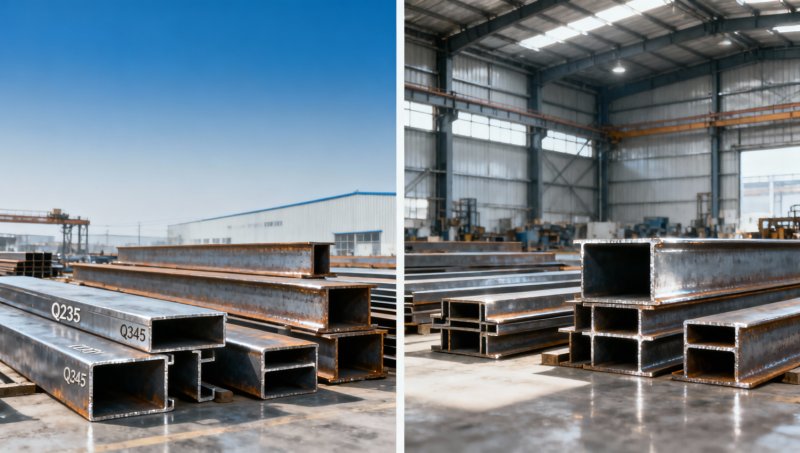
Q235 and Q345 are common carbon structural steels under Chinese GB standards. In simple terms, the letter “Q” refers to yield strength, while the number generally indicates the minimum yield value in MPa. Q235 is widely used for general structural parts, while Q345 is selected when higher strength and better load-bearing performance are required.
For international buyers, Q235 is often compared with grades such as S235JR, and Q345 is commonly discussed alongside S355-related grades. However, these are not always one-to-one equivalents. Chemical composition, impact requirements, and delivery conditions may differ by standard, so engineering review is still necessary before substitution.
In daily fabrication, the difference becomes visible in section design and plate thickness. A project using Q345 can sometimes reduce material weight by around 10% to 20% compared with Q235 in certain structural members, depending on design code, safety factor, and load combination. That can affect transport cost, welding length, and erection efficiency.
Q235 remains highly practical because it offers stable workability, broad market availability, and lower unit cost in many standard profiles. For workshops making brackets, frames, rails, stairs, purlins, and low- to medium-load supports, it is often sufficient. Q345 becomes more attractive in heavy steel structures, equipment bases, platforms, and projects with longer spans or higher stress demand.
Basic technical comparison
The table below summarizes the most relevant differences from a sourcing and engineering perspective. Exact values can vary by thickness, subgrade, and standard revision, so final documents should always be checked against the required material certificate and project specification.
The key takeaway is straightforward: Q235 is often the cost-efficient choice for ordinary structural use, while Q345 offers a stronger performance margin for demanding designs. Buyers should not compare price per ton alone. They should also evaluate how each grade affects weight, fabrication time, and compliance with structural calculations.
Mechanical Properties, Weldability, and Processing Differences
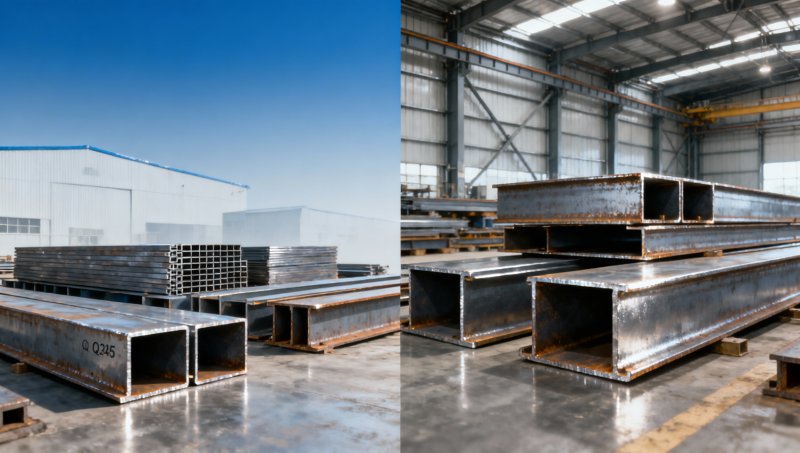
Mechanical properties are usually the first screening factor. Q345 provides higher yield strength and often higher tensile strength than Q235, which makes it more suitable for columns, trusses, bridge members, equipment support frames, and heavily loaded platforms. When a design has strict deflection limits or dynamic loads, the stronger grade can provide better reserve capacity.
Weldability is another major concern. Both Q235 and Q345 are weldable, but Q345 generally needs more attention because higher strength steel may require tighter control of heat input, preheating, and welding consumables, especially in thicker sections such as 20 mm, 30 mm, or above. This is particularly important for low-temperature service or high-restraint joints.
From a fabrication viewpoint, Q235 is often easier for general cutting, bending, and routine workshop welding. For light fabrication lines producing angle steel, channel steel, and standard welded assemblies in volume, Q235 can improve process simplicity. Q345 may increase workshop control requirements, but it can still be processed efficiently when procedures are matched to thickness and joint design.
Impact performance also matters. Different subgrades within the Q345 family may carry distinct low-temperature toughness requirements. In projects exposed to winter installation, outdoor service, or vibration, it is important to define the exact grade suffix and testing requirement in the purchase order rather than requesting only “Q345” as a generic description.
How fabrication teams usually assess the two grades
- Check required section thickness. Welding risk changes noticeably once thickness moves from below 12 mm to 20 mm and above.
- Review whether the project is dominated by static load, dynamic load, or repeated loading cycles.
- Confirm if cold bending radius, punching, or tight dimensional tolerance is required during fabrication.
- Verify whether impact testing, third-party inspection, or mill test certificate detail is mandatory.
Typical performance focus by buyer role
Engineers usually focus on yield margin, tensile behavior, and structural reliability. Procurement teams often compare price difference per ton, stock availability, and replacement flexibility. Quality teams examine certificate traceability, chemistry, tensile test reports, and welding consistency. Project managers normally care most about whether the selected grade can reduce rework and keep delivery within a 2–6 week schedule window.
In marine and retaining structures, strength selection becomes even more practical. For example, Steel Sheet Piles are commonly supplied in grades such as S275, S355, S390, S430, SY295, SY390, and ASTM A690, produced to EN10248, EN10249, JIS5528, JIS5523, or ASTM standards. These products are used in deep water construction and cofferdams, with single lengths reaching over 80 m, and their grade choice follows the same basic logic as the Q235 versus Q345 discussion: required strength, site condition, penetration performance, and durability all influence the final specification.
This example shows why steel sourcing should be application-led. A lower grade may be entirely suitable for temporary structures or moderate duty, while higher grades become more efficient where load, water depth, penetration resistance, or repeated reuse must be considered from the start.
Application Scenarios: When to Choose Q235 and When Q345 Makes More Sense
The right grade depends on what the steel will actually do. Q235 is commonly used in factory buildings, handrails, support brackets, stairs, enclosure frames, warehouse racks, and light structural systems. It is also common in OEM fabrication where the part is easy to process, does not carry high stress, and needs dependable cost control over large production runs.
Q345 is more frequently selected for heavier steel frames, long-span workshops, mezzanine beams, crane-supporting structures, mining equipment frames, transmission towers, and industrial platforms. In these cases, the higher yield strength can either support greater design load or reduce section size while keeping the same design target. That can lower dead weight and simplify transportation in some projects.
Another common scenario is export substitution. Some buyers start with a European or Japanese reference grade and then evaluate whether Q235 or Q345 can be used for equivalent manufacturing under local code review. This is possible in many cases, but dimensional tolerance, impact requirement, and delivery condition must still be checked line by line. Cross-standard comparison should always be confirmed before mass production.
Cost-sensitive buyers sometimes assume Q235 is always the best financial choice. That is not always correct. If a Q345 design reduces steel consumption by 12%, cuts weld seam length by 8%, or helps avoid adding stiffeners, the final fabricated cost may become competitive. The real comparison is project cost, not material price alone.
Application-based selection table
The following table gives a practical selection view for different structural and industrial scenarios. It is especially useful for technical evaluators, purchasing teams, and commercial decision-makers balancing strength and budget.
This comparison confirms that there is no universal winner. Q235 works best where fabrication efficiency and low cost matter most. Q345 is the stronger option when structural demand is higher or when optimized design can offset the higher material price.
Procurement, Quality Control, and Cost Evaluation
For purchasing teams, steel grade selection should be linked to a clear review process. At minimum, 4 areas should be checked before order confirmation: grade and standard, required dimensions, inspection documents, and fabrication route. If only the grade name is listed without thickness, impact requirement, or acceptance standard, misunderstandings can happen during production and final inspection.
A practical cost evaluation should consider at least 5 variables: raw material price, fabrication hours, welding consumables, transport weight, and inspection risk. A lower-price grade can become more expensive if it increases tonnage, machining time, or field reinforcement work. This is especially relevant for overseas shipments where freight and installation delays can materially affect total project cost.
Quality control teams should verify mill test certificates, heat number traceability, dimensional tolerance, surface condition, and mechanical test results. For welded assemblies, it is also wise to align the base material with the WPS, electrode selection, and any NDT requirement before production begins. A disciplined review at the purchasing stage can reduce rework later.
Reliable suppliers add value by supporting standard and OEM orders, clarifying equivalence risks, and maintaining stable production schedules. Hongteng Fengda supplies angle steel, channel steel, steel beams, cold formed steel profiles, and custom structural steel components with quality control aligned to major international standards. This helps global buyers manage compliance and lead time more consistently across projects.
Checklist for steel grade sourcing decisions
- Confirm the governing standard first, such as GB, ASTM, EN, or JIS, rather than comparing grade names only.
- Define product form clearly: plate, beam, angle, channel, cold formed profile, or fabricated component.
- State thickness range, tolerance, testing requirement, and whether impact or third-party inspection is needed.
- Compare total project cost over 1 full supply cycle, including freight, fabrication, and installation effects.
- Review lead time, especially when the order includes non-standard sizes or OEM processing steps.
Procurement decision matrix
The matrix below can help buyers align technical and commercial priorities during supplier evaluation and budget approval.
A disciplined comparison like this reduces sourcing risk. It also helps internal stakeholders, from engineering to finance approval, understand why a higher-grade steel may sometimes be the more economical decision over the full project cycle.
Common Questions, Risks, and Practical Selection Advice
Many sourcing issues come from oversimplified assumptions. One common mistake is treating Q235 and Q345 as interchangeable only because both are structural steels. In reality, strength difference, welding procedure, and certification detail can all affect production and project approval. Another mistake is comparing grades from different standards without reviewing chemistry and toughness requirements.
Lead time is another practical concern. Standard sections in common sizes may ship faster, while non-standard profiles, large fabricated members, or special testing requirements can extend production by 7–20 days or more, depending on order complexity. Buyers should confirm whether the order is stock-based, rolling-based, or fabrication-based before locking a construction schedule.
For long-term partnerships, supplier capability matters as much as grade choice. Stable production capacity, clear communication on standards, and consistent documentation help reduce disputes after shipment. This is particularly important for distributors, EPC contractors, and project managers handling multiple countries or mixed-standard orders.
In most cases, the best approach is to start from the design load and compliance requirement, then evaluate fabrication method and total cost. If the project is routine and price-sensitive, Q235 often remains the practical answer. If the project targets higher strength, lower weight, or stronger structural margin, Q345 deserves closer review.
Is Q345 always better than Q235?
No. Q345 is stronger, but stronger does not automatically mean more economical or more suitable. If the structure carries moderate load and uses standard sections, Q235 may provide better overall value because of lower material cost and easier processing.
Can Q235 replace S235JR directly?
It may be close in strength class for some applications, but direct replacement should not be assumed. Buyers should compare standard details, impact requirements, chemistry limits, and acceptance conditions before approval, especially for export or certified structural work.
What should be written on the purchase order?
At minimum, specify the grade, product form, dimensions, standard, quantity, required certificate, and any testing or processing requirement. For fabricated components, also define tolerances, coating if applicable, and inspection method. A well-written order can prevent delays and disputes more effectively than post-shipment corrections.
Final selection guidance
Q235 steel and Q345 steel each serve a clear purpose in structural and industrial projects. The right decision depends on 3 core factors: required strength, fabrication method, and total project cost. Buyers who evaluate these together usually make better sourcing decisions than those comparing price per ton alone.
For global buyers seeking reliable structural steel supply from China, Hongteng Fengda offers standard specifications and customized solutions across angles, channels, beams, cold formed profiles, and tailored components. If you need help matching Q235, Q345, or other structural steel grades to your project, contact us to discuss specifications, request a custom quotation, or get a practical sourcing solution for your next order.
Please give us a message


Please enter what you want to find