Q195 angle steel remains a practical choice for light structures where cost, forming ease, and steady supply matter as much as strength. In workshops, small buildings, support frames, and non-critical assemblies, it often delivers the right balance between performance and budget. The key is not treating it as a universal solution. Its value becomes clear only when load level, welding needs, corrosion exposure, and service life are judged together.
Why Q195 angle steel still matters in light construction
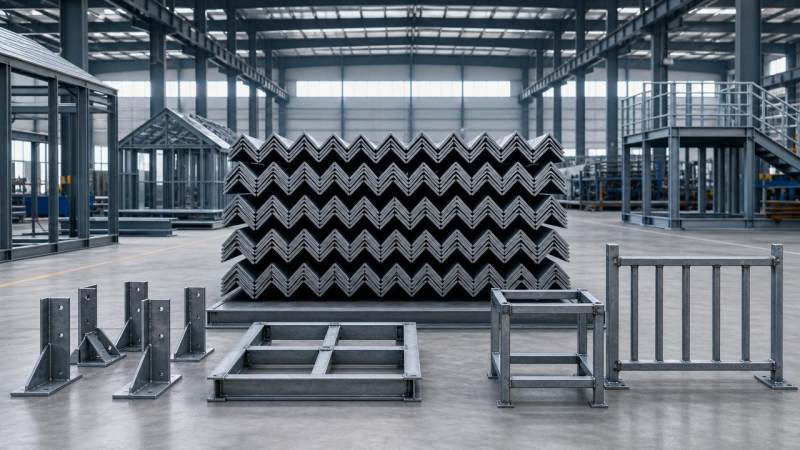
In the steel market, lighter structures often need materials that are simple to process and easy to source in stable quantities. That is where Q195 angle steel stays relevant.
It is a low-carbon structural steel angle commonly used for brackets, frames, fences, rack supports, equipment bases, and light truss members. These uses do not demand the same capacity as heavy industrial steelwork.
From a project view, the attraction is straightforward. Material cost is relatively low, fabrication is convenient, and replacement or secondary processing is usually uncomplicated.
For exporters and project suppliers, this also fits markets that need standard sections with dependable delivery rather than highly specialized grades. That helps explain its steady presence across construction, manufacturing, and utility-related jobs.
What Q195 angle steel offers in real use
The practical strengths of Q195 angle steel are less about headline performance and more about workability. In many light-duty applications, that matters more than chasing a higher grade.
Good forming and fabrication behavior
Because of its low carbon content, Q195 angle steel is generally easy to cut, punch, drill, and bend. This reduces processing difficulty during fabrication and site adjustment.
Welding is also manageable in routine structural work when proper procedures are followed. For simple assemblies, that lowers manufacturing complexity.
Cost efficiency for non-heavy-load tasks
Not every support member needs a higher-strength grade. When loads are modest, selecting Q195 angle steel can help control total project cost without unnecessary overdesign.
This is particularly useful in repetitive fabrication, temporary installations, utility frames, and secondary support systems.
Broad processing compatibility
Q195 angle steel works well in production lines that already handle punching, shearing, welding, and surface coating. It supports efficient fabrication without major process changes.
In projects combining framing and enclosure materials, this compatibility matters. A light steel frame may be paired with roofing or cladding products such as Color Coated Galvanized Roof Sheet PPGI, especially in residential, agricultural, or public building applications where ease of installation and cost control are both priorities.
Where the limits begin to show
The main mistake with Q195 angle steel is expecting light-duty material to perform like a higher-grade structural section. Its limits are not hidden, but they do need attention before selection.
Strength margin is the first concern. If the member faces dynamic loading, sustained stress, deformation sensitivity, or strict safety requirements, Q195 angle steel may not be the best fit.
Corrosion is the second concern. Bare angle steel in wet or outdoor conditions can deteriorate quickly if surface protection is insufficient. In those cases, coating strategy becomes part of material selection, not an afterthought.
Consistency is another issue worth checking. For projects involving export, repeated assembly, or OEM production, dimensional tolerance and quality control are just as important as grade name.
Typical scenarios where it fits best
Q195 angle steel is usually most effective when the structure is useful, visible, and functional, but not highly stressed.
- Light support frames for equipment, cabinets, and utility systems.
- Small racks, shelving supports, and workshop fixtures.
- Fencing structures, guard frames, and simple perimeter installations.
- Agricultural sheds, storage annexes, and basic roof support members.
- Secondary structural parts inside larger steel assemblies.
It becomes less suitable when the design involves long unsupported spans, vibration-sensitive equipment, heavy lifting zones, or demanding environmental exposure.
That distinction is important because many light structures look simple, yet operate under very different conditions. A warehouse partition frame and an outdoor machinery base may have similar shapes but very different risks.
How to judge selection more accurately
Choosing Q195 angle steel well usually comes down to a few practical checks rather than a long specification list.
Start with the actual load path
Look at whether the angle carries compression, tension, torsion, or repeated movement. Light static loads are very different from shock or cyclic conditions.
Check the service environment
Indoor dry use is one thing. Outdoor rain, salt air, fertilizer storage, or chemical splash changes the decision completely.
Match processing with finish
If punching and welding happen before painting or galvanizing, surface protection should be planned around fabrication steps. Rework often adds cost later.
Confirm standards and supply stability
Reliable sourcing matters when replacing parts or producing the same frame repeatedly. Manufacturers with clear quality systems help reduce variation across batches.
That is one reason global buyers often work with established structural steel suppliers. Hongteng Fengda, for example, serves projects across North America, Europe, the Middle East, and Southeast Asia with angle steel, beams, channels, cold formed profiles, and OEM structural components produced under controlled quality processes.
Looking beyond the angle section itself
In light structures, the performance of Q195 angle steel rarely stands alone. Roof sheets, wall panels, fasteners, coatings, and connection details all influence service life and maintenance needs.
For example, a light roof frame may use Q195 angle steel effectively, while the envelope material needs stronger corrosion resistance and weather stability. In that context, coated sheet products such as PPGI or PPGL can complement the structure well.
A solution like Color Coated Galvanized Roof Sheet PPGI is often selected for wavy or trapezoidal roofing because it combines easy formability, attractive finish options, and corrosion resistance. Typical thickness ranges from 0.2mm to 1.2mm, with service life that can exceed 25 years under suitable conditions.
This wider system view helps avoid a common problem: choosing the cheapest frame member correctly, but missing cost drivers in roofing, maintenance, or premature surface failure.
A practical way to move forward
Q195 angle steel makes sense when the structure is light, the loading is clear, and the environment is manageable. It is not a shortcut for every job, but it is often an efficient answer for the right one.
The most useful next step is to review three points together: load demand, exposure conditions, and fabrication method. That usually reveals whether Q195 angle steel is appropriate as specified, needs coating support, or should be replaced by a higher-grade option.
When comparing suppliers, it also helps to look beyond price and check tolerance control, standards compliance, OEM capability, and delivery reliability. Those factors shape the real performance of light structural steel in day-to-day use.
With that approach, Q195 angle steel becomes easier to judge on its true merits: economical, workable, and useful within clear structural limits.
Please give us a message


Please enter what you want to find