Corrosion prevention in cold-formed steel framing starts with controlling moisture, not simply covering rust with paint. A galvanized surface can protect steel for years, but persistent leaks, condensation, trapped water, damaged coatings and incompatible metal contact can eventually expose the thin framing section beneath it. Because cold-formed members rely on relatively thin steel, localized metal loss at a connection or bearing point deserves prompt attention.
For systems made with acero conformado en frio, the practical priorities are to find where water enters or condenses, identify whether the protective coating is still functioning, and distinguish superficial staining from damage that could affect the structure. Repairs that ignore the moisture source may conceal deterioration without stopping it.
Find the moisture source before treating the steel
Cold-formed steel framing can remain in good condition in a dry, enclosed assembly. Problems arise when moisture reaches the metal and cannot dry. Rainwater may enter through failed sealant or flashing; plumbing leaks can wet a wall from within; and condensation can form when humid indoor air reaches a surface below its dew point. A single stain does not reveal which mechanism is responsible.
Trace moisture both upward and outward from the affected area. Water can travel along tracks, sheathing, fasteners and service penetrations before it becomes visible. Check roof-to-wall junctions, window sills, cladding attachments, plumbing routes and the base of walls. At floor level, distinguish an isolated spill from repeated wetting caused by cleaning, drainage problems or water entering at the building envelope.
Condensation requires a different response from a leak. It may appear on cold surfaces, around thermal bridges or in cavities where warm, moist air can reach chilled steel. Simply sealing a visible opening or applying a coating to the stud does not necessarily correct the air leakage, insulation discontinuity or humidity condition producing the condensation. Changes to insulation and vapor-control layers should be compatible with the building’s climate and assembly design; an incorrectly placed impermeable layer can trap moisture rather than prevent it.
Also look for conditions that keep steel damp after the original event: wet insulation, debris in bottom tracks, blocked drainage paths or contact with persistently wet materials. Remove trapped water and address the cause before closing the assembly. Drying time depends on the materials and access available, so confirm that concealed components have dried rather than relying on a dry-looking surface.
Inspect vulnerable locations, not just exposed stud faces
A clean section of visible framing does not establish the condition of the whole assembly. Prioritize locations where water collects, coatings are interrupted or structural forces are transferred:
- Bottom tracks and floor interfaces: Check for standing water, debris, discoloration and rust at the track web and flanges. The underside may be less accessible than the face visible from the room.
- Connections and fasteners: Examine screw heads, washers, overlapping sheets and the steel around fastener holes. Crevices can retain moisture, and damage at a connection can be more consequential than similar-looking staining on an unloaded face.
- Cut edges and penetrations: Inspect field-cut ends, holes and areas abraded during installation or later service work. These may have less coating protection than the original sheet surface.
- Openings and exterior junctions: Review framing below windows, near door thresholds and behind failed flashing, where intermittent water entry may remain hidden.
- Service areas: Check framing adjacent to pipes, ducts and equipment where leaks, condensation or repeated washdown can keep surfaces wet.
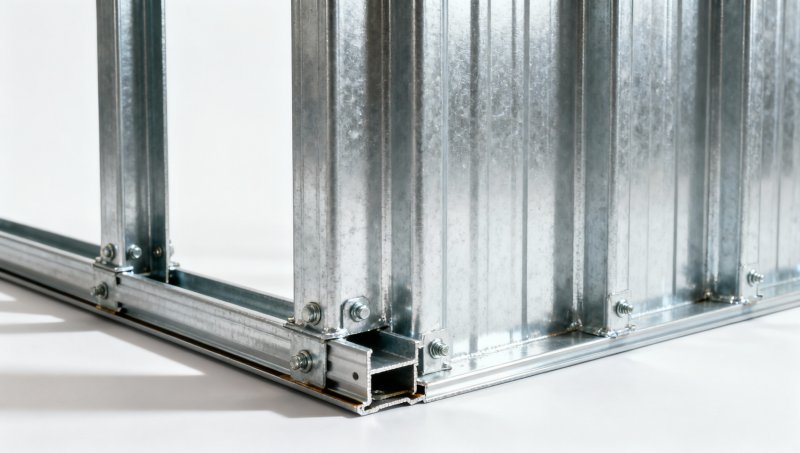
Use a torch and mirror where appropriate, and document the location before removing finishes. Where evidence points to concealed damage, arrange a targeted opening rather than assuming that the visible area represents the full extent. Opening fire-rated or moisture-control assemblies can affect their performance, so plan reinstatement with the relevant building requirements in mind.
Photographs should include a wider view that establishes the location and a close-up with a scale. Record whether the surface is dry or wet, the apparent source of moisture, the affected members and fasteners, and whether corrosion is concentrated at an edge, joint or contact point. Comparable photographs taken after repair and at the next inspection make recurrence easier to identify.
Separate coating changes from structural deterioration
Many cold-formed framing members are manufactured from zinc-coated steel. The coating provides a barrier and can also protect adjacent exposed steel sacrificially. Its appearance can change as it weathers, so color alone is not a reliable measure of remaining protection.
White or pale deposits on galvanized surfaces can indicate zinc corrosion products, particularly where moisture has been trapped. They are a reason to investigate wetting and the condition beneath the deposits, not automatic proof that the steel member has lost structural capacity. Red-brown rust indicates corrosion of iron or steel, although staining can also come from a nearby unprotected fastener or another component. Identify its source before deciding how much of the framing is affected.
More serious indicators include pitting, flaking or delamination of the steel, visible perforation, distorted sections, loose fasteners and corrosion spreading around screw holes or bearing surfaces. Avoid judging remaining thickness by appearance alone: corrosion products can occupy more volume than the metal lost, while a small pit at a critical location may be significant.
Where section loss is suspected, protect the area from additional loading and refer the condition to a qualified structural engineer. Accurate assessment may require selective cleaning, access to both sides, thickness measurement and comparison with the original design information. Measurements must distinguish remaining steel from coatings and corrosion products, and a single reading does not characterize an entire damaged region.
Do not drill, cut, grind or aggressively scrape a questionable member to investigate it without an approved method. Such work can remove sound material, damage protective coatings or weaken a connection. If the member is bowed, perforated, detached or supporting a visibly distressed assembly, restrict access as appropriate and obtain engineering direction before disturbing it.
Repair the cause, then restore protection
For a localized area with intact steel and limited coating damage, a suitable repair may involve cleaning and applying a compatible zinc-rich repair product or other specified protective coating. The exact method depends on the original coating, surface condition, exposure and product instructions. Surface preparation matters: loose corrosion, contaminants and moisture can prevent adhesion, while excessive abrasion can remove sound coating around the defect.
Do not apply a generic finish over damp steel or loose rust and assume the problem is solved. A coating system must be suitable for the substrate and service environment, and its application conditions must be met. Where the original specification or governing project documents prescribe a repair method, follow those requirements. A zinc-rich coating is a localized protection measure; it is not automatically equivalent to restoring the original factory-applied coating throughout an assembly.
When section loss or connection damage is present, coating alone is not a structural repair. An engineer may specify replacement, reinforcement or another repair based on the member’s role, remaining section, load path and accessibility. Avoid substituting a similar-looking stud or installing a patch without a design: thickness, steel strength, profile geometry, screw spacing and connection details can all affect performance.
During replacement, preserve the functions of adjacent layers. Reinstall insulation, air and water barriers, sheathing and fire-protection materials to the approved assembly requirements. A structurally adequate replacement can still leave a recurring corrosion problem if flashing is not restored or humid air can enter the cavity.
Pay attention to dissimilar metals and adjacent services
When two different metals are electrically connected in the presence of an electrolyte such as moisture, galvanic corrosion can increase attack on the less noble metal. The risk depends on the materials, exposed areas and wetting conditions; contact between unlike metals in a reliably dry interior is not equivalent to contact in a persistently wet or salt-contaminated location.
Check fasteners, brackets, pipe supports and other attachments for compatibility with the framing and its coating. Where isolation is specified, use an appropriate nonconductive separator or compatible protective system without compromising the connection. Do not insert an improvised gasket into a structural joint if it alters clamping, bearing or the approved load path.
Pipes are relevant to framing maintenance mainly as a potential source of leakage, condensation or incompatible contact. A Carbon Steel Pipe Supplier may provide pipe for construction or fluid-service applications, but pipe and cold-formed framing have different functions and specifications. A pipe material grade or finish should not be treated as evidence that an adjacent framing connection is protected against corrosion.
Adjust inspection frequency to the exposure
A fixed calendar interval is less useful than a schedule based on how the assembly is exposed and what previous inspections have shown. Give closer attention to locations with recurring leaks, coastal salt exposure, chemical contaminants, washdown, condensation or a history of coating damage. A dry interior partition with no evidence of water entry presents a different maintenance problem from framing beside an exterior opening that has repeatedly leaked.
Increase inspection after an event that changes the risk: a roof leak, flood, pipe failure, façade repair or prolonged interruption of building climate control. Following a leak, an initial visit should identify and contain the source; a later check should confirm that concealed materials dried and that corrosion is not continuing. If finishes prevent confirmation, determine whether selective opening or moisture investigation is warranted.
For each affected location, keep a record of the moisture source, the visible condition, photographs, any measurements, the repair specification and the person responsible for follow-up. Record whether the cause was eliminated or only temporarily controlled. That distinction helps prevent an apparently completed coating repair from disappearing into the maintenance history while water continues to reach the steel.
The most effective preventive action is often outside the framing itself: a functioning flashing detail, a repaired pipe, a clear drainage path or controlled indoor humidity. Where corrosion has already appeared, resolve that exposure and verify the condition of the steel before deciding whether cleaning, coating or engineered replacement is appropriate.
Please give us a message


Please enter what you want to find