Mild Steel Plate for shipbuilding plays a vital role in marine structures where strength, weldability, and class approval matter most. For buyers comparing high strength steel plate, steel sheet price, and steel coil price per ton, understanding specification, quality control, and supply reliability is essential. This guide explains how to evaluate certified shipbuilding steel for safe, cost-effective, and efficient project sourcing.
In shipbuilding, the material decision affects hull integrity, fabrication speed, inspection outcomes, and long-term maintenance cost. Technical evaluators focus on grade, impact toughness, and traceability. Procurement teams compare price per ton, delivery schedule, and documentation completeness. Project managers need stable supply to avoid production delays, while quality and safety teams must verify compliance with marine standards and approved manufacturing practices.
For global buyers sourcing from China, the challenge is rarely limited to finding steel plate alone. The real task is balancing class approval requirements, dimensional tolerance, welding performance, corrosion environment, and commercial risk. A capable structural steel manufacturer with modern production control, export experience, and consistent response can reduce uncertainty across the full purchasing cycle.
What class-approved mild steel plate means in shipbuilding
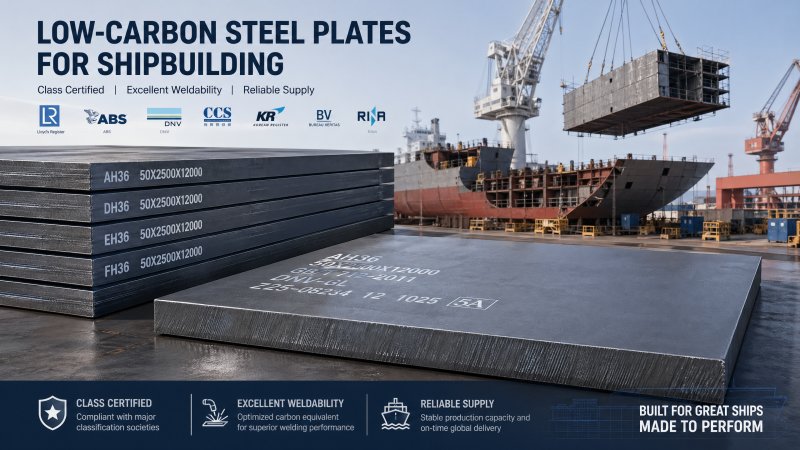
Class-approved shipbuilding steel plate refers to steel that is produced, tested, and documented in line with recognized marine classification requirements. In practical terms, this usually includes chemical composition control, mechanical property verification, impact testing where required, and traceable mill records. For mild steel plate used in ship structures, common baseline expectations include reliable yield strength, stable elongation, and good weldability for large block fabrication.
The most common mild steel grades in shipbuilding are general strength grades used for hull sections, decks, bulkheads, and internal structures. Although exact grade naming may vary by class society and standard system, buyers typically assess 4 core points: strength level, notch toughness, plate thickness range, and approved production route. For standard hull construction, thickness can range from about 5 mm to 50 mm or more depending on section design and vessel type.
Weldability is especially important because shipyards process large volumes of plate through cutting, bending, and multi-pass welding. Mild steel plate is often preferred where fabrication efficiency matters because its carbon content and alloy balance generally support easier welding than higher-alloy alternatives. That can reduce preheating demand, help control distortion, and improve throughput during panel line or block assembly operations.
Class approval rules matter because marine structures operate under cyclic loading, saltwater exposure, and strict inspection regimes. A low plate price without valid documentation can create expensive downstream issues: rejected material, delayed launch schedules, re-testing, or replacement procurement. In many projects, a 2% to 5% material saving can be outweighed by a single production stoppage of 3 to 7 days.
Key properties buyers should verify
Before placing an order, both technical and commercial teams should align on the minimum performance envelope. The following table outlines the practical review points commonly used when sourcing mild steel plate for marine construction.
The table shows that class-approved steel plate is not simply a commodity purchase. It is a controlled engineering input. Buyers who define these three checkpoints early can reduce RFQ ambiguity, compare quotations more accurately, and shorten approval time between sourcing, engineering, and quality departments.
Typical mistakes during early evaluation
- Comparing only steel sheet price per ton without checking whether the quote includes class-endorsed documentation and testing scope.
- Assuming all mild steel plate has the same welding behavior, even though thickness, chemistry, and rolling practice can change fabrication response.
- Overlooking tolerance requirements for flatness, edge condition, or cut-to-length accuracy, which can affect nesting and fit-up efficiency.
- Confirming a vessel schedule before verifying realistic export lead time, port handling, and batch inspection timing.
For companies handling broader steel procurement beyond marine projects, it is also useful to compare different coated and structural products for support facilities, building enclosures, and equipment housings. For example, PPGI Steel Sheet is commonly used in construction, roofing, wall panels, appliance housings, agricultural buildings, and public facilities. Typical specifications include 0.2 mm to 1.2 mm thickness, 600 mm to 1250 mm width, PE to PVDF paint systems, and top coating thickness from 11 μm to 35 μm, making it suitable for corrosion-resistant, visually finished applications adjacent to industrial steel projects.
How to select the right shipbuilding steel plate specification
Selecting the right plate starts with the vessel design requirement, not the stock list. Buyers should first define whether the application is for hull plating, deck plating, internal stiffeners, tank boundary structures, or supporting fabrication parts. Each area may involve different thickness, notch toughness, and inspection expectations. Even within the same vessel, a 6 mm plate and a 32 mm plate do not present the same forming and welding risks.
General strength mild steel plate is often sufficient for standard ship sections where ultra-high yield strength is not the main design driver. However, if operating temperature, structural stress, or classification notes require enhanced toughness, procurement must not substitute a lower-tested plate simply to reduce purchase cost. The price gap per ton may appear attractive at quotation stage, but non-compliant material can disrupt a project much more severely than the initial savings justify.
Specification review should also include edge preparation, surface condition, rolling condition, and delivery status. Some buyers require shot-blasted and primed material for production flow efficiency, while others prefer mill-finish plate to complete downstream blasting in-house. These decisions affect freight weight, storage life, and workshop scheduling. Clear communication at the PO stage reduces mismatch and claims after arrival.
For international projects, standards mapping is another practical issue. Buyers may work across ASTM, EN, JIS, and GB references while still needing marine class acceptance. A supplier experienced in exporting structural steel can help align equivalent or near-equivalent requirements, but final approval should always follow project documentation and class expectations rather than informal grade comparison.
Specification checklist for procurement and engineering teams
A structured checklist can prevent omissions before RFQ release. The following points are commonly used in marine steel sourcing and are especially helpful when multiple departments participate in the decision.
- Confirm grade, thickness range, width, length, and quantity split by plate size.
- State required inspection documents, including mill test certificate, heat traceability, and any class witness requirements.
- Define mechanical and impact test expectations by thickness or lot, especially if service temperature is low.
- Specify surface condition, edge condition, and whether blasting, priming, or special packing is needed.
- Clarify delivery schedule, shipment split, Incoterms, and destination constraints such as port handling limits.
This 5-step checklist improves quote comparability. It also helps financial approvers and business evaluators understand why one offer may be 20 to 60 USD per ton higher than another. The premium may reflect additional testing, tighter tolerance control, better packaging, or more dependable lead times rather than simple markup.
Typical specification ranges in project sourcing
Although each project differs, many buyers work within recurring procurement windows. Common order lots may range from 50 tons for repair or sectional replacement up to 500 tons or more for newbuild block production. Thickness bands often cluster around 6–12 mm, 12–25 mm, and 25–40 mm, because these ranges influence rolling availability, welding heat input planning, and freight loading efficiency.
Lead time also changes by specification complexity. Stock-based standard sizes can move faster, while class-documented production lots or non-standard cut lengths may require 2–6 weeks depending on mill schedule, testing sequence, and export documentation. For project managers, this timing is as important as the steel sheet price itself because schedule exposure often drives total cost.
Quality control, testing, and traceability in marine steel supply
Quality control is the point where a steel supplier either protects the buyer’s project or transfers risk to it. In marine applications, good quality control means more than passing one tensile test. It includes raw material consistency, rolling parameter stability, dimensional inspection, test sample management, marking accuracy, and documentation alignment from production to shipment. If one link fails, inspection at the shipyard can become complicated and time-consuming.
Traceability should connect each plate to a heat number, test record, and shipping batch. This is especially important when an order contains multiple thicknesses or split deliveries over several weeks. Without proper plate marking and record control, buyers may struggle to segregate material during receiving inspection. That creates avoidable delays for quality teams and can interfere with class review during fabrication audits.
Reliable exporters usually establish inspection points before shipment. Typical checkpoints include dimensional verification, surface examination, quantity reconciliation, certificate review, and packing confirmation. For buyers handling 100 to 300 tons per shipment, even small documentation errors can multiply quickly if bundles, plate counts, and certificate entries do not match.
Hongteng Fengda’s business direction as a structural steel manufacturer and exporter is relevant here because marine and industrial buyers often need more than basic supply. They need stable production capacity, consistent quality control, and dependable lead times across international standards such as ASTM, EN, JIS, and GB. This becomes especially valuable when procurement teams must coordinate technical review, commercial approval, and logistics planning across multiple regions.
Practical QC checkpoints before shipment
The table below summarizes common quality control items that should be agreed before dispatch. These are useful for quality managers, project coordinators, and distributors who need clear acceptance criteria.
The key takeaway is that documentation quality and physical quality must move together. A plate can be dimensionally acceptable but still create project risk if its certificate, marking, or test reference is incomplete. Buyers should treat paperwork review as part of material verification, not as a separate clerical exercise.
Risk control measures for import buyers
- Request a pre-shipment document pack 3 to 5 days before loading so technical and QC teams can review certificates in advance.
- Use a receiving checklist with at least 6 items: quantity, size, plate marking, surface condition, certificate match, and packaging integrity.
- For first orders or critical projects, consider trial procurement of 20 to 50 tons before rolling out larger volume contracts.
- Separate approval responsibility between engineering, quality, and purchasing to avoid single-point decision errors.
These measures do not add much administrative burden, but they can significantly improve sourcing confidence. In marine steel purchasing, disciplined control at the front end often saves more cost than aggressive price negotiation at the final stage.
Commercial evaluation: price, delivery, and total sourcing cost
Buyers often enter the market comparing high strength steel plate, mild steel plate, steel sheet price, and steel coil price per ton. That is reasonable, but ton price alone is not the full commercial picture. For shipbuilding projects, total sourcing cost includes freight, inspection coordination, packaging, customs documentation, replacement risk, and the financial impact of late delivery. A lower quoted rate may become more expensive if it causes workshop idle time or re-ordering.
Procurement teams should classify offers into at least 3 categories: stock supply, production supply, and project-managed supply. Stock supply may deliver faster but may not fit exact dimensions or documentation needs. Production supply can meet specification more precisely but needs longer scheduling. Project-managed supply usually combines specification control, export coordination, and staged delivery support, which is useful when vessel construction follows several milestones over 4 to 12 weeks or longer.
For financial approvers, evaluating cost variance by line item is more useful than focusing only on the final per-ton figure. A quote that is 30 USD per ton higher may still reduce overall project cost if it includes shorter lead time, reduced wastage through exact dimensions, or fewer inspection issues. This matters especially for large orders above 200 tons where downstream disruption can exceed the apparent material savings.
Global steel buyers also need a supplier who understands export communication and specification discipline. Hongteng Fengda supports customers across North America, Europe, the Middle East, and Southeast Asia with structural steel products, OEM-oriented solutions, and stable delivery planning. In B2B sourcing, that export experience can help reduce the commercial friction that often appears between technical requirements and shipping execution.
Comparison framework for supplier selection
When multiple suppliers submit quotations, a weighted comparison model can make internal approval faster. The table below shows a practical way to compare marine steel offers beyond price alone.
This comparison method helps commercial and technical teams reach a shared decision. It also provides a stronger approval basis for management, because the purchase is framed around risk-adjusted value rather than a single low-price metric.
Questions that should be answered before issuing the PO
- Is the quoted plate fully aligned with required class approval and testing scope?
- What is the realistic lead time: 7–15 days for stock, or 3–6 weeks for production material?
- Can the supplier provide split shipment if the project needs partial delivery first?
- How will non-conformity be handled if marking or documentation mismatch is found on arrival?
These questions are simple, but answering them before order release can materially improve procurement outcomes. In steel purchasing, clarity before production is usually cheaper than negotiation after shipment.
Implementation tips, common risks, and FAQ for project teams
Once specification and supplier selection are complete, execution quality determines whether the sourcing plan actually works at the yard or fabrication site. Project teams should align material release, drawing confirmation, shipment scheduling, and receiving inspection into one timeline. A delay of even 48 to 72 hours can affect cutting plans, labor loading, and subcontractor coordination if the project operates on a tight block production sequence.
One frequent risk is underestimating documentation review time. Another is mixing plates from different heats or thickness groups without clear segregation. For distributors and resellers, labeling discipline is especially important because stock turnover across customers can create traceability gaps if repacking is not controlled. Good warehouse practice should include heat-number visibility, dry storage, and incoming-to-outgoing record continuity.
Operational users and fabrication supervisors should also check whether the delivered plate condition fits their process. Flatness, rust condition, and edge quality influence cutting performance and welding preparation. Even when the plate passes specification, poor handling after unloading can reduce usability. This is why packing, stacking, and site storage are part of the real supply solution, not separate afterthoughts.
Below are common search-driven questions from buyers, engineers, and project owners who evaluate mild steel plate for shipbuilding under class approval rules.
How do I know whether a shipbuilding steel plate quote is complete?
A complete quote should specify grade, dimensions, quantity, standard reference, testing scope, document set, delivery condition, packing method, price basis, and lead time. If 2 or 3 of these items are missing, the quotation may still look attractive but remain difficult to compare accurately. Ask for clarification before internal approval.
What delivery cycle is realistic for export orders?
For standard stock items, 7–15 days may be possible depending on quantity and port schedule. For mill production, class-related testing, or non-standard dimensions, 3–6 weeks is a more practical planning range. Bulk project scheduling should always include buffer time for document review and shipping coordination.
What are the most common sourcing risks?
- Price comparison without verifying class-related test and certificate scope.
- Assuming dimensional tolerance is the same across all suppliers and mills.
- Ignoring shipment split planning for phased construction schedules.
- Receiving material without a documented inspection checklist at unloading.
How can buyers reduce total project risk?
Use a supplier with proven structural steel export capability, define approval criteria before RFQ, review documents before shipment, and align purchasing with engineering and QC. For repeat programs, start with a smaller trial lot, then scale to annual or quarterly framework purchasing once performance is verified in real project conditions.
Mild steel plate for shipbuilding is a strategic engineering material, not just a line-item commodity. When buyers combine specification accuracy, quality traceability, and realistic delivery planning, they can improve safety, control cost, and keep fabrication schedules on track. If you are evaluating class-approved shipbuilding steel or broader structural steel supply from China, contact Hongteng Fengda to discuss project requirements, request a tailored quotation, or get a customized sourcing solution for your next marine or industrial order.
Please give us a message


Please enter what you want to find