When technical evaluators and structural engineers stare at a material specification sheet, the decision between carbon and alloy variants often feels like a simple trade-off between cost and performance. However, the true story of how these materials behave under stress, fatigue, and environmental exposure is written long before they reach the construction site. It is written in their microstructure. Understanding the microstructure differences between carbon and alloy Steel Rod materials is crucial for selecting components for demanding structural applications. While carbon options offer excellent weldability and cost-efficiency, alloy variants provide enhanced strength, toughness, and wear resistance due to their specific metallurgical composition. This article delves into the fundamental microstructural variations, helping engineers and procurement professionals make informed decisions to optimize project performance, ensure compliance with international standards, and achieve long-term structural integrity.
The Baseline of Purity: Microstructure in Carbon Steels
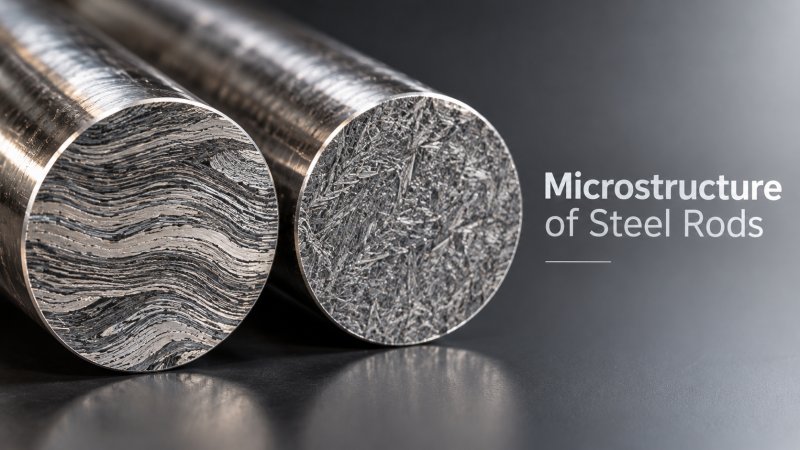
To appreciate the complexity of alloy steels, we must first understand the baseline. A standard carbon Steel Rod is essentially an iron-carbon alloy where the microstructure is primarily dictated by the carbon content and the cooling rate from the austenite phase. In most low to medium carbon grades used for general structural purposes, the room-temperature microstructure consists of a mixture of ferrite and pearlite.
Ferrite is the soft, ductile, body-centered cubic (BCC) phase of iron. It provides the material with its characteristic formability and excellent weldability. Pearlite, on the other hand, is a lamellar composite of alternating ferrite and cementite (iron carbide) layers. Think of pearlite as the microscopic reinforcement within the soft ferrite matrix. As the carbon content increases, the proportion of pearlite grows, naturally increasing the tensile strength and hardness of the Steel Rod, but at the direct expense of ductility and impact toughness.
For technical evaluators, the beauty of this carbon-ferrite-pearlite system lies in its predictability. The absence of complex alloying elements means the phase transformations during heating and cooling are relatively straightforward. This predictability is exactly why carbon steels remain the undisputed workhorses of general fabrication. They forgive minor errors in welding heat input and do not demand rigorous pre-heating or post-weld heat treatments, keeping project timelines and budgets intact.
The Metallurgical Intervention: How Alloys Alter the Game
When project demands exceed the physical limits of the ferrite-pearlite paradigm—such as in high-stress dynamic loading, extreme wear environments, or sub-zero temperature operations—engineers turn to alloy steels. The introduction of elements like chromium, molybdenum, nickel, and vanadium is not merely about adding bulk strength; it is a deliberate intervention in the steel’s crystalline behavior.
Alloying elements fundamentally shift the Time-Temperature-Transformation (TTT) and Continuous Cooling Transformation (CCT) diagrams. By delaying the formation of soft ferrite and pearlite, these elements allow the austenite to transform into much harder and stronger microstructures at slower cooling rates. This is the secret behind the formation of martensite and bainite.
Martensite forms through a diffusionless, shear-type transformation. The carbon atoms are trapped in the crystal lattice, creating a highly strained body-centered tetragonal (BCT) structure. This lattice distortion is what gives martensitic alloy steels their exceptional hardness and strength. However, untempered martensite is notoriously brittle. Therefore, the true art of alloy steel manufacturing lies in the tempering process, which allows some carbon to precipitate out as fine carbides, relieving internal stresses while retaining a high-strength matrix.
Bainite, often the target microstructure for high-toughness alloy structural steels, offers a remarkable balance. It consists of fine, non-lamellar ferrite and carbide particles. Because the carbides are dispersed rather than layered as in pearlite, bainitic structures provide superior toughness and fatigue resistance, making them ideal for critical load-bearing components.
Furthermore, elements like vanadium and niobium play a crucial role in grain refinement. By forming fine carbonitride precipitates, they pin the austenite grain boundaries during high-temperature processing, preventing grain growth. A finer grain size simultaneously increases both the yield strength and the impact toughness of the Steel Rod—a rare and highly desirable combination in metallurgy.
The Hidden Friction: Weldability and the Heat Affected Zone
While the enhanced mechanical properties of alloy steels are tempting, technical evaluators must look beyond the tensile test report. The most significant operational challenge introduced by complex microstructures is weldability. When a high-strength alloy Steel Rod is welded, the intense localized heat creates a Heat Affected Zone (HAZ) in the base metal adjacent to the weld pool.
In carbon steels, the HAZ typically experiences a slight grain growth and a minor increase in hardness, which is usually manageable. In alloy steels, however, the rapid cooling after welding can cause the formation of untempered, brittle martensite in the HAZ. This drastically increases the susceptibility to hydrogen-induced cold cracking. Evaluators must carefully calculate the Carbon Equivalent (CE) of the alloy steel to determine the necessary pre-heating temperatures and interpass controls. Ignoring these microstructural sensitivities can lead to catastrophic delayed failures, long after the welding crew has left the site.
System Integration: Balancing Materials in Structural Design
Real-world structural projects rarely rely on a single material grade. A well-engineered structure is a symphony of different materials, each selected for its specific microstructural advantages. High-stress connection nodes or moving mechanical parts might require the tough, tempered martensitic or bainitic core of an alloy Steel Rod. Meanwhile, the broader framework, purlins, and secondary supports benefit from the cost-effective, easily fabricated nature of carbon steel profiles.
This is where the expertise of a reliable manufacturing partner becomes invaluable. At Hongteng Fengda, we understand that structural integrity relies on the seamless integration of these diverse materials. Our manufacturing facilities are equipped to handle the strict metallurgical controls required for both standard carbon profiles and specialized alloy components, ensuring compliance with ASTM, EN, JIS, and GB standards. For instance, when designing a complex industrial framework, engineers might specify a high-strength alloy for the primary mechanical columns, while utilizing our premium Channel In Steel for the secondary wall beams and lightweight roof supports. This hybrid approach optimizes both the structural performance and the overall project budget.
Decision Framework for Technical Evaluators
When facing the choice between carbon and alloy variants, evaluators should adopt a holistic decision matrix rather than a simple strength-to-cost ratio. Consider the following practical dimensions:
Fabrication Complexity: If the project involves extensive on-site welding, complex geometries, or limited access to pre-heating equipment, the forgiving microstructure of a low-carbon Steel Rod is often the safer, more economical choice. The risk of HAZ cracking in alloy steels can introduce unacceptable delays.
Loading Conditions: For structures subjected to static loads, the pearlitic structure of carbon steel is more than adequate. However, if the component will experience cyclic loading, impact forces, or vibration, the refined grain structure and dispersed carbides of an alloy steel will provide the necessary fatigue resistance and fracture toughness.
Environmental Exposure: While microstructure primarily dictates mechanical properties, it also influences corrosion behavior. If the project is in a highly corrosive environment, the selection might lean towards specific alloying additions (like copper or chromium) or require a shift to stainless variants, where the microstructure shifts entirely to austenitic or duplex phases for corrosion resistance.
The Bottom Line
The microscopic world of ferrite, pearlite, martensite, and bainite is not just an academic exercise for metallurgists; it is the fundamental reality that dictates how a structure will perform over its decades-long lifespan. By understanding these microstructure differences, technical evaluators can move beyond superficial spec-sheet comparisons. They can anticipate fabrication challenges, optimize material usage, and ultimately deliver structures that are not only compliant with international standards but are genuinely engineered for longevity and resilience. In the end, respecting the microstructure is the most reliable way to ensure macroscopic success.
Please give us a message


Please enter what you want to find