Low-carbon steel wire is a readily formed steel product used for mesh, ties, fasteners, and many other fabricated parts. Its relatively low carbon content supports ductility and weldability, while drawing and heat treatment allow its strength and stiffness to be adjusted for different uses. Known as alambre bajo carbono in Spanish, it is available in several diameters, surface finishes, and mechanical conditions. Those differences often matter as much as the basic material name.
A soft wire that bends easily around reinforcing bars, for example, will behave differently from a harder drawn wire intended to hold the shape of a formed component. Both can be low-carbon steel, but they are not automatically interchangeable.
What gives low-carbon steel wire its properties?
Low-carbon steel contains less carbon than medium- and high-carbon steels. The exact composition is defined by the applicable grade and specification rather than by the phrase “low carbon” alone. Other elements, including manganese, also influence the steel’s behavior. For a particular wire, composition must be considered alongside the amount of cold work and any subsequent heat treatment.
The starting material is commonly steel wire rod, which is pulled through dies to reduce its diameter. This drawing process increases strength through cold work, but it also reduces ductility. A heavily drawn wire can resist deformation better than a softer wire of similar composition, yet it is generally less accommodating when bent sharply or twisted repeatedly.
Annealing heats the wire under controlled conditions to restore ductility after cold working. Annealed wire is often chosen where easy bending, twisting, or wrapping matters more than retaining the higher strength of a hard-drawn condition. Annealing does not make every wire identical: final properties still reflect the steel grade, processing history, and diameter.
Low-carbon wire is also magnetic and conducts heat and electricity. It is not inherently stainless or corrosion-resistant. Bare wire exposed to moisture can rust, so surface protection and storage conditions deserve attention when appearance or service life matters.
Properties that affect fabrication
Ductility and bending
Ductility describes the ability to undergo permanent deformation before fracture. In wire fabrication, it affects whether a part can be coiled, looped, flattened, or bent around a small radius without cracking. An annealed condition generally permits more severe forming than a hard-drawn condition.
Bend radius and wire diameter must be considered together. A bend that is gentle for thin wire becomes proportionally tighter when the same tooling is used on thicker material. Tool marks, surface damage, and repeated bending at the same point also increase the chance of failure. A sample formed on the intended equipment is more informative than judging flexibility by hand alone.
Springback matters even when a wire bends without cracking. Once the forming force is released, the part opens slightly as elastic deformation recovers. Harder wire tends to require more allowance for springback, so tooling set for annealed wire may produce inaccurate angles when the wire condition changes.
Strength and stiffness are different
Cold drawing raises tensile strength, but a stronger wire is not necessarily much stiffer in the elastic range. Stiffness of a wire component is strongly affected by its diameter, unsupported length, and geometry. A longer straight span deflects more easily than a shorter span, even when both are made from the same wire.
This distinction matters for mesh panels and formed supports. Increasing wire strength can improve resistance to permanent deformation, while changing the wire diameter or the spacing between supports may have a greater effect on visible deflection. The joint design and surrounding frame also contribute to the behavior of the finished assembly.
Weldability
Low-carbon steel is commonly selected for welded wire products because its composition is generally suitable for welding. Weld quality still depends on the exact material, wire condition, surface, and process settings. Resistance welding, for instance, joins intersecting wires by applying electrical current and pressure; variation in contact, electrode condition, or wire diameter can change the result.
Drawing lubricants, rust, and coatings can affect the consistency of a weld. A galvanized surface also changes the welding conditions and produces fumes that require appropriate controls. Where joint performance matters, the welding procedure and finished joints should be evaluated for the actual wire and equipment rather than assumed acceptable from the material description.
Common fabrication uses
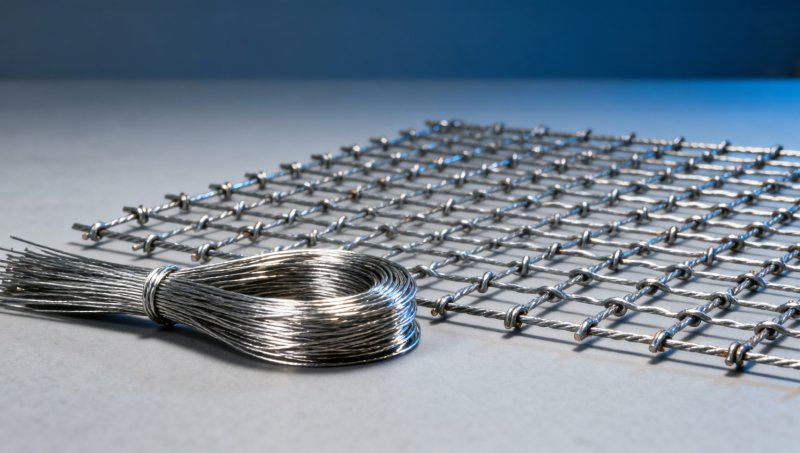
Welded wire mesh. Straightened wires are arranged in a grid and joined at intersections to produce panels or rolls. Applications include guards, partitions, cages, and construction mesh. Wire diameter, opening size, weld integrity, and panel dimensions all affect the finished product. A close-spaced grid made from light wire does not necessarily carry load like a wider-spaced grid made from heavier wire.
Binding and tying wire. Soft annealed wire is convenient for tying reinforcing bars and securing temporary bundles because it bends and twists without requiring excessive force. Its purpose is to hold items in position during handling or construction; a tie should not be assumed to provide a structural connection or a lifting point.
Fasteners and small hardware. Low-carbon wire can be fed into machines that cut, form, head, and thread parts such as nails, staples, and certain screws. The required combination of forming ability and final strength varies by part. Wire that forms a nail head reliably, for example, must also suit the shank geometry and intended driving conditions.
Wire forms and fabricated components. Hooks, handles, clips, baskets, and retainers use bends and curves to create a functional shape. For these parts, dimensional consistency can be as important as tensile strength. Coil set, springback, and surface condition influence whether a formed piece fits its mating component or feeds smoothly through automated equipment.
Fencing and agricultural products. Wire may be woven, twisted, or welded into fencing. The appropriate condition depends on whether the wire must bend around a knot, maintain tension over a span, or resist damage in service. Outdoor exposure often calls for a protective coating, but coating selection should also account for forming and joining after the wire is supplied.
Surface finish and corrosion protection
Bare wire has no protective metallic coating. It is suitable where a later finishing process is planned, where the service environment is controlled, or where a clean steel surface is required for fabrication. Temporary oil or drawing lubricant can reduce handling-related corrosion, but it is not equivalent to a durable coating.
Galvanized wire has a zinc coating that protects the underlying steel. Coating characteristics depend on the production method and specification. If the wire is bent after coating, tight radii or aggressive tooling can damage the surface; if it is welded, the area at and around the joint may need additional protection. Wire galvanized before mesh production and mesh galvanized after fabrication also present different coating conditions at joints and cut edges.
PVC-coated and other polymer-coated wires provide a different surface and appearance. The steel core supplies the underlying strength, while the covering adds to the overall diameter. When a specification gives only the finished diameter, it can conceal differences in core size. Both dimensions matter when wire must fit a die, maintain a particular mesh opening, or carry a specified load.
Storage affects all finishes. Condensation trapped between closely packed coils can cause staining or corrosion, including on coated products. Keeping coils dry and protected from contamination also reduces cleaning and handling problems before fabrication.
Reading a wire specification
A useful specification describes more than nominal diameter. It identifies the steel grade or required chemistry, the mechanical condition, the surface finish, and the intended form of supply. A coil for continuous machine feeding has different handling requirements from straight cut lengths used in a manual assembly process.
Diameter tolerance deserves particular attention because it influences fit, feeding, and the amount of steel in a given cross-section. For coated wire, the specification should make clear whether the stated dimension applies to the steel core, the finished coating, or both. Roundness and surface condition can also affect close-fitting dies and automated straightening equipment.
Mechanical requirements should match the forming operation. Tensile strength alone does not describe how well wire will tolerate a tight bend; elongation, bend performance, or another suitable ductility requirement may also be needed. Conversely, specifying a very soft condition without considering the loads on a finished hook or mesh panel can result in a part that forms easily but bends in service.
Coil dimensions and winding direction influence how wire pays off into a machine. Excessive tangling, inconsistent cast, or residual curvature can interrupt feeding and change formed dimensions. Where a part has tight tolerances, a trial using the proposed coil format and production tooling helps reveal issues that a material certificate cannot show.
Wire and pipe in the same fabrication
Wire is sometimes combined with tubular steel in guards, enclosures, and equipment frames. Mesh may form the infill while pipe provides a perimeter or support. In such assemblies, Carbon Seamless Pipe is a separate product form from wire: its outside diameter, wall thickness, grade, and joining requirements must be assessed for the frame, while the wire is selected for the mesh and its connections.
Even when both materials are carbon steel, their specifications and processing histories need not match. Welding a thin wire to a much heavier tube requires attention to heat input so the wire is joined without excessive melting, and any protective finish interrupted at the connection needs to suit the exposure conditions.
Recognizing problems during forming
Cracking at a bend can indicate insufficient ductility, a radius that is too tight, surface damage, or a combination of these factors. A fracture at a tooling mark points to a different corrective action from cracking across a consistently sharp bend. Comparing the same wire with a larger bend radius and examining the contact surfaces can help isolate the cause.
Inconsistent finished dimensions can arise even when the nominal wire diameter is correct. Changes in hardness alter springback; changes in coil curvature affect straightening; worn guides or rollers introduce variation. Adjusting the forming machine without identifying the source can make one batch acceptable while leaving the next one out of tolerance.
Discoloration after forming also needs context. It may come from lubricant residue, abrasion, oxidation, or heat near a weld. The appropriate response differs for each, especially where the component will receive paint or another finish. Keeping a representative sample of the incoming wire and recording the processing condition makes comparison with the finished part easier.
Please give us a message


Please enter what you want to find