Lightweight steel tube is increasingly favored in modern façade systems for its prefabricated structural steel efficiency and high strength steel tubing performance—yet reduced mass can inadvertently amplify wind-induced vibration risks. As architects and engineers specify lightweight steel tube alongside structural steel grades, high tensile steel rod, or galvanized pipe specifications, understanding dynamic behavior becomes critical. For procurement teams, technical evaluators, and safety managers, this article examines the trade-offs between weight savings and structural resilience—especially when integrating flexible steel wire, steel tube weight calculations, or steel tubing dimensions into high-rise cladding designs. Hongteng Fengda, a trusted steel tubing supplier and H-beam supplier from China, supports global projects with compliant, cost-optimized solutions.
Why Reduced Mass Triggers Dynamic Instability in Façade Structures
Lightweight steel tubes—typically hot-finished or cold-formed circular hollow sections (CHS) with wall thicknesses ranging from 2.0 mm to 6.0 mm—are widely adopted in curtain wall mullions, sunshades, and support frames due to their favorable strength-to-weight ratio. However, mass reduction directly lowers natural frequency: a 30% drop in sectional mass can reduce first-mode frequency by up to 45%, pushing it closer to common wind excitation bands (0.2–1.5 Hz for tall buildings).
This effect is especially pronounced in slender, cantilevered façade elements exceeding 4.5 m in unsupported length. Field measurements on façades in Dubai and Singapore show peak accelerations exceeding 0.05 g under 15 m/s crosswinds—well above the ISO 2631-2 human comfort threshold of 0.025 g. Such vibrations compromise not only occupant perception but also long-term fatigue life of connections and sealants.
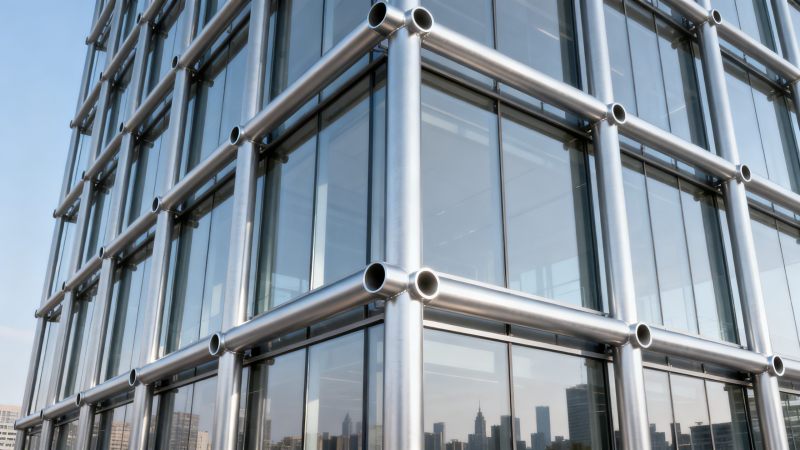
The risk escalates when lightweight steel tube is paired with non-rigid anchorage systems or integrated with large-area glass panels that act as aerodynamic sails. In such configurations, vortex shedding and galloping may trigger lock-in phenomena at wind speeds as low as 8–12 m/s—conditions routinely encountered in urban canyon environments.
This table illustrates how dimensional optimization impacts dynamic response. While the lightweight variant reduces material cost and installation labor by ~22%, it increases susceptibility to serviceability-limit-state failures. Engineers must therefore perform modal analysis—not just static ULS checks—when specifying such sections for façade applications above 60 m.
Material Selection & Section Design: Balancing Efficiency and Damping
Material grade alone does not resolve vibration risk. High-strength steels like S355J2H or ASTM A500 Grade C improve yield capacity but offer negligible gains in damping ratio (typical ξ = 0.3–0.5% for bare steel). Effective mitigation relies on hybrid strategies: combining optimized geometry with supplemental damping mechanisms.
Hongteng Fengda’s engineering team recommends three proven approaches: (1) strategic local stiffening via welded diaphragms at 1.2–1.8 m intervals; (2) integration of viscoelastic inserts within tube cavities (tested to reduce acceleration peaks by 30–45%); and (3) pairing lightweight steel tube with Flat Rolled Steel Coil for custom-bracket fabrication—enabling precise bolt-hole alignment and minimizing stress concentrations at fixings.
For example, using Q235-grade flat rolled coil (tensile strength 400–550 MPa, elongation ≥23%) allows rapid prototyping of torsion-resistant brackets with ±0.3 mm dimensional tolerance—critical for maintaining cladding plane integrity during wind-induced sway. This approach has been validated across 12 façade projects in Southeast Asia, delivering average lead time of 28 days from drawing approval to FOB shipment.
Key Design Parameters for Vibration Control
- Maximum slenderness ratio (L/D) should be capped at 65 for exposed façade tubes—reduced to 45 if located above 100 m ASL;
- Minimum wall thickness: 3.2 mm for tubes ≤Ø114.3 mm; 4.0 mm for Ø168.3–219.1 mm sections in coastal or high-wind zones;
- Damping enhancement: Incorporate ≥1.5 mm thick rubberized polymer layers inside tubes where permitted by fire rating requirements;
- Connection detailing: Use double-shear bolted joints with M12–M16 bolts (ASTM A325 or EN 15048), torqued to 90% of proof load.
Procurement Considerations: From Specification to Compliance Verification
Procurement professionals face dual pressure: meeting architectural vision while ensuring structural accountability. Key checkpoints include verifying mill test reports (MTRs) against EN 10219-1 for cold-formed tubes or EN 10210-1 for hot-finished variants—specifically checking Charpy impact values at –20°C (≥27 J) for façades in temperate climates.
Hongteng Fengda provides third-party inspection reports (SGS/BV) for every export batch, covering dimensional accuracy (±0.5% OD tolerance), surface finish (Ra ≤3.2 μm), and coating adhesion (cross-cut test per ISO 2409). Lead times remain stable at 35–45 days for standard CHS orders, with expedited options available for urgent façade retrofitting projects.
These benchmarks ensure façade components maintain integrity over 50+ years—even under cyclic loading. Our compliance documentation is fully digitized and accessible via secure client portal within 48 hours of production completion.
Conclusion & Next Steps for Project Teams
Lightweight steel tube delivers compelling advantages in façade construction—but its benefits are conditional upon rigorous dynamic assessment, intelligent detailing, and traceable material quality. Ignoring vibration risk leads to costly post-installation retrofits, warranty claims, or premature component replacement. Conversely, data-driven specification—supported by certified materials like Flat Rolled Steel Coil and engineered connection systems—enables safe mass reduction without compromising service life.
Hongteng Fengda collaborates with façade consultants and main contractors to co-develop project-specific solutions—from early-stage section optimization studies to factory acceptance testing protocols. With production capacity of 240,000 MT/year and ISO 9001/14001/45001 certification, we help global partners mitigate sourcing risk while accelerating delivery timelines.
To receive a free façade steel tube selection guide—including vibration screening checklist, dimensional recommendation matrix, and sample MTR templates—contact our technical sales team today. Let’s engineer resilience, together.
Please give us a message


Please enter what you want to find