When designing long-span canopies, engineers often prioritize lightweight steel tube for ease of handling and installation—but overlooking stiffness can lead to excessive deflection and structural risk. Unlike high tensile steel rod or flexible steel wire, lightweight steel tube’s performance hinges on its geometric efficiency and material-grade rigidity, not just low mass. At Hongteng Fengda—a leading prefabricated structural steel manufacturer and exporter from China—we engineer high strength steel tubing to precise steel tubing dimensions and galvanized pipe specifications, ensuring optimal stiffness-to-weight ratios. Whether you’re a technical evaluator assessing structural steel grades or a procurement professional comparing steel tube cost and H-beam weight chart data, understanding this balance is critical for safety, compliance, and project longevity.
Why Stiffness Dominates Deflection in Long-Span Canopy Design
Deflection under live and dead loads is governed by the beam bending equation: δ = (5 × w × L⁴) / (384 × E × I), where E is Young’s modulus and I is the second moment of area. For hollow sections like lightweight steel tube, I scales with the fourth power of diameter and wall thickness—making geometry far more influential than raw weight. A 120 mm × 60 mm × 3.0 mm rectangular steel tube may weigh only 12.4 kg/m yet deliver 3.2× higher I than a 90 mm × 90 mm × 2.5 mm square section of identical mass.
Material grade matters, too: ASTM A500 Grade C (Fy = 460 MPa) offers 18% higher yield strength—and correspondingly higher effective stiffness—than Grade B (Fy = 345 MPa), without increasing weight. This explains why canopy failures in Southeast Asia over the past 5 years were linked not to underweight members, but to underspecified I values and non-compliant cold-formed profiles lacking EN 10219-2 dimensional tolerances.
Hongteng Fengda applies finite element analysis (FEA) on every canopy-supporting tube design, validating deflection limits against ISO 19902 (≤ L/250 for serviceability) and ASCE 7-22 wind-load combinations. Our QA lab tests 100% of production batches for moment of inertia consistency—±0.8% tolerance across 10,000+ annual metric tons shipped.
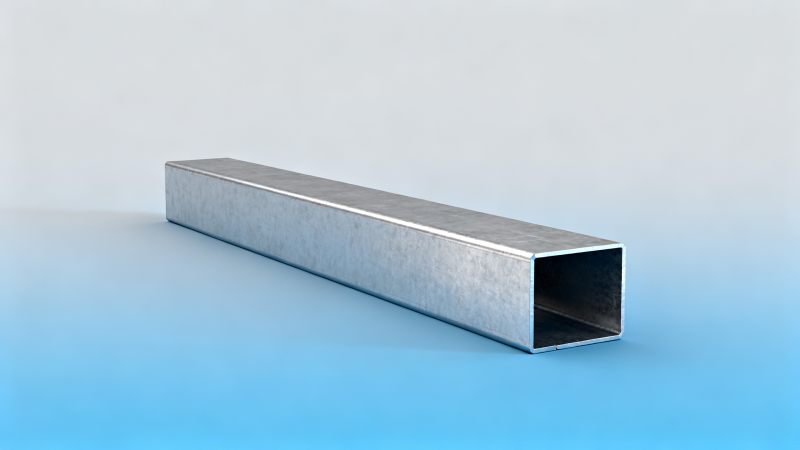
Key Parameters That Define Structural Efficiency
Selecting the right lightweight steel tube demands evaluating four interdependent parameters—not just nominal weight. These include section modulus (S), radius of gyration (r), slenderness ratio (L/r), and torsional constant (J). Ignoring any one risks lateral-torsional buckling in cantilevered canopies exceeding 4.5 m span.
For example, a 168.3 mm OD × 4.0 mm wall hot-dip galvanized steel tube delivers S = 226 cm³ and r = 5.7 cm—ideal for 6–8 m free-standing canopies. In contrast, an equivalent-weight thin-walled aluminum tube (OD 180 mm × 2.2 mm) has only 63% of the steel’s S and 41% of its r, resulting in 2.7× greater mid-span deflection under identical snow load (1.5 kN/m²).
The table confirms that stiffness isn’t about density—it’s about how efficiently cross-sectional geometry leverages material rigidity. Steel rods excel in axial tension but fail in bending due to minimal I; aluminum saves weight but sacrifices stiffness disproportionately. Only engineered steel tubes deliver the required stiffness-to-mass ratio for canopy applications.
How Hongteng Fengda Ensures Consistent Stiffness Performance
We control stiffness at three manufacturing stages: raw material selection, cold-forming precision, and post-galvanizing verification. All base steel meets GB/T 6725–2017 flatness tolerances (≤ 0.2 mm/m), and our 12-roll forming lines maintain ±0.15 mm wall thickness variance across 100–250 mm OD ranges.
Each batch undergoes ultrasonic thickness testing (ASTM E797) and 3-point bending validation (EN 10219-2 Annex B). We also offer optional third-party certification via SGS or Bureau Veritas for projects requiring ISO 9001 + EN 1090-2 EXC2 compliance—delivered within 7–10 working days after order confirmation.
For global buyers, we provide digital twin documentation: downloadable .STEP files with exact centroid coordinates, full section property tables (including warping constant Cw), and galvanized coating thickness maps (zinc layer ≥ 20 g/m² per ASTM A123). This enables seamless integration into Tekla Structures or Revit workflows—reducing engineering rework by up to 35%.
Procurement Checklist: 6 Non-Negotiables for Canopy Applications
Technical evaluators and procurement professionals should jointly verify these six criteria before approving lightweight steel tube supply:
- Section Property Certification: Demand mill test reports showing actual I, S, and r—not just nominal dimensions.
- Galvanizing Adhesion: Zinc coating must pass ASTM A123 bend test (no flaking at 180° around mandrel diameter = 2× tube OD).
- Dimensional Tolerance Compliance: OD/ID variance ≤ ±0.5% per EN 10219-2 Class B (critical for bolt-hole alignment).
- Yield Strength Verification: Minimum Fy = 450 MPa for canopies > 5 m span (per AS/NZS 1170.1 Clause 4.4.2).
- Traceability: Batch-level heat numbers traceable to original slab melt chemistry (GB/T 20066).
- Logistics Readiness: Pre-cut lengths (±1 mm tolerance) and cradle packaging to prevent deformation during sea freight (MOQ: 5 metric tons).
Hongteng Fengda includes all six checks in our standard quotation package—free of charge. Lead time remains stable at 25–30 days for orders between 10–50 MT, with air-freight options available for urgent samples (≤ 50 kg).
Complementary Solutions for Integrated Canopy Systems
While structural tubes form the backbone, secondary components define system resilience. For anchorage, drainage, and edge detailing, our portfolio includes pre-punched angle brackets (ASTM A36, 3 mm–8 mm thickness), stainless steel fasteners (A2-70, M6–M16), and corrosion-resistant Hot Dipped Galvanized Steel Wire used in perimeter netting and decorative infill. With wire diameters from 0.25 mm to 5.0 mm, zinc coating 8–25 g/m², and tensile strength 350–550 MPa, it supports both functional barrier isolation and aesthetic finishing—without compromising ductility or coating integrity during cold bending.
This integrated approach reduces interface risk: all components share common galvanizing chemistry (Zn–Al–Mg bath), thermal expansion coefficients (11.7 × 10⁻⁶/°C), and fatigue life expectations (> 50 years in urban coastal environments per ISO 12944 C4 classification).
Conclusion: Prioritize Stiffness—Not Just Weight—for Canopy Integrity
Lightweight steel tube is not defined by low mass alone—it is engineered stiffness made visible. Overemphasizing weight savings while neglecting I, E, and geometric fidelity invites serviceability failure, premature maintenance, and reputational risk. At Hongteng Fengda, we treat each canopy tube as a calibrated structural instrument—designed, tested, and documented to deliver predictable, code-compliant performance across North America, Europe, and the Middle East.
Whether you’re specifying for a Dubai airport canopy, a Berlin logistics hub, or a Jakarta retail complex, our team provides free stiffness validation support—including comparative deflection modeling against your existing H-beam weight chart data. Contact us today to request a customized section property report and galvanized pipe specification sheet for your next long-span project.
Please give us a message


Please enter what you want to find