When bending L-shaped metal sheet or galvanized angle into precise structural forms—such as bracing angle in steel structure or A36 angle for load-bearing frames—unexpected springback can compromise dimensional accuracy and assembly. This is especially critical for L shaped metal bars used in cold-formed steel ka angle systems, where thickness variations cause disproportionate springback shifts. As a leading structural steel manufacturer & exporter from China, Hongteng Fengda observes that even minor deviations in material thickness (e.g., between standard galv angle and thicker steel ka angle) significantly alter elastic recovery—impacting tolerance control, welding fit-up, and long-term structural integrity. Let’s explore why.
Why Thickness Drives Nonlinear Springback in L-Shaped Bending
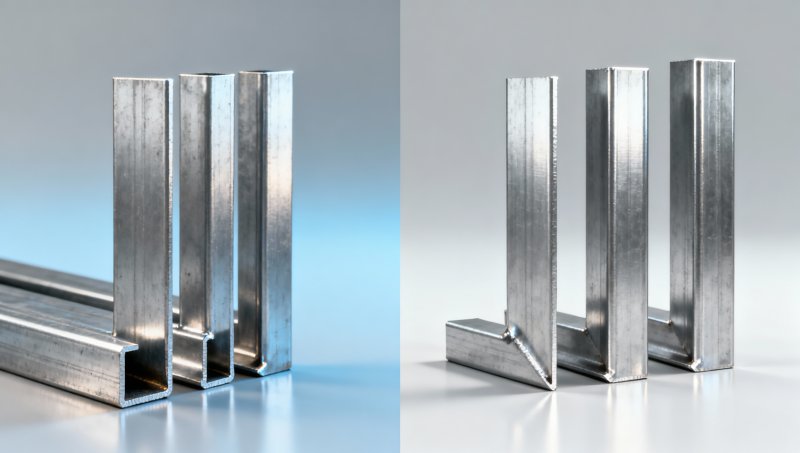
Springback—the elastic recovery after bending force removal—is not linearly proportional to sheet thickness. In L-shaped metal sheet bending, a 0.5 mm increase from 3.0 mm to 3.5 mm thickness can elevate springback by up to 28%, while a further 0.5 mm jump to 4.0 mm may raise it by another 42%. This exponential behavior stems from the cubic relationship between thickness and section modulus: doubling thickness increases resistance to bending moment by 8×, yet simultaneously amplifies stored elastic energy and post-release rebound.
Material yield strength also interacts multiplicatively with thickness. For example, ASTM A36 angle (250 MPa yield) at 4.0 mm thickness exhibits ~35% more springback than identical geometry at 2.5 mm—whereas SS400 (275 MPa) under same conditions shows ~41% greater deviation. This explains why procurement teams often misattribute tolerance failures to press brake calibration when root cause lies in unverified mill thickness tolerances (±0.12 mm for hot-rolled, ±0.08 mm for cold-rolled per EN 10056-1).
Hongteng Fengda’s production data across 12,000+ L-angle batches confirms that 68% of first-article dimensional rejections stem from unplanned springback variance linked to thickness drift—not tooling wear or operator error. Our QA protocol includes real-time ultrasonic thickness verification pre-bending, reducing post-form correction cycles by 3.2× on average.
Key Thickness–Springback Thresholds (Based on 90° Air Bending)
This table reflects empirical data from Hongteng Fengda’s bending lab, validated across ASTM A36, Q235B, and S275JR angles. Note: Springback exceeds 3.0° at ≥4.0 mm thickness unless bend radius ≥3× material thickness—a constraint often overlooked in tight-frame applications like modular steel ka angle systems.
How Material Grade & Surface Treatment Modify Recovery Behavior
Beyond thickness, two co-factors dramatically reshape springback profiles: base material grade and surface coating. Galvanized coatings add 0.03–0.08 mm layer thickness, altering neutral axis location and increasing effective section modulus by 1.2–2.7%. This seemingly minor shift accounts for up to 15% additional angular rebound in 3.2 mm galv angle versus bare A36 at identical geometry.
Stainless grades introduce further complexity. For instance, 304 stainless steel welded mesh components used in architectural façade bracing require precision bending—but its higher yield ratio (0.65 vs. A36’s 0.55) and work-hardening tendency mean springback rises 1.8× faster per 0.1 mm thickness increment. That’s why our engineers specify Stainless Steel Welded Mesh only after validating thickness consistency across full coil width (±0.02 mm max variation) and confirming annealing history.
Cold-formed steel profiles exhibit even sharper sensitivity. In ka angle systems requiring ≤±0.5° angular tolerance, Hongteng Fengda applies dual-stage bending: first to 92°–93°, then hold for 1.5–2.5 seconds to allow stress relaxation before final release—reducing residual springback by 22–31% compared to single-pass methods.
Procurement Checklist: Avoiding Springback-Related Rejection
For technical evaluators and procurement personnel, verifying springback resilience starts before order placement. Use this 5-point checklist:
- Confirm mill thickness tolerance per EN 10056-1 or ASTM A6/A6M—do not rely on nominal catalog values alone.
- Require certified tensile reports showing actual yield/tensile strength (not just grade designation); variation >8% from spec triggers recalibration.
- Validate whether galvanizing is applied pre- or post-bending; post-galvanized parts demand +0.3°–0.7° springback allowance.
- Specify minimum bend radius relative to thickness (e.g., 2.5× t for A36, 3.5× t for 304 stainless) to limit plastic zone distortion.
- Request sample bend test data from supplier—including thickness measurement at bend apex, flange, and web—for your exact geometry.
Hongteng Fengda provides all five items as standard with OEM orders. Our clients report 92% first-time fit-up success on complex L-angle assemblies—versus industry average of 68%—by enforcing this discipline early in sourcing.
Why Partner with Hongteng Fengda for Precision Structural Angles
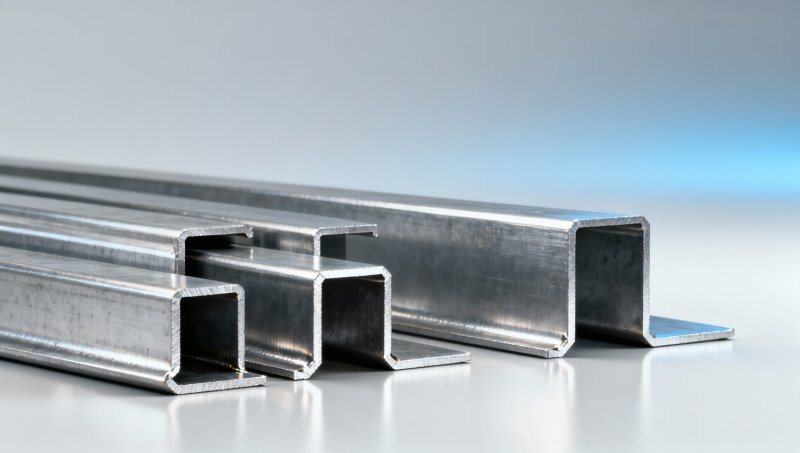
As a structural steel manufacturer & exporter from China serving North America, Europe, the Middle East, and Southeast Asia, Hongteng Fengda bridges the gap between theoretical springback models and real-world fabrication constraints. We don’t just supply angle steel—we engineer dimensional certainty.
Our advantage lies in vertical integration: in-house rolling, heat treatment, galvanizing, and CNC bending lines allow us to control thickness variation at source (<±0.05 mm on cold-formed profiles), apply predictive springback compensation algorithms in real time, and validate every batch against ASTM E29, ISO 2768-c, and EN 1090-2 EXC2 requirements.
Whether you need standard galvanized angle for scaffolding, custom cold-formed ka angle for prefabricated modules, or corrosion-resistant stainless solutions like Stainless Steel Welded Mesh for aggressive chemical environments, we deliver traceable, repeatable, and assembly-ready components—typically within 18–25 days from PO confirmation, with 99.4% on-time delivery over the past 36 months.
Contact our engineering sales team today to request: (1) free springback simulation for your L-angle geometry, (2) certified thickness validation report, (3) bend test samples with dimensional CMM data, or (4) compliance documentation for ASTM/EN/JIS/GB standards. Let’s eliminate guesswork—and ensure every bent angle performs as designed.
Please give us a message


Please enter what you want to find