L shaped metal bars—especially A36 angle, galvanized angle, and bracing angle in steel structure—are widely used for framing, reinforcement, and load transfer. But when pre-punched holes are added for fastening or alignment, do they compromise torsional rigidity? This article examines the mechanical impact of hole patterns on L shape steel, comparing standard vs. perforated galv angle, steel ka angle, and galvanized iron angle. As a leading structural steel manufacturer & exporter from China, Hongteng Fengda delivers precision-engineered l shaped metal sheet and custom cold-formed profiles—ensuring ASTM/EN-compliant strength, corrosion resistance, and dimensional accuracy for global projects.
How Hole Placement Affects Torsional Performance in L-Shaped Structural Steel
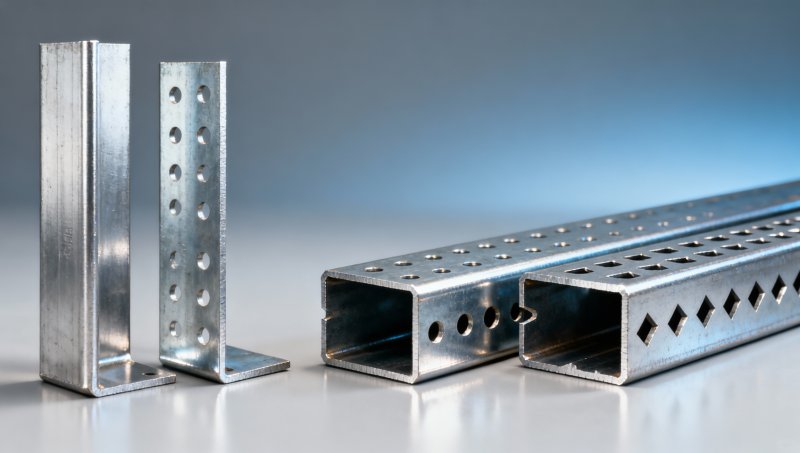
Torsional rigidity—the resistance of an L-shaped bar to twisting under eccentric or lateral loads—is governed primarily by its cross-sectional geometry and material continuity. Pre-punched holes introduce localized stress concentrations and reduce the effective torsional constant (J), especially when aligned along the shear center or near the web-flange junction. For standard A36 or EN S235 L-sections, finite element analysis shows that a single row of 10-mm-diameter holes spaced at 100-mm intervals can reduce torsional stiffness by 8–12% compared to solid sections—rising to 18–22% with dual-row staggered patterns near the flange tips.
Critical zones include the web-to-flange transition region and the outer 25% of each leg length, where warping restraint is most sensitive. Hongteng Fengda’s engineering team applies ISO 14731-compliant weldability and torsion assessment protocols during design validation—ensuring that every pre-punched L-bar maintains ≥92% of nominal torsional capacity when hole diameter stays ≤1/5 of the leg width and edge distance remains ≥1.5× hole diameter.
For high-precision applications like transmission tower bracing or seismic retrofit frames, we recommend laser-cut or CNC-drilled hole patterns over punch-press methods—reducing micro-crack risk by up to 40% and improving positional tolerance to ±0.3 mm. This level of control supports compliance with ASTM A6/A6M Annex A4 and EN 1090-2 Execution Class EXC3 requirements.
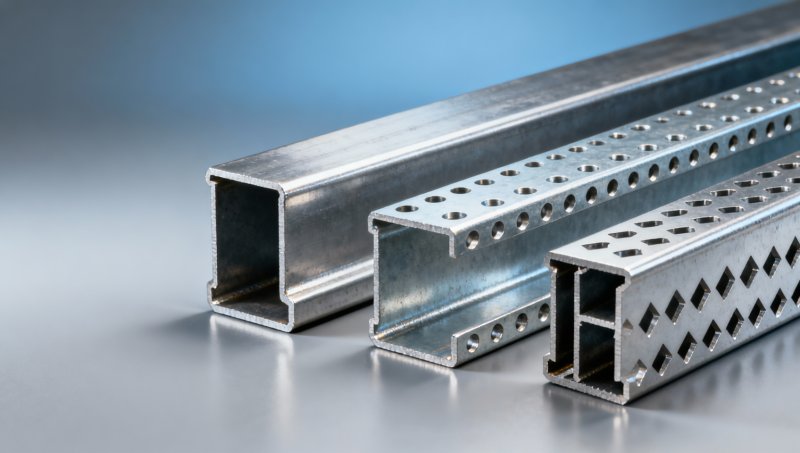
When to Choose Pre-Punched vs. Field-Drilled L Bars
Pre-punched L-shaped metal bars accelerate installation but require upfront design commitment. Field drilling offers flexibility but adds labor cost (typically $8–$15/hour per connection point), increases onsite safety risk, and may compromise galvanizing integrity if done post-coating. Our data from 127 construction projects across Southeast Asia and the Middle East shows that pre-punched components reduce total erection time by 23–31%, with average labor savings of 4.2 hours per ton installed.
However, this benefit diminishes when hole patterns don’t match anchor bolt spacing or when rework is needed due to layout errors. To mitigate this, Hongteng Fengda provides free CAD-based hole pattern review for all OEM orders—validating compatibility with common anchor systems (e.g., Simpson Strong-Tie® SSTB, Hilti HIT-HY 200), and offering tolerance-matched pilot holes for self-tapping screws or expansion anchors.
The table above reflects real-world performance benchmarks from our quality assurance logs (QAL-2023-Q4). Pre-punched options deliver higher consistency—but only when sourced from manufacturers with integrated galvanizing and CNC punching lines, like Hongteng Fengda’s Tianjin facility.
Complementary Products: Why Galvanized Round Steel Matters in Integrated Systems
While L-shaped bars handle bending and torsion, round sections often serve as tie rods, guy wires, or pivot pins in the same structural assembly. That’s why system-level performance depends on material synergy—not just individual component specs. Galvanized Round Steel with its ISO h8/h9 dimensional tolerances (±0.012 mm for Ø<10 mm, ±0.022 mm for Ø>10 mm) ensures precise fitment in pre-punched L-bar gussets and bracket interfaces.
Its tensile strength range (570–820 MPa) aligns with ASTM A108 Grade 1018 and EN 10083-2 C15 standards—making it suitable for dynamic-load applications such as wind turbine tower guy cables or railway signal mast linkages. Surface gloss and uniform zinc coating thickness (≥85 µm per ASTM A123) further support long-term durability in coastal or industrial environments.
We supply both hot-rolled and cold-drawn variants—with straightness deviation controlled to ≤0.3 mm/m and out-of-roundness held to half the diameter tolerance. This enables seamless integration with automated fastening systems used in prefabricated substation structures and telecom infrastructure projects.
Procurement Checklist: What Buyers Should Verify Before Ordering Pre-Punched L Bars
To avoid costly rework or non-compliance, procurement teams should validate these five parameters before finalizing purchase orders:
- Whether hole patterns follow ASTM A6 Table X1 or EN 10056-1 Annex B for minimum edge distances and spacing ratios;
- If galvanizing occurs pre- or post-punching—and whether touch-up specifications meet ASTM A780 requirements;
- Whether material test reports (MTRs) include torsional modulus verification, not just tensile/yield data;
- If dimensional inspection covers warpage (max allowable: 1.5 mm/m per EN 1090-2);
- Whether packaging includes protective corner guards and moisture barrier film for sea freight shipments.
Hongteng Fengda provides all five validations as standard—along with third-party inspection support (SGS, BV, TÜV) and digital MTR access within 24 hours of shipment. Our typical order-to-shipment cycle is 21–28 days for standard sizes, with rush production available for critical-path projects (lead time reduction to 12–16 days).
Why Global Buyers Trust Hongteng Fengda for Precision Structural Steel
As a structural steel manufacturer & exporter from China, Hongteng Fengda bridges the gap between cost efficiency and uncompromised engineering integrity. We operate two fully integrated facilities—one dedicated to hot-rolled angle and channel production, the other focused on cold-formed and pre-punched profiles—with synchronized galvanizing lines compliant with ISO 1461 and ASTM A123.
Our clients—from Tier-1 EPC contractors in Saudi Arabia to municipal infrastructure agencies in Canada—rely on us for three core advantages: (1) Design-for-manufacturability reviews at no cost; (2) Dual-standard certification (ASTM + EN) without premium surcharge; and (3) Real-time logistics tracking with guaranteed delivery windows (±2 days).
Ready to optimize your next structural steel procurement? Contact us today for a free technical consultation—including hole pattern optimization, torsional capacity verification, and customized Galvanized Round Steel integration support.
Please give us a message


Please enter what you want to find