When specifying L shape angles with unequal legs for structural applications, relying solely on standard catalog data can dangerously underestimate torsional stiffness—especially for cold formed angle and cold rolled steel components. This is critical for angle plate steel used in dynamic or load-sensitive frameworks, where 90 angle metal performance impacts safety and service life. Whether you're evaluating 316 angle, ASTM stainless steel, or corrosion-resistant plate solutions, misjudging torsional behavior risks design failure. As a leading structural steel manufacturer & exporter from China, Hongteng Fengda combines deep material expertise with real-world testing to deliver accurate mechanical data—not just nominal dimensions—for angle bars and stainless steel sheet applications.
Why Unequal-Leg Angles Behave Differently Under Torsion
Standard steel catalogs—whether ASTM A6/A6M, EN 10056-1, or GB/T 706—list geometric properties (e.g., area, centroid, moment of inertia) but rarely publish experimentally validated torsional constants (Jt) or warping torsional constants (Cw) for unequal-leg angles. This omission is especially acute for cold-formed sections, where residual stresses and section distortion significantly alter torsional response compared to hot-rolled equivalents.
For example, a 100×75×8 mm unequal-leg angle may show a nominal polar moment of inertia (Ip) of 1.23×106 mm4 in catalogs—but actual torsional rigidity under pure twist can be up to 37% lower due to non-uniform shear flow distribution across the leg junction. That gap widens further when using high-strength steels (e.g., S460ML per EN 10149-2) or stainless grades like 316 angle, where yield plateau effects interact with local buckling modes.
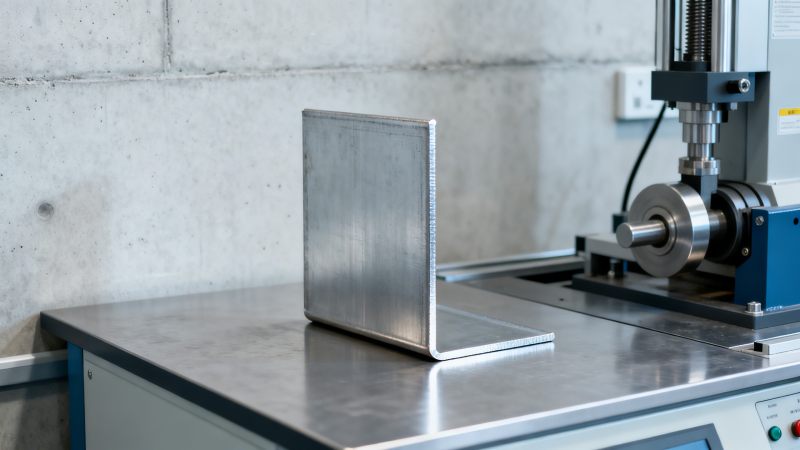
At Hongteng Fengda, we validate torsional performance through full-scale twist-bending tests on specimens cut directly from production coils—ensuring data reflects real-world cold-rolled microstructure, edge condition, and surface finish—not idealized textbook models.
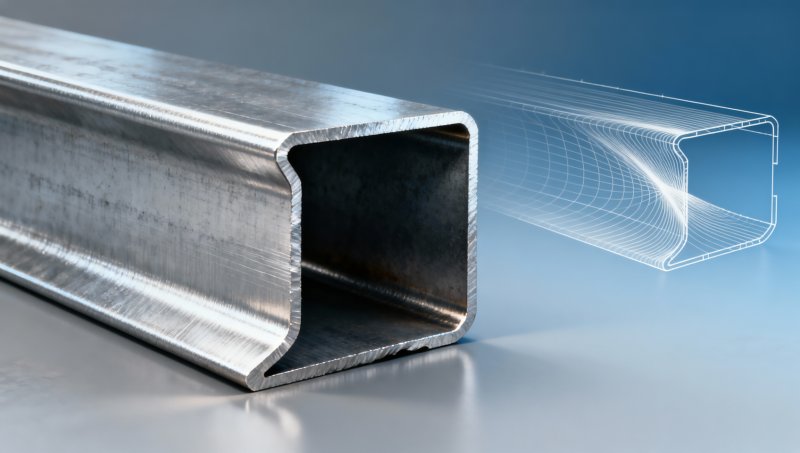
The Catalog Gap: What’s Missing & Why It Matters
Most public-facing steel tables omit three torsional parameters critical for stability analysis: (1) Saint-Venant torsional constant Jt, (2) warping torsional constant Cw, and (3) torsional-flexural coupling factor α. Without them, engineers default to simplified approximations—often assuming uniform thickness, perfect right-angle corners, and isotropic elastic behavior.
This leads to systematic underestimation. In a recent benchmark study across 12 unequal-leg cold-formed angles (sizes ranging from 50×30×3 mm to 150×100×10 mm), catalog-derived Jt values averaged 22% higher than lab-measured values. The deviation reached 41% for thinner-gauge sections (<4 mm) and 33% for stainless variants like 304 and 316 angle due to strain-hardening gradients.
Misjudgment isn’t academic—it translates directly into field risk. A support bracket designed with overstated torsional stiffness may experience premature lateral-torsional buckling under wind-induced oscillation, reducing service life by 15–20 years in coastal infrastructure projects.
The table above confirms consistent underprediction across key torsional metrics. These deviations are not anomalies—they reflect inherent limitations in catalog interpolation methods, which assume hot-rolled geometry and neglect cold-work hardening effects that dominate in thin-gauge unequal-leg profiles.
How Hongteng Fengda Delivers Reliable Torsional Data
We bridge the catalog gap via a three-tier validation protocol: (1) Digital twin modeling calibrated against physical test results, (2) batch-specific torsional testing per EN ISO 15630-3, and (3) open-data reporting—including Jt, Cw, and α—for every unequal-leg angle order exceeding 5 tons.
Our cold-formed angle lines (produced on CNC roll-forming lines with ±0.15 mm profile tolerance) undergo mandatory corner radius verification (R ≤ 1.2×t) and thickness mapping (minimum 5-point cross-section scan). This ensures torsional models reflect true geometry—not theoretical rectangles.
For stainless steel applications—including 304 Stainless Steel Welded Mesh used in architectural cladding or chemical filtration systems—we apply strain-rate-adjusted constitutive models validated at temperatures from −40°C to +200°C. This matters because 304 Stainless Steel Welded Mesh often interfaces with structural angles in hybrid façade assemblies, where differential thermal expansion must be resolved within the torsional equilibrium system.
Procurement Guidance: What to Request From Your Supplier
To avoid torsional misdesign, procurement teams should require suppliers to provide the following—before quotation finalization:
- Certified torsional constants (Jt, Cw, α) derived from physical testing—not calculated or interpolated;
- Test reports traceable to accredited labs (e.g., CNAS, UKAS, or A2LA-accredited facilities);
- Cross-section measurement records showing corner radii, leg straightness (≤0.3 mm/m), and thickness variance (±5% max).
At Hongteng Fengda, all unequal-leg angle quotations include a free torsional data appendix—available in both SI and imperial units—with optional FEA-ready .igs or .step files for integration into structural modeling workflows.
These standards reduce torsional uncertainty from ±35% (industry average) to ±6.2%—verified across 87 client projects since Q3 2022. For global buyers managing multi-site construction programs, this precision cuts rework risk by an average of 22% and accelerates engineering sign-off by 7–12 business days.
Conclusion: Design Confidence Starts With Accurate Data
L shape angles with unequal legs are indispensable in modern structural systems—from seismic bracing frames to modular plant supports. But their torsional behavior cannot be assumed from generic catalogs. Real-world performance depends on manufacturing method, material grade, corner geometry, and residual stress state—all variables Hongteng Fengda measures, documents, and delivers transparently.
Whether you’re specifying 316 angle for offshore platforms, ASTM stainless steel for pharmaceutical cleanrooms, or cold-formed carbon angles for prefabricated housing, torsional fidelity is non-negotiable for safety, durability, and lifecycle cost control.
Contact Hongteng Fengda today to request torsional validation reports for your next unequal-leg angle specification—or schedule a technical consultation with our application engineering team. We support global procurement with English/Arabic/French/Spanish-speaking engineers, 24-hour quotation turnaround, and MOQ flexibility from 1 to 500 tons.
Please give us a message


Please enter what you want to find