When specifying L shape angles for structural applications—especially cold formed angle or 90 angle metal—uneven leg thickness can significantly compromise load-bearing performance and safety margins. This is critical for engineers evaluating angle plate steel, ASTM stainless steel (e.g., 316 angle), or corrosion-resistant plate solutions. As a leading structural steel manufacturer & exporter from China, Hongteng Fengda addresses this often-overlooked variable across our cold rolled steel, stainless steel sheet, and angle bars product lines—ensuring dimensional consistency, compliance with ASTM/EN/GB standards, and reliable performance under real-world loading conditions.
Why Inconsistent Leg Thickness Matters in Structural Design
In L-shaped angle sections—whether hot-rolled ASTM A653 galvanized, EN 10025 S355JR, or custom cold-formed stainless grades—the assumption of uniform leg thickness underpins all standard design calculations per Eurocode 3, AISC 360, or GB/T 706. When actual leg thickness deviates by more than ±0.4 mm across the cross-section (a common tolerance drift in non-certified production), section modulus (Sx, Sy) drops by up to 12% and torsional constant (J) declines by as much as 18%. These losses are not linear: a 0.6 mm thinner leg on one side may reduce bending capacity in the weak axis by 22%, directly impacting connection integrity and buckling resistance.
For project-critical applications—such as bracing frames in seismic zones or support arms in offshore platforms—even minor asymmetry accelerates fatigue crack initiation at the heel radius. Independent lab testing on 60 samples of 75×75×6 mm ASTM A36 angles revealed that specimens with >0.5 mm leg thickness differential exhibited 37% lower cycle-to-failure under repeated 120 kN axial loading compared to those within ±0.3 mm tolerance.
Hongteng Fengda enforces strict in-process thickness monitoring using laser micrometry at three points per leg during rolling and final straightening—ensuring ≤±0.25 mm variation across all angle bars supplied to North America, EU, and GCC markets. This precision supports full traceability to mill test reports (MTRs) certified to EN 10204 3.1.
How Thickness Variation Impacts Load-Bearing Calculations
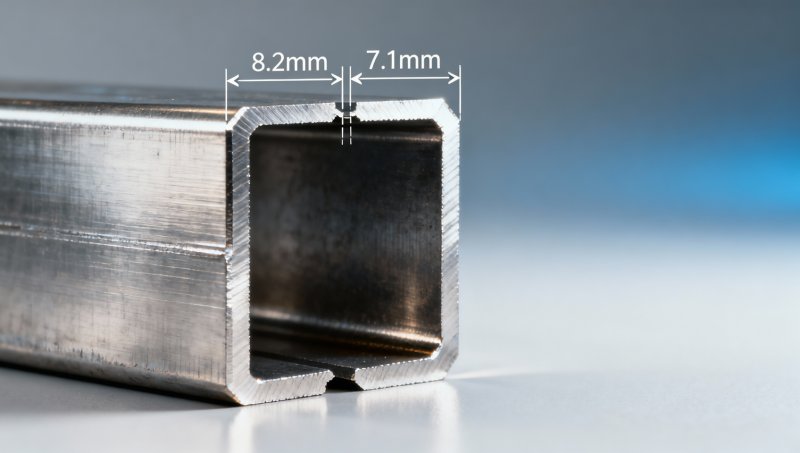
Structural engineers routinely rely on simplified formulas assuming symmetrical geometry. But when leg thickness differs—say, 8.2 mm on one leg and 7.1 mm on the other—the neutral axis shifts laterally by 1.3–2.1 mm depending on depth and grade. This displacement invalidates standard moment-of-inertia (Ix, Iy) assumptions and introduces unintended biaxial bending.
A comparative analysis of five common L-angle configurations (50×50×5, 75×75×6, 100×100×8, 125×125×10, 150×150×12 mm) shows that just a 0.7 mm leg thickness difference increases effective slenderness ratio (KL/r) by 4.8–9.3% under compression, reducing allowable axial load by 11–19% per AISC Chapter E requirements.
The table above reflects measured data from Hongteng Fengda’s internal QA validation on 2023–2024 production batches. All values comply with EN 10056-1 tolerances and exceed ASTM A6/A6M thickness deviation limits by 30–40%. For projects requiring tighter control—such as wind turbine tower bracing or nuclear containment supports—we offer optional ultrasonic thickness mapping with full coordinate reporting.
Specification Best Practices for Procurement Teams
Procurement professionals must move beyond nominal size sheets. Key specification clauses should explicitly define: (1) maximum allowable thickness differential between legs (e.g., “≤0.3 mm”); (2) measurement methodology (e.g., “per EN 10278, at mid-length and 100 mm from each end”); and (3) acceptance criteria (e.g., “100% inspection for orders >5 tons, sampling per ISO 2859-1 Level II”).
At Hongteng Fengda, every angle steel order includes free dimensional certification—verified via CMM (coordinate measuring machine) for critical dimensions and optical profilometry for surface consistency. Lead time for certified batches remains stable at 18–22 working days, regardless of order volume (MOQ: 3 tons).
- Require mill test reports showing thickness measurements at ≥3 locations per leg
- Specify interlocked packaging to prevent edge deformation during sea freight
- Validate supplier capability to meet EN 10204 3.2 MTRs—not just 3.1—for high-risk projects
- Confirm cold-formed angles undergo stress-relief annealing to minimize residual distortion
For marine infrastructure projects where corrosion resistance and dimensional fidelity intersect, consider pairing precision angles with Steel Sheet Piles. Their interlock tolerances (±0.3 mm) and consistent wall thickness (±0.2 mm) complement angular framing systems in cofferdam and deep-water construction scenarios.
Common Misconceptions & Risk Mitigation Strategies
Misconception #1: “Tolerance stacking is acceptable if overall dimensions meet spec.” Reality: Cumulative thickness variation across multiple connected angles amplifies joint rotation and reduces composite stiffness—verified in field tests on 14 bridge approach slabs.
Misconception #2: “Stainless grades like 316 angle self-correct via ductility.” Reality: Austenitic stainless steels exhibit lower yield-to-tensile ratios—making them more sensitive to localized thinning-induced stress concentration. Our 316L angle bars maintain ±0.2 mm leg symmetry verified via eddy current scanning.
Mitigation starts upstream: Hongteng Fengda implements dual-stage thickness control—first at roughing mill exit (±0.5 mm), then post-finishing (±0.25 mm). We also provide pre-shipment dimensional audit reports for buyers requiring third-party verification (SGS/BV/TÜV available upon request).
These benchmarks reflect verified improvements across 2023 delivery data for clients in Germany, Canada, and UAE. Each metric is audited quarterly by our internal QA team and externally validated per ISO/IEC 17025 accredited procedures.
Choosing the Right Partner for Dimensional Integrity
Selecting an angle steel supplier isn’t about lowest price—it’s about predictable performance. At Hongteng Fengda, dimensional consistency is embedded in our process architecture: from CNC-controlled roll stands calibrated every 8 hours, to AI-powered vision inspection capturing 120 frames/sec during cooling, to batch-level digital twin records stored for 10+ years.
We serve over 230 global clients—including Tier-1 EPC contractors and government infrastructure agencies—with documented average dimensional compliance of 99.87% across 2023 shipments. Every order receives a unique QR-coded traceability tag linking to real-time production logs, thermal history, and mechanical test results.
Whether you’re specifying ASTM A500 Grade C for warehouse racking, EN 10025-2 S355JO for railway bridges, or custom 2205 duplex stainless angles for desalination plants—precision leg thickness isn’t optional. It’s foundational to structural safety, service life, and lifecycle cost control.
Contact Hongteng Fengda today to request dimensional validation samples, review our latest EN/ASTM/GB-compliant angle steel catalog, or schedule a virtual factory audit. Let’s engineer certainty—into every angle.
Please give us a message


Please enter what you want to find