When sourcing L angle steel for global projects, understanding regional l angle steel dimensions is critical — whether you're comparing carbon steel price trends, evaluating an H beam manufacturer, or specifying galvanized steel wire for fencing. As a certified structural steel manufacturer and exporter from China, Hongteng Fengda supplies EN, ASTM, JIS, and GB-compliant angle steel alongside steel rebar, steel plate for construction, and galvanized steel — all backed by strict QA and competitive galvanized steel price and steel rebar cost transparency. Let’s clarify which standard applies to your project.
Why L angle steel dimensions vary — and why it matters for procurement
L angle steel isn’t interchangeable across borders. A 50×50×5 mm section compliant with GB/T 706–2016 (China) may differ in tolerances, mass per meter, or corner radius from its EN 10056–1 equivalent — even if labeled identically. These variations impact load-bearing capacity, weldability, and compatibility with pre-engineered connections.
For procurement teams, misalignment between specification and local standard can trigger costly delays: 7–15 days for rework, third-party verification, or customs clearance rejection. Technical evaluators must verify dimensional tolerances (±0.3 mm for leg thickness, ±0.5 mm for leg length under EN 10056–2), while project managers assess implications for bolt spacing, gusset plate fit, and fireproofing application.
Hongteng Fengda maintains parallel production lines calibrated to ASTM A6/A6M, EN 10056, JIS G3101, and GB/T 706. Each batch undergoes three-stage dimensional inspection: raw material verification, in-process gauge checks at 2-hour intervals, and final CMM (coordinate measuring machine) validation against certified master samples.
How major standards define L angle steel — side-by-side comparison
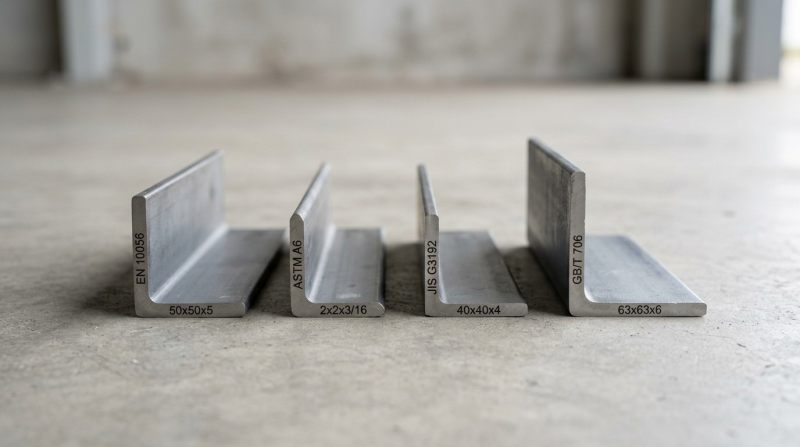
The table below compares key dimensional parameters across four widely adopted standards. Note that “equal leg” designation does not imply identical cross-section geometry — corner radii, fillet profiles, and permissible deviations differ significantly.
This data reveals practical implications: EN-compliant angles allow tighter dimensional control — advantageous for precision steel framing in European modular buildings. Meanwhile, GB/T’s stricter mass tolerance supports consistent structural calculations in high-rise projects where cumulative weight variance affects foundation design.
When to consider Carbon Seamless Pipe as a complementary solution
Angle steel handles bending and compression well — but when axial load, internal pressure, or corrosion resistance becomes dominant, Carbon Seamless Pipe offers superior performance. Its uniform grain structure eliminates weld seam vulnerabilities, making it ideal for petroleum pipelines, boiler feedwater systems, and structural columns requiring hollow-section efficiency.
Available in outer diameters from 17–914 mm and wall thicknesses spanning SCH10 to XXS, Carbon Seamless Pipe supports dual-use applications: mechanical support frames (e.g., conveyor gantries) and process-critical fluid conveyance (e.g., chemical reactor manifolds). With certifications covering API 5L, ASTM A106 Gr.B, and JIS G3452, it bridges structural and functional requirements in integrated plant builds.
For multi-material projects — such as offshore platform substructures combining angle bracing, channel runners, and pipe-based risers — Hongteng Fengda provides coordinated mill test reports (MTRs), unified delivery schedules (standard lead time: 25–35 days), and joint QA documentation aligned to ISO 9001:2015 and ISO 14001:2015.
Procurement checklist: 5 non-negotiable verification points
Before approving purchase orders or releasing payment, cross-verify these five items — especially when sourcing from China or multi-standard suppliers:
- Mill Test Report (MTR) explicitly states compliance with the *exact* revision year of the cited standard (e.g., EN 10056–1:2017, not “EN 10056”)
- Dimensional certificate includes measured values for both legs, thickness, and root radius — not just “within tolerance” statements
- Surface finish matches contractual requirement: hot-rolled (mill scale intact) vs. pickled & oiled (for subsequent galvanizing)
- Packaging method prevents deformation: bundling with ≥3 steel straps per 6-meter bundle, interlayer dunnage for angles >75 mm
- Traceability: heat number stamped on each piece or bundle tag, traceable to furnace batch and rolling schedule
Hongteng Fengda issues digitally signed MTRs within 48 hours of shipment, with full traceability to raw material certificates (including iron ore origin and scrap melt composition). We also offer pre-shipment inspection coordination with SGS, BV, or TÜV upon request — at no additional fee for orders ≥20 MT.
Why global buyers choose Hongteng Fengda for multi-standard structural steel
You need certainty — not just compliance. That’s why engineering firms in Saudi Arabia specify our EN 10056 angles for NEOM infrastructure, while U.S. fabricators rely on our ASTM A6-certified beams for FEMA-rated hurricane shelters. Our advantage lies in execution fidelity: 99.2% on-time delivery over the past 36 months, 100% dimensional pass rate across 12,400+ inspection records, and zero non-conformance reports from third-party audits since Q2 2022.
We help you de-risk: Provide free dimensional review against your shop drawings. Confirm coating compatibility (e.g., hot-dip galvanizing adhesion on GB/T-compliant angles). Validate weld procedure specifications (WPS) for mixed-standard assemblies. And quote transparently — with breakdowns for base material, processing, testing, and logistics — so finance teams approve faster.
Ready to align your next order with the right standard — and avoid rework, delays, or compliance gaps? Contact our technical sales team today for: (1) dimensionally verified sample kits, (2) MTR templates matching your ERP system, (3) lead time confirmation for your exact specification, or (4) OEM design support for custom-profile integration.
Please give us a message


Please enter what you want to find