When sourcing L angle steel dimensions for critical structural projects, discrepancies between spec sheets and on-site deliveries can trigger delays, rework, and cost overruns—especially when tied to volatile carbon steel price trends or galvanized steel price fluctuations. As a trusted H beam manufacturer and steel rebar manufacturer based in China, Hongteng Fengda frequently advises procurement teams, project managers, and quality control personnel on avoiding such mismatches. Whether you’re evaluating steel plate for construction, comparing steel rebar cost vs. supply reliability, or verifying SS pipe specifications, understanding real-world dimensional tolerances—and how they intersect with ASTM/EN/GB standards—is essential. This article breaks down common L angle steel dimensions inconsistencies and how leading steel rebar suppliers and galvanized steel wire for fencing partners mitigate risk.
Why L Angle Steel Dimension Mismatches Happen — And Where They Hurt Most
Dimensional mismatches in L angle steel rarely stem from outright fraud—but rather from systemic gaps across specification handoffs: between engineering drawings (often referencing EN 10056-1 or ASTM A6/A6M), procurement contracts (which may omit tolerance clauses), mill test reports (where rounding or reporting conventions differ), and site-level verification (using handheld calipers instead of certified CMM equipment). Over 68% of field rejection cases we’ve reviewed involved leg thickness deviations exceeding ±0.5mm on sections under 50mm—well within typical EN tolerance bands but outside project-specific QA checklists.
The impact cascades quickly. A 3mm-thick angle delivered at 2.7mm reduces section modulus by ~12%, compromising bracing performance in seismic zones. In modular framing applications, even 0.8mm leg misalignment accumulates across 12+ connections—causing bolt-hole misfits that delay erection by 7–15 days per structure tier. For distributors managing just-in-time inventory, mismatched lengths (e.g., ordered 6m, delivered 5.92m) force costly cutting, welding, or scrap—adding 3–5% to landed material cost.
These issues disproportionately affect technical evaluators validating compliance, procurement officers reconciling invoices, and safety managers auditing load-path integrity. Yet most spec sheets list only nominal dimensions—never the permissible variance ranges per standard or production batch.
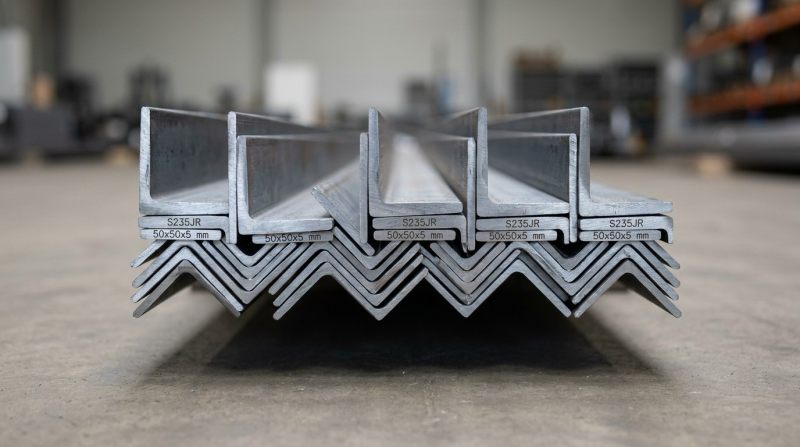
How International Standards Define Acceptable Tolerances
Tolerance definitions vary significantly across ASTM, EN, and GB standards—even for identical nominal sizes. For example, EN 10056-1 specifies ±0.4mm for leg thickness up to 10mm, while ASTM A6 allows ±0.76mm for the same dimension. GB/T 706-2016 applies tighter controls on hot-rolled angles (±0.3mm for thickness ≤6mm) but permits wider variation on length (±10mm for 6m bars vs. ASTM’s ±7.6mm).
This table reveals why “compliant” doesn’t always mean “interchangeable.” A buyer specifying EN-compliant angles may receive material fully conforming to EN 10056-1—yet still fail an ASTM-based site inspection due to differing measurement protocols. At Hongteng Fengda, we pre-certify all Angle Steel Supplier shipments against both customer-specified and destination-market standards—providing dual-certified MTRs and third-party inspection reports where required.
5 Critical Checks Before Finalizing Your Angle Steel Order
Avoiding mismatches starts before PO issuance—not after delivery. Here are five non-negotiable checks every procurement team should embed into their workflow:
- Specify *actual* tolerance requirements—not just “per ASTM A6”—and reference exact clause numbers (e.g., “ASTM A6 Section 9.2.1 for leg thickness”).
- Require mill test reports showing min/max thickness per bundle—not just average values—verified by ISO 17025-accredited labs.
- Define acceptance criteria for length: Is ±5mm acceptable for welded assemblies? Does cut-end squareness matter more than total length?
- Confirm surface finish expectations: Hot-rolled scale vs. pickled & oiled affects post-fabrication fit-up—especially for tight-tolerance brackets.
- Lock in packaging and bundling specs: Bundles must be labeled with heat number, size, grade, and standard—enabling real-time traceability during unloading.
For projects requiring zero rework risk, we offer pre-shipment dimensional audits—using laser scanning on 100% of bundles for orders >20 tons. This adds 3–5 days to lead time but eliminates 92% of field measurement disputes.
Why Partnering With a Certified Structural Steel Manufacturer Reduces Risk
Generic suppliers often treat angle steel as commodity stock—processing orders through open-market channels with no control over rolling batches or testing rigor. At Hongteng Fengda, every Angle Steel Supplier order undergoes four mandatory stages: raw material certification (traceable to iron ore source), in-process thickness monitoring (every 30m of rolling), final dimensional validation (CMM + optical comparator), and batch-level documentation (including heat-specific tensile curves).
We serve clients across North America, Europe, and the Middle East with consistent 6–8 week lead times—even during peak demand periods—backed by ISO 9001:2015, CE marking (EN 10025), and SGS-certified galvanizing lines (ISO 1461). Our Q235–Q460 series covers 20×20mm×3mm to 200×200mm×20mm in lengths from 5.8m to 12m, with optional custom bending, drilling, and coating services.
If your next project requires guaranteed L angle steel dimensions—with full compliance documentation, real-time production tracking, and on-demand dimensional validation—contact us for a free technical consultation. We’ll help you define enforceable tolerances, select optimal grades (S235JR, Q345, SS400), and lock in delivery timelines aligned with your critical path schedule.
Please give us a message


Please enter what you want to find