Understanding l angle steel dimensions is essential for selecting the right material, checking fit on site, and avoiding costly fabrication errors.
Whether used for supports, frames, brackets, platforms, or industrial equipment, correct size reading improves safety, cost control, and installation efficiency.
This guide explains l angle steel dimensions through practical scenarios, so size requirements can be identified and communicated clearly.
Reading L Angle Steel Dimensions in Real Project Scenarios
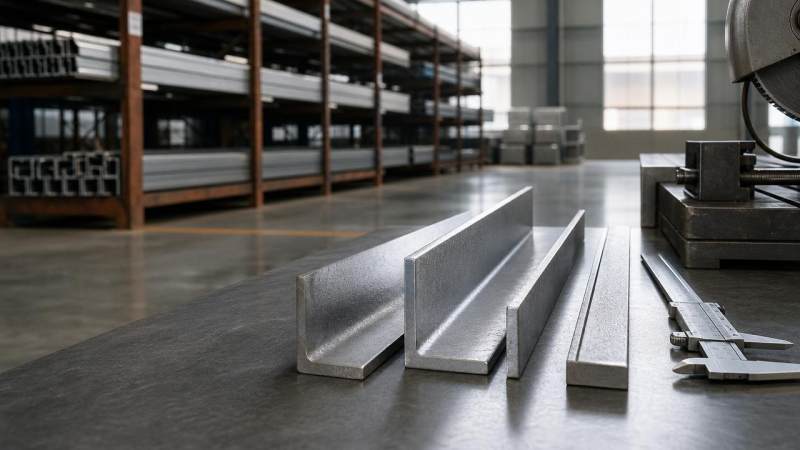
L angle steel dimensions usually describe two legs, one thickness, and one length. These values define fit, strength, and fabrication behavior.
A common size may appear as 50 × 50 × 5 mm × 6 m. It means two 50 mm legs, 5 mm thickness, and 6 m length.
For unequal angle steel, the format may be 75 × 50 × 6 mm. The longer leg is normally listed first.
Reading l angle steel dimensions correctly prevents wrong cutting, hole misalignment, weak brackets, and unnecessary rework during assembly.
Equal Angle or Unequal Angle: The First Decision
Equal angle steel has two legs of the same size. It is often used when loads and fixing points are balanced.
Unequal angle steel has different leg sizes. It helps when one side needs more bearing area or wider fastening space.
When comparing l angle steel dimensions, always confirm whether the section is equal or unequal before checking thickness.
Scenario Background: Why Size Reading Changes by Application
The same angle size can perform differently in a frame, a shelf, a bridge support, or a machine base.
Load direction, span, welding method, bolt spacing, corrosion exposure, and tolerance all affect suitable l angle steel dimensions.
A light bracket may require accurate hole placement. A structural frame may require verified thickness, grade, and standard compliance.
For export projects, l angle steel dimensions should also match ASTM, EN, JIS, or GB size tables where applicable.
Typical Scenario 1: Structural Supports and Bracing
In structural supports, l angle steel dimensions are judged by load path, connection position, and required stiffness.
Thicker angle steel improves resistance to bending and local deformation. Larger legs provide more contact area for welding or bolting.
For diagonal bracing, length accuracy matters because small errors can affect frame squareness and tension alignment.
Check whether drawings specify nominal dimensions, actual tolerances, surface treatment, and steel grade before ordering.
Core Judgment Points
- Confirm equal or unequal angle type.
- Match leg length with connection layout.
- Check thickness against load and span.
- Verify length tolerance for bracing alignment.
Typical Scenario 2: Frames, Racks, and Equipment Bases
Frames and racks require l angle steel dimensions that balance strength, weight, and fabrication convenience.
A larger leg may make welding easier. A smaller section may reduce weight and simplify manual handling.
For equipment bases, the inside corner radius can influence fit with plates, pads, or mounted components.
If holes are punched near the edge, choose l angle steel dimensions with enough leg width and edge distance.
Practical Fit Checks
- Measure available installation space.
- Confirm the required bolt diameter.
- Check weld access around corners.
- Compare finished coating thickness.
Typical Scenario 3: Brackets, Lintels, and Edge Protection
Brackets often fail because selected l angle steel dimensions are too small for leverage and repeated vibration.
A short leg may look acceptable, but it may not provide enough fixing area for anchors or bolts.
For lintels and edge protection, leg length should cover the supported surface and allow stable contact.
Thickness should consider load, impact, corrosion allowance, and possible deformation during welding.
When Unequal Angle Works Better
Unequal angle steel is useful when one side needs a wide support face, while the other side must remain compact.
This makes l angle steel dimensions easier to adapt in restricted spaces, renovation work, and special equipment frames.
Typical Scenario 4: Industrial Platforms, Guards, and Infill Panels
Industrial platforms and guards often combine angle steel frames with mesh, plates, or grating panels.
Here, l angle steel dimensions must match panel thickness, fixing method, and required opening clearance.
For corrosion-resistant enclosures, stainless mesh may be installed inside carbon steel or stainless angle frames.
Where filtration, screening, or protective infill is required, Stainless Steel Welded Mesh can complement angle steel assemblies.
Available materials include SS 201, 304, 304L, 316, 316L, and 430 stainless steel wire.
Typical specifications include 2–635 mesh, maximum 240″ roll width, and maximum 2000′ roll length.
It offers resistance to rust, corrosion, acid, alkali, heat, and chemicals in demanding industrial applications.
Different Scenario Requirements for L Angle Steel Dimensions
This comparison shows why l angle steel dimensions should not be selected only from a general stock list.
The final choice should reflect load, assembly sequence, connected materials, and site tolerance requirements.
How to Decode Common Size Expressions
Metric angle sizes are usually shown in millimeters. Imperial sizes may use inches and pounds per foot.
For example, L50 × 50 × 5 means equal angle with two 50 mm legs and 5 mm thickness.
L75 × 50 × 6 means unequal angle with a 75 mm long leg, 50 mm short leg, and 6 mm thickness.
When length is added, L75 × 50 × 6 × 6000 means one piece is 6000 mm long.
Information That Should Be Confirmed
- Leg A and leg B dimensions.
- Nominal thickness and tolerance.
- Total bar length or cut length.
- Steel grade and production standard.
- Surface finish, such as black, galvanized, or painted.
Scenario Adaptation Suggestions for Better Selection
Choose l angle steel dimensions by starting from the working condition, not only from price or available stock.
If the component carries load, confirm calculations or engineering requirements before finalizing thickness.
If the component mainly positions parts, focus on leg size, tolerance, straightness, and hole accuracy.
If corrosion is expected, consider coating, stainless material, or additional thickness allowance.
Common Mistakes When Reading L Angle Steel Dimensions
One common mistake is confusing thickness with leg length. This can lead to serious fabrication mismatch.
Another mistake is assuming all mills use identical tolerances. Actual dimensions may vary by standard and production route.
Ignoring the inside radius is also risky when plates, covers, or precision parts must sit tightly against the angle.
Surface treatment may change final fit. Hot-dip galvanizing adds coating thickness and may affect tight assemblies.
Cutting length is another overlooked factor. Stock length and finished length should be separated in documentation.
Checks Before Fabrication
- Compare drawings with actual angle labels.
- Measure several points along the bar.
- Confirm hole locations after cutting.
- Allow coating clearance where needed.
- Record standard, grade, and heat information.
Working With a Structural Steel Supplier
Reliable supply depends on more than listing l angle steel dimensions in a request.
The request should include size, grade, standard, surface finish, quantity, length, tolerance, and required documents.
Hongteng Fengda supplies structural steel from China for construction, industrial, and manufacturing projects worldwide.
Products include angle steel, channel steel, steel beams, cold formed profiles, and customized structural components.
Production and quality control support ASTM, EN, JIS, and GB requirements for international projects.
Conclusion: Turn Size Reading Into Better Project Control
Correctly reading l angle steel dimensions helps avoid wrong material selection, poor fit, and unnecessary rework.
Start with the application scenario, then confirm leg size, thickness, length, grade, tolerance, and surface treatment.
For structural supports, frames, brackets, and industrial guards, accurate l angle steel dimensions improve reliability and installation speed.
Share drawings, standards, and project conditions early to receive suitable size recommendations and stable steel supply.
Please give us a message


Please enter what you want to find