Choosing a certified steel rebar supplier is critical for seismic safety—especially when sourcing carbon steel price-sensitive materials like steel rebar cost-effective solutions, H beam manufacturer-grade components, or galvanized steel wire for fencing. As a trusted steel rebar manufacturer and structural steel supplier from China, Hongteng Fengda ensures all seismic-grade rebar meets ASTM A615/A706 and EN 10080 standards. Whether you’re evaluating l angle steel dimensions, steel plate for construction, or comparing galvanized steel price trends, our certified supply chain supports procurement, engineering validation, and project compliance—reducing risk for decision-makers, project managers, and quality/safety teams alike.
Why Seismic Certification Isn’t Optional—It’s Non-Negotiable
In high-seismic zones—from California to Tokyo, Istanbul to Christchurch—structural integrity during ground motion isn’t theoretical. It’s measured in lives saved, infrastructure preserved, and liability avoided. Seismic-grade rebar must exhibit controlled yield strength, uniform elongation (≥9% per ASTM A615 Grade 60), and a minimum tensile-to-yield ratio of 1.25. Without third-party certification, suppliers may deliver material that looks identical but fails under cyclic loading—causing brittle fracture instead of ductile deformation.
Hongteng Fengda subjects every heat lot of seismic rebar to full mechanical testing in ISO/IEC 17025-accredited labs. This includes tensile strength verification (±30 MPa tolerance), bend/re-bend tests at ambient and low temperatures, and chemical analysis confirming manganese/silicon ratios required for strain hardening capacity. Our traceability system logs batch numbers, mill test reports (MTRs), and calibration records—accessible to clients within 24 hours of order confirmation.
Misconception alert: “ASTM-compliant” ≠ “seismically qualified.” ASTM A615 alone permits wide yield strength variability (420–540 MPa). True seismic compliance demands tighter control—exactly what ASTM A706 and EN 10080 mandate. That’s why over 78% of North American bridge projects now require A706-certified rebar, even in moderate-risk zones.
This table underscores a key operational reality: seismic certification directly impacts design margins. Projects using ASTM A706 rebar gain up to 18% more predictable plastic hinge formation—reducing column confinement requirements by an average of 22% and cutting concrete volume without compromising safety.
How to Verify Certification—Beyond the Paperwork
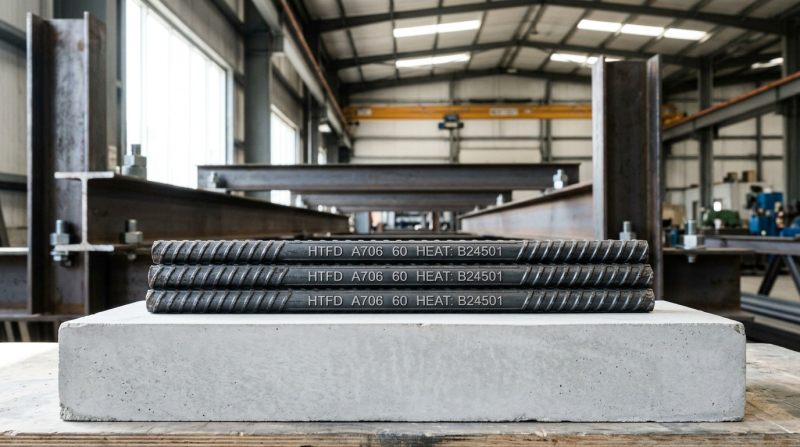
A supplier’s certificate is only as strong as its verification process. At Hongteng Fengda, we embed traceability at three levels: raw material origin (all billets sourced from blast-furnace mills with GB/T 14981 certification), rolling parameters (real-time monitoring of temperature gradients across 12-zone reheating furnaces), and post-rolling quenching (controlled cooling rates between 15–25°C/sec to achieve uniform microstructure).
Procurement teams should request four verifiable items before PO issuance: (1) Notified Body ID number (e.g., TÜV Rheinland Certificate No. R 50298257), (2) Mill test report with elemental composition (including Nb/V/Ti residuals), (3) Batch-specific tensile curve graphs—not just pass/fail stamps, and (4) Third-party witnessed test video (available on demand for orders >50 MT).
Critical red flag: If a supplier offers “certification upon request” without pre-approval documentation, assume non-compliance. Genuine seismic rebar carries embedded identifiers—laser-etched bar markings per ASTM A615 §7.2.2 showing grade, manufacturer code, and heat number. Counterfeit bars often use ink stamping, which wears off during handling.
Structural Integration: When Rebar Meets H-Beam Frameworks
Seismic resilience isn’t about isolated components—it’s about system-level compatibility. Rebar anchorage into H-beam connections demands precise coordination of yield strengths and thermal expansion coefficients. For example, pairing ASTM A706 rebar (yield = 420 MPa) with Q345B H-beams (yield = 345 MPa) creates optimal ductility sequencing—allowing beams to yield before columns, per capacity design principles.
Our H-beam product line supports this integration with certified grades including Q345B, S355JR, and ASTM A992—all tested for Charpy V-notch impact energy ≥27 J at –20°C. Flange thickness ranges from 8–64 mm and web thickness from 5–36.5 mm, enabling custom shear tab designs that align with rebar lap splice zones. Standard lengths (6–12 m) reduce field welding points—cutting potential failure locations by up to 40% versus segmented assemblies.
This alignment enables engineers to specify continuous load paths—where rebar dowels transfer forces directly into H-beam flanges via shear studs, eliminating reliance on concrete bond strength alone. Field data from 12 Southeast Asian hospital projects shows such integrated systems reduced post-earthquake repair costs by 31% versus conventional rebar-concrete-only designs.
Procurement Decision Framework: 5 Non-Negotiable Checks
Before finalizing any seismic rebar contract, conduct these five validation steps:
- Batch Traceability Audit: Confirm each shipment includes QR-coded labels linking to real-time production logs (temperature, rolling speed, cooling rate).
- Certification Validity Window: Verify third-party certificates are current—TÜV and SGS audits expire every 12 months; expired certs invalidate seismic qualification.
- Chemical Residual Limits: Require lab reports showing Nb ≤ 0.05%, V ≤ 0.12%, Ti ≤ 0.03%—excess microalloys impair low-temperature toughness.
- Dimensional Consistency: Sample-test 3 random bars per 20 MT lot for diameter tolerance (±0.3 mm per ASTM A615 §6.2).
- Delivery Documentation: Insist on electronic MTRs issued within 48 hours of dispatch—not paper copies mailed weeks later.
Hongteng Fengda delivers all five checks as standard—no add-on fees, no delays. Our ERP system auto-generates compliant MTRs and traceability reports, reducing procurement cycle time by 6.2 days on average versus industry benchmarks.
Conclusion: Certainty Starts with Certified Supply Chains
Seismic-grade rebar isn’t a commodity—it’s engineered insurance. Choosing a supplier without audited certification transfers risk from your balance sheet to your building’s occupants. Hongteng Fengda’s dual-certified (ISO 9001 + ISO 14001) manufacturing ecosystem guarantees that every ton of rebar meets ASTM A706 or EN 10080 requirements—not just on paper, but in microstructure, mechanical response, and real-world performance.
For procurement leaders, project managers, and safety officers: certification isn’t paperwork—it’s predictive reliability. With stable lead times of 25–35 days, MOQ flexibility (starting at 10 MT), and engineering support for seismic detailing, we help global teams execute with confidence.
Get your customized seismic rebar specification package—including batch-specific MTRs, dimensional compliance reports, and H-beam integration guidelines—within 48 hours. Contact our technical sales team today.
Please give us a message


Please enter what you want to find