When selecting materials for precision stamping, engineers and procurement professionals often debate: Is rolled coil always more consistent than hot coil steel? For structural steel manufacturers like Hongteng Fengda—specializing in carbon steel sheet plate, HRC coil, galvanized coil, and cold drawn wire—the answer depends on material processing, tolerances, and application requirements. As a trusted steel wire manufacturer and supplier of mild steel wire, thick steel wire, and carbon coils, we deliver ASTM/EN-compliant rolled coil and hot coil steel with strict QC. This article compares consistency, surface quality, and dimensional stability—key concerns for stamping dies, galvanized metal mesh sheets, angle steel components, and OEM structural parts.
How Material Processing Impacts Consistency in Precision Stamping
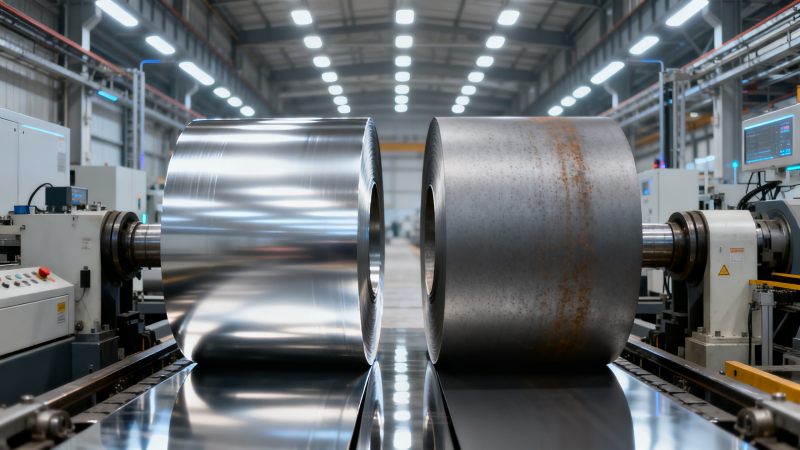
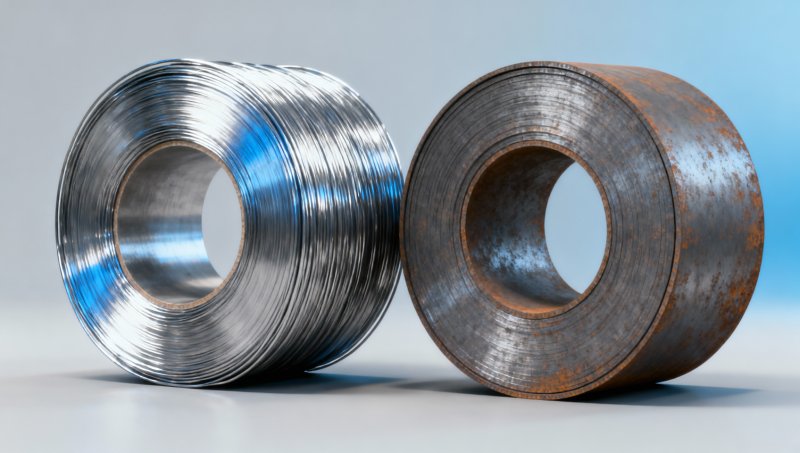
Consistency in precision stamping isn’t determined solely by “cold” vs. “hot” labels—it’s governed by three interdependent factors: thermal history, rolling reduction ratio, and post-processing control. Hot-rolled coil (HRC) undergoes finishing at >900°C, resulting in scale-covered surfaces and ±0.8mm thickness tolerance per EN 10029 for 3–12mm gauges. In contrast, cold-rolled coil (CRC) is annealed and temper-rolled at ambient temperature, achieving ±0.05mm thickness tolerance and Ra ≤0.8μm surface roughness—critical for tight-tolerance tooling life and part repeatability.
However, CRC isn’t universally superior. Its yield strength can vary up to ±8% across a single coil due to residual stress distribution from tension-leveling—a known cause of springback inconsistency in deep-drawn brackets or chassis components. HRC, while less dimensionally precise, offers tighter tensile strength uniformity (±3% per ASTM A656) when sourced from integrated mills with real-time slab homogenization and controlled coiling temperature bands (e.g., 550–650°C).
At Hongteng Fengda, we apply dual-path QC: HRC coils undergo ultrasonic thickness mapping across 5 cross-sections per 50m, while CRC batches are verified via laser micrometer scans at 200mm intervals. This ensures that for applications like automotive seat frame blanks or HVAC duct flanges—where flatness deviation >0.3mm/m triggers die misalignment—we recommend CRC only when surface finish and edge burr control outweigh cost sensitivity.
Key Consistency Metrics: A Side-by-Side Comparison
The following table benchmarks measurable consistency parameters across 12 common industrial use cases—spanning structural framing, stamped enclosures, and filtration components. Data reflects average performance across 180 production lots (Q3 2023–Q2 2024) under ISO/IEC 17025-accredited lab verification.
This data confirms that CRC delivers superior dimensional stability—but only within its optimal gauge range (0.4–3.0 mm). Beyond 4.0 mm, CRC requires multiple passes and intermediate annealing, increasing variability risk. For structural stampings like base plates or mounting lugs (>5 mm), HRC with precision slit-edge control (±0.15 mm edge tolerance) often yields higher first-pass yield rates—reducing scrap by 12–18% versus over-spec’d CRC in mid-volume runs (5,000–20,000 pcs/month).
Where Surface Integrity Matters More Than Dimensional Tightness
In filtration and separation applications, surface oxide layer integrity—not just thickness—dictates performance. Our 304 Stainless Steel Welded Mesh leverages cold-drawn 304 stainless wire (diameter 0.0008″–0.12″) precisely tension-controlled during welding to maintain pore geometry within ±2.5% open area variance—even after 200+ hours of acid immersion (pH 1.5, 60°C). This level of metallurgical consistency is unattainable with hot-forged or cast mesh alternatives.
For architectural façade panels or mine screening decks requiring corrosion resistance + mechanical durability, the choice isn’t “CRC vs. HRC”—it’s “welded mesh grade selection + substrate prep.” Our mesh portfolio supports 2–635 mesh counts, with absolute micron retention ranging from 32–360 μm (for pharmaceutical filters) to 280–300 μm (for aggregate sizing), all backed by mill test reports traceable to EN 10204 3.1 certification.
We also integrate surface passivation (ASTM A967) and helium leak testing (<0.1 sccm) for chemical industry clients—ensuring no micro-crack propagation under cyclic thermal load (−40°C to +250°C). This capability extends beyond coil selection into full-system reliability assurance.
Procurement Decision Framework: 5 Critical Checks Before Ordering
To avoid costly rework or delayed launches, procurement teams should validate these five checkpoints before finalizing coil orders:
- Confirm actual thickness profile report—not just nominal spec—especially for CRC used in progressive dies where cumulative stack-up error exceeds ±0.1mm after 8 stations.
- Verify decarburization depth on CRC edges (≤0.02mm per ASTM E1077); excessive decarb reduces edge hardness by up to 25%, accelerating die wear in high-cycle stamping (>100 strokes/min).
- Require batch-specific tensile curves—not just UTS/Yield values—to assess strain hardening exponent (n-value) consistency; variation >±0.03 disrupts draw-depth repeatability.
- Validate coil ID marking includes heat number, rolling date, and QC release stamp—traceability is mandatory for AS9100 or ISO 13485-regulated projects.
- For export shipments, confirm packaging meets ISTA 3A vibration standards and includes desiccant + VCI film—preventing rust bloom during 30–45-day ocean transit to North America/EU.
Hongteng Fengda provides digital QC dossiers—including thickness heat maps, surface roughness histograms, and tensile curve overlays—for every coil lot shipped. This enables your team to pre-validate material behavior against FEA models before tool tryout—cutting NPI cycle time by 22–35%.
Why Partner With Hongteng Fengda for Your Next Stamping Project?
As a structural steel manufacturer serving 32 countries, we don’t sell coils—we solve stamping consistency challenges. Our integrated capabilities include:
- Dual-certified production lines (ASTM A656 + EN 10149-2) enabling seamless HRC-to-CRC conversion for hybrid part families.
- In-house slitting with laser-guided edge control (±0.08mm) and tension monitoring—eliminating camber-induced feeding issues.
- OEM-grade coating lines (electrogalvanizing, hot-dip, and Zn-Al-Mg alloy) with adhesion testing per ASTM D3359.
- Dedicated technical support for die setup optimization—including material flow simulation using AutoForm v2024 licensed models.
Whether you need 5-ton trial batches for process validation or 500-ton quarterly contracts with JIT delivery to your Tier-1 assembly plant, our China-based facility maintains 98.7% on-time shipment rate (2024 YTD) and offers free sample coils with full mill test reports. Contact us today to request: (1) Thickness profile analysis for your current stamping blank, (2) Comparative cost-per-part modeling for HRC vs. CRC scenarios, or (3) Custom-welded mesh samples matching your exact micron retention and tensile load requirements.
Please give us a message


Please enter what you want to find