For operators and production teams, choosing the right material directly affects cutting speed, tool life, and surface finish. So, is low carbon steel round bar good for machining? In many applications, low carbon steel round bar for machining offers reliable workability, stable performance, and cost efficiency, making it a practical choice for general manufacturing, fabrication, and structural component production.
Material Overview and Machining Basics
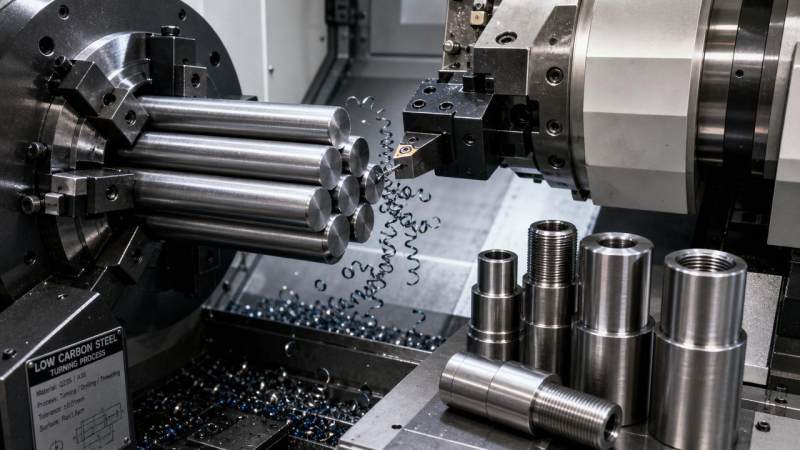
Low carbon steel usually contains a relatively small amount of carbon. This lower carbon level improves ductility, reduces hardness, and supports easier cutting in many routine machining operations.
When discussing low carbon steel round bar for machining, the focus is usually on turning, drilling, threading, milling, and sawing. These processes benefit from balanced strength and consistent chip formation.
Compared with harder alloy grades, low carbon steel is less demanding on tooling. It often allows stable feeds and speeds without excessive tool wear or sudden edge failure.
This does not mean every grade behaves the same way. Surface condition, diameter tolerance, chemistry consistency, and mill quality still influence the final machining result.
Why Low Carbon Steel Round Bar Remains Relevant
In steel processing, machining efficiency is closely tied to total production cost. Material that cuts cleanly and predictably helps control labor time, scrap rate, and maintenance frequency.
Low carbon steel round bar for machining remains widely used because it fits many standard production environments. It is accessible, economical, and suitable for large-volume parts with moderate strength demands.
Current industry attention often centers on three issues:
- How to maintain stable machining quality across batches
- How to reduce tool consumption and downtime
- How to match material cost with actual part requirements
For these goals, low carbon steel round bar for machining often provides a useful balance. It is not the hardest or strongest material, but it is frequently the most practical.
Key Machining Factors
Practical Benefits in Daily Production
The main advantage of low carbon steel round bar for machining is process stability. Many workshops prefer materials that behave predictably instead of offering unnecessary performance beyond the application.
It commonly delivers acceptable surface finish under standard cutting conditions. With proper tooling and coolant, operators can achieve repeatable dimensions for shafts, pins, sleeves, brackets, and connectors.
Another benefit is lower overall material cost. For non-critical or medium-load parts, choosing low carbon steel can prevent overspending on alloy grades with limited added value.
Weldability also matters. Many machined parts later require assembly, reinforcement, or structural joining. Low carbon steel supports this sequence better than some harder or higher carbon alternatives.
In broader steel supply chains, material compatibility is important. A project may combine bars, profiles, beams, and custom fabricated sections from one source.
For example, structural projects that machine connection details may also require profile products such as Rail systems, especially in transport, access, or support installations.
Where It Performs Well and Where It Does Not
Low carbon steel round bar for machining is a strong option for general-purpose components. It performs well when the part needs easy cutting, moderate strength, and simple downstream fabrication.
Typical suitable applications include:
- Bushings and spacers
- Threaded rods and studs
- Machine bases and support pins
- General shafts with limited stress
- Fabricated structural connection parts
However, it may be less suitable when the part needs very high wear resistance, extreme hardness, or heavy impact performance. In those cases, alloy steel or heat-treated grades are often better choices.
Application Comparison
Selection Points That Influence Machining Results
Even if low carbon steel round bar for machining is the right category, grade and supply quality still matter. Better purchasing decisions usually begin with process requirements, not only price.
Important selection points include:
- Confirm dimensional tolerance and straightness for the intended machine setup.
- Check whether the bar surface is black, oiled, peeled, or otherwise processed.
- Review chemistry consistency if repeat production is required.
- Match the material to threading, drilling depth, and finish targets.
- Consider later welding, bending, coating, or galvanizing steps.
For large projects, one supplier often supports multiple steel categories. Alongside bars and profiles, transport or infrastructure work may also involve products like Rail in carbon steel or medium manganese steel.
Such rail products can cover U74, U71Mn, PD2, PD3, BNbRE, Q235, 55Q, 50Q, U71, and 45Mn, with lengths from 12m to 30m and several common specifications.
Process Recommendations for Better Efficiency
To get the best from low carbon steel round bar for machining, process control should stay simple and consistent. Material choice helps, but setup discipline creates the final result.
- Use sharp tools and avoid worn cutting edges.
- Adjust feed and speed to prevent built-up edge formation.
- Apply coolant when surface finish and tool life are priorities.
- Secure the round bar properly to reduce chatter.
- Inspect first-piece dimensions before extended production runs.
If burrs, rough finish, or unstable chips appear, the issue may involve tooling geometry rather than the steel itself. Low carbon steel usually responds well to practical parameter adjustments.
Reliable steel sourcing also supports machining performance. Consistent production, international standards compliance, and stable lead times help reduce risk in ongoing manufacturing programs.
Operational Conclusion and Next-Step Guidance
So, is low carbon steel round bar good for machining? In most general manufacturing situations, the answer is yes. It offers practical machinability, cost control, and flexible downstream processing.
Low carbon steel round bar for machining is especially useful when production needs steady quality without paying for unnecessary material performance. It fits a wide range of fabricated and structural component applications.
The best approach is to compare actual load conditions, finish requirements, welding needs, and machining volume before final selection. This avoids both under-specification and wasteful over-specification.
If a project includes round bars, structural sections, or related steel systems, working with an experienced structural steel manufacturer can simplify sourcing, quality control, and delivery planning.
For long-term efficiency, review your current part drawings, identify the most machined items, and confirm whether low carbon steel round bar for machining matches the real service requirement.
Please give us a message


Please enter what you want to find