For technical evaluators comparing material options, ASTM A36 steel plate remains widely specified for balanced strength, weldability, machinability, and cost efficiency.
Its predictable properties support frames, brackets, bases, platforms, and general fabrication where extreme toughness or high yield strength is not required.
Still, ASTM A36 steel plate should be selected against load conditions, service exposure, tolerances, fabrication methods, and applicable project standards.
Is ASTM A36 steel plate still right for general fabrication?
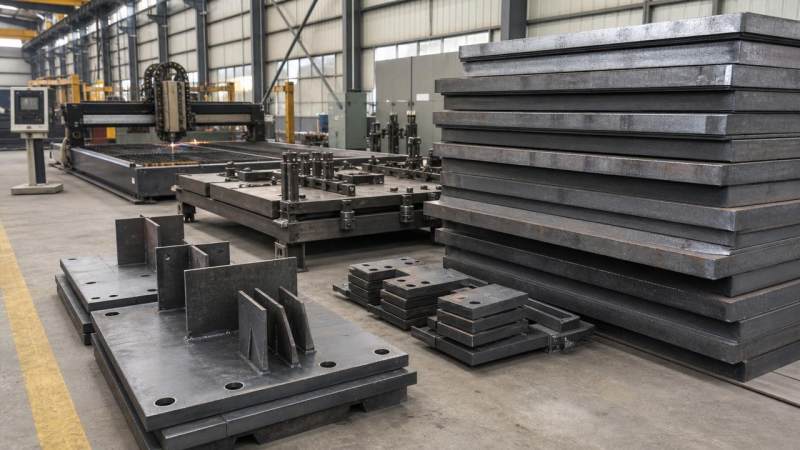
The short answer is yes, but with clearer boundaries than before.
ASTM A36 steel plate remains a practical choice when projects require moderate strength, easy forming, stable supply, and efficient welding.
The current market, however, is becoming more specification-driven.
Fabrication work now often demands better traceability, tighter dimensional control, documented testing, and clearer compatibility with downstream processes.
This shift does not reduce the value of ASTM A36 steel plate.
It changes how the grade should be evaluated, purchased, processed, and approved for use.
Current signals show A36 demand is becoming more application-specific
General fabrication is no longer a single, simple category.
It now includes warehouse frames, equipment supports, machinery bases, access platforms, welded brackets, handling fixtures, and light structural assemblies.
Across these uses, ASTM A36 steel plate is still common because it offers a practical balance of performance and cost.
Its minimum yield strength of 36 ksi supports many non-critical and moderately loaded components.
Its carbon steel composition also makes cutting, drilling, punching, bending, and welding relatively straightforward.
Yet project reviews increasingly ask whether ASTM A36 steel plate is enough, or whether higher-strength grades are safer.
That question usually depends less on grade popularity and more on design assumptions.
If stiffness, fatigue, impact toughness, corrosion exposure, or weight reduction drives the design, A36 may not be the best answer.
If workability, availability, and economical fabrication dominate, ASTM A36 steel plate remains very competitive.
Why ASTM A36 steel plate remains widely specified
The continued use of ASTM A36 steel plate is not accidental.
It fits many fabrication environments where performance requirements are known, repeatable, and not unusually severe.
These advantages explain why ASTM A36 steel plate continues to appear in drawings, bills of materials, and fabrication schedules.
The grade also benefits from market familiarity.
Fabrication teams understand how it behaves during cutting, fitting, welding, straightening, and surface preparation.
Where A36 delivers the strongest value
ASTM A36 steel plate performs best where moderate load, standard tolerances, and conventional fabrication methods define the requirement.
- Machinery bases and mounting plates.
- Welded brackets, gussets, and stiffeners.
- Equipment frames and support assemblies.
- Walkways, platforms, and non-critical structural parts.
- General construction components with suitable design verification.
In these applications, ASTM A36 steel plate can reduce unnecessary over-specification.
Using a stronger grade is not always beneficial if design loads do not require it.
Higher-strength materials may introduce different forming behavior, welding requirements, or cost implications.
A36 often supports a simpler fabrication route when engineering approval confirms suitability.
Where ASTM A36 steel plate needs careful review
A36 is versatile, but it is not a universal solution.
Some applications require closer assessment before ASTM A36 steel plate is approved.
- High cyclic loading or fatigue-sensitive parts.
- Low-temperature service requiring verified toughness.
- Highly corrosive environments without coating protection.
- Weight-sensitive designs seeking thinner sections.
- Precision assemblies needing tight flatness control.
For these situations, design review may point toward normalized grades, weathering steel, high-strength low-alloy steel, or certified impact-tested material.
The key is not to reject ASTM A36 steel plate automatically.
The better approach is to compare actual risks with documented material capability.
Fabrication trends are raising expectations for documentation
Material selection now includes more than mechanical strength.
Traceability, mill test certificates, heat numbers, chemical composition, and dimensional inspection increasingly influence acceptance.
For ASTM A36 steel plate, this trend makes supplier discipline more important.
A plate that meets the grade but lacks clear records can create approval delays.
Consistent thickness, flatness, edge quality, and surface condition also affect cutting accuracy and welding efficiency.
Hongteng Fengda supports structural steel projects with standard and customized products under ASTM, EN, JIS, and GB requirements.
Its production control helps align material supply with fabrication schedules, quality records, and project-specific specifications.
Impact on design, fabrication, and sourcing decisions
The decision to use ASTM A36 steel plate affects several project stages.
Design teams must verify section size, load path, deflection limits, and connection details.
Fabrication planning must confirm cutting method, weld procedure, preheat needs, hole quality, and distortion control.
Sourcing must confirm grade compliance, certificate availability, plate size, delivery time, and packaging requirements.
These links matter because ASTM A36 steel plate is often used in welded assemblies rather than isolated parts.
A small mismatch in thickness, flatness, or documentation can affect fit-up and inspection.
For related low-carbon steel applications, products such as Mild Steel Wire Rod may support wire mesh, fencing, packaging, and tie applications.
Its Q195 and Q235 options reflect the same broader market need for workable, economical low-carbon steel materials.
Key points to check before approving A36
A practical selection checklist can prevent under-specification and unnecessary over-specification.
- Confirm design loads and safety factors.
- Check whether minimum yield strength is sufficient.
- Review welding method and required consumables.
- Verify plate thickness, tolerance, and flatness.
- Assess corrosion exposure and coating system.
- Confirm mill test certificate requirements.
- Compare A36 with higher-strength alternatives only when needed.
This checklist keeps the discussion practical.
ASTM A36 steel plate should be evaluated as part of a system, not only as a material label.
How to judge A36 against common alternatives
Many projects compare ASTM A36 steel plate with A572, A283, S275, S355, or local carbon steel grades.
The correct comparison should include strength, weldability, price, availability, inspection level, and design code acceptance.
This comparison shows why ASTM A36 steel plate remains relevant.
It is not always the strongest grade, but it is often the most efficient match.
Practical response for changing fabrication requirements
As fabrication requirements become more detailed, the response should be structured and evidence-based.
- Define the working environment and expected loads.
- Match mechanical properties with design requirements.
- Confirm fabrication steps before ordering material.
- Require traceable documents for ASTM A36 steel plate.
- Review coating or surface treatment early.
- Select a supplier with stable production capacity.
Hongteng Fengda provides structural steel products including angle steel, channel steel, steel beams, cold formed profiles, and customized components.
Stable manufacturing, strict quality control, and export experience help reduce sourcing risk for global construction and industrial projects.
Final judgment: A36 is right when the application is right
ASTM A36 steel plate is still right for many general fabrication projects.
It offers dependable weldability, workable strength, broad availability, and attractive cost performance.
The important change is that selection must be more disciplined.
A36 should be approved after checking loads, environment, tolerances, documentation, and fabrication requirements.
When those conditions align, ASTM A36 steel plate remains one of the most practical carbon steel choices.
For project evaluation, prepare drawings, thickness needs, standards, certificates, and delivery expectations before confirming the material plan.
A clear specification allows reliable steel supply, smoother fabrication, and better control over cost, quality, and schedule.
Please give us a message


Please enter what you want to find