When evaluating materials for commercial or industrial applications, many engineers ask whether 430 stainless sheet for kitchen equipment offers the right balance of corrosion resistance, formability, and cost. This article examines its performance, limitations, and suitable use cases, helping technical buyers make informed decisions based on function, environment, and long-term value.
Why a checklist matters before choosing 430 stainless sheet for kitchen equipment
Material selection in kitchens is rarely about corrosion resistance alone. Heat exposure, cleaning chemicals, food contact, welding, appearance retention, and budget all affect whether 430 stainless sheet for kitchen equipment is enough.
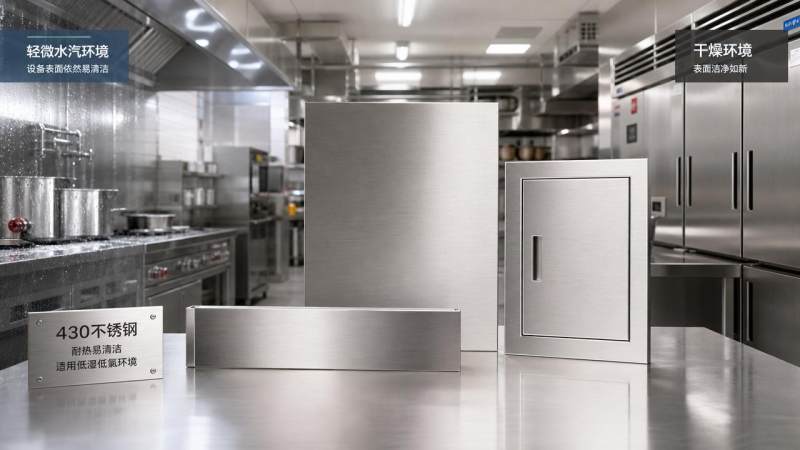
Grade 430 is a ferritic stainless steel with chromium content that supports good oxidation resistance and moderate corrosion resistance. It is usually more affordable than 304, but it does not perform equally in aggressive wet conditions.
A checklist-based decision reduces expensive mistakes. It helps compare where 430 stainless sheet for kitchen equipment performs well, where it needs protection, and where a higher alloy grade is the safer option.
Core checklist: how to judge if 430 stainless sheet for kitchen equipment is enough
- Check moisture exposure first. Use 430 for dry or intermittent wet areas, but avoid it in zones with constant water retention, trapped condensation, or frequent salt contamination.
- Review the cleaning process carefully. Confirm whether the surface will face chlorides, bleach, or harsh alkaline cleaners, because these can stain or attack 430 faster than 304.
- Match the grade to the equipment function. Choose 430 for panels, covers, trim, doors, and housings, but verify food contact and sanitary requirements before final approval.
- Evaluate forming requirements early. 430 stainless sheet for kitchen equipment has acceptable formability for many parts, yet deep drawing performance is usually less forgiving than austenitic grades.
- Confirm welding demand before production starts. Ferritic stainless can be welded, but weld quality, filler choice, heat input, and post-fabrication finishing strongly affect final appearance and corrosion behavior.
- Specify the right surface finish. A smoother finish sheds moisture and grease more easily, improving cleanability and helping 430 maintain a better visual result in busy kitchens.
- Compare total lifecycle cost, not only sheet price. Lower material cost can be attractive, but replacement, staining complaints, and extra maintenance may offset the initial savings.
- Verify local standards and end-use expectations. Some kitchen projects require proven resistance levels, hygienic design rules, or customer-mandated grades that make 430 unsuitable despite its lower cost.
Performance strengths of 430 stainless sheet for kitchen equipment
The biggest advantage of 430 stainless sheet for kitchen equipment is value. It provides a stainless appearance, useful oxidation resistance, and practical service performance at a lower cost than 304 in many markets.
It also offers good resistance to heat and scaling in moderate-temperature applications. That makes it suitable for exterior covers, appliance panels, oven trims, backsplashes, and decorative sections away from severe corrosion.
Because 430 contains little or no nickel, pricing may be more stable when nickel markets fluctuate. For cost-sensitive projects, that can improve planning and reduce sourcing pressure.
In support applications, related stainless components may also matter. For filtration screens or protective inserts used around processing areas, Stainless Steel Welded Mesh is available in grades including 430, 304, and 316, with customized size and specification options.
Where 430 stainless sheet for kitchen equipment works well
Dry preparation and service areas
430 is often sufficient for front panels, cabinet skins, kick plates, and splash zones with limited standing water. In these locations, appearance and moderate corrosion resistance are usually enough.
It is also common on visible appliance exteriors where direct food contact is limited and cleaning exposure is controlled. Good finishing and routine wipe-downs support acceptable long-term performance.
Heat-adjacent housings and trim parts
For oven trims, warming equipment covers, and non-immersed heat shields, 430 stainless sheet for kitchen equipment can be a practical fit. Its oxidation resistance is helpful when temperatures rise intermittently.
However, heat alone should not drive the choice. If steam, cleaning chemicals, or salty residues are also present, the corrosion side of the equation becomes more important.
Budget-driven fabrication projects
When the target is controlled cost for non-critical stainless parts, 430 may deliver the best balance. It allows a stainless visual finish without the premium usually associated with 304 or 316.
Where 430 stainless sheet for kitchen equipment is usually not enough
High-chloride cleaning environments
Repeated exposure to bleach-based cleaners or chloride-bearing sanitizers can cause discoloration and corrosion. In these cases, 304 is often the minimum safer choice, while 316 may be required.
Sink zones and wet processing stations
Areas with pooled water, wet cloth contact, food acids, and frequent washdown are more demanding. 430 stainless sheet for kitchen equipment may show tea staining or localized attack over time.
Heavy welding and sanitary fabrication
Complex welded assemblies require close control. If weld seams remain rough or heat tint is not removed, corrosion risk rises. Hygienic designs with strict cleanability standards may therefore favor higher grades.
Common oversights and risk reminders
Ignore finish selection and problems appear earlier. A rough surface traps grease, moisture, and cleaner residue, making 430 look worse and corrode faster than a smoother finished sheet.
Assume all stainless behaves the same and specification errors follow. The question is not whether stainless is used, but whether 430 stainless sheet for kitchen equipment fits the exact exposure profile.
Overlook fabrication details and service life shortens. Sharp crevices, poor drainage, mixed-metal contamination, and unpassivated weld areas can undermine even a reasonable grade selection.
Compare only raw material prices and the project may cost more later. Staining complaints, part replacement, and downtime can erase the initial savings from choosing 430.
Practical execution advice
- Map each part by exposure level: dry, splash, washdown, chemical contact, and heat.
- Assign 430 only to low-risk zones where standing moisture and chlorides are controlled.
- Request sample panels with the intended finish and test them using actual cleaning chemicals.
- Specify fabrication rules for weld cleaning, edge treatment, and contamination control.
- Use alternative stainless grades for sinks, wet counters, aggressive sanitation areas, and critical food-contact sections.
If a project includes screens, guards, or filtration components near kitchen or processing lines, the same grade logic applies. A mesh product such as Stainless Steel Welded Mesh can be selected in 430 for milder conditions or upgraded where corrosion demand is higher.
Conclusion: is 430 stainless sheet enough for kitchen equipment
Yes, 430 stainless sheet for kitchen equipment is enough in many dry, low-chloride, cost-sensitive applications. It performs well for exterior panels, covers, trim, and moderate-heat parts when finish and fabrication are properly controlled.
No, it is usually not enough for constant wet exposure, chloride-heavy cleaning, sink areas, or demanding sanitary assemblies. In those situations, the lower price does not outweigh the performance risk.
The most effective next step is simple: list each component, define its environment, test the finish, and match the grade to actual service conditions. That process turns the question from a guess into a durable specification.
Please give us a message


Please enter what you want to find