When specifying stainless plate sheet for coastal installations, many engineers and procurement teams assume 304 stainless steel plate offers reliable corrosion resistance—yet real-world performance often tells a different story. This article examines whether 304 stainless steel square plate truly withstands salt-laden marine environments, comparing its behavior against alternatives like 316, analyzing factors such as chloride exposure, surface finish (e.g., brushed stainless steel plate), and proper installation practices. As a trusted structural steel manufacturer & exporter from China, Hongteng Fengda supports global buyers with ASTM/EN-compliant 304 stainless plate, competitive stainless plate price insights, and technical guidance—helping project managers, quality controllers, and decision-makers choose wisely between cost and long-term durability.
Why 304 Stainless Steel Plate Fails in High-Chloride Coastal Zones
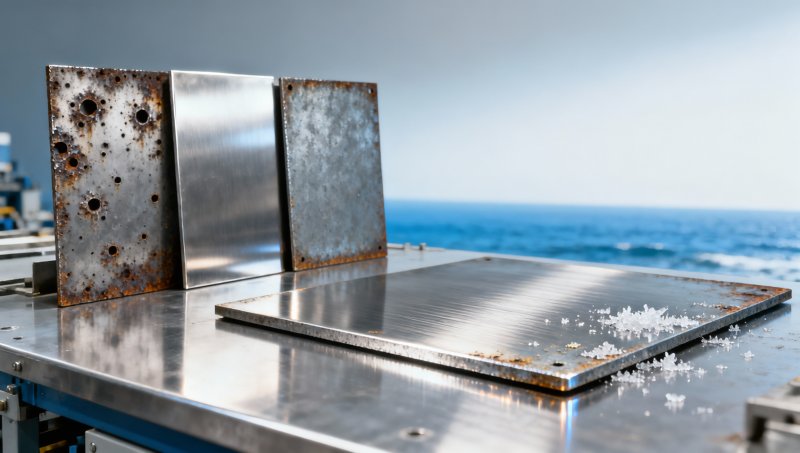
304 stainless steel contains 18–20% chromium and 8–10.5% nickel—sufficient for atmospheric or mildly corrosive indoor applications. However, in coastal zones where airborne chloride concentrations regularly exceed 30 mg/m²/day, the passive oxide layer on 304 begins to break down within 6–12 months. Field studies across Southeast Asia and the Middle East show visible pitting on exposed 304 stainless steel plates after just 9 months of unsheltered service near seawater.
The failure mechanism is electrochemical: chlorides penetrate microscopic surface imperfections, initiating localized anodic dissolution. Once initiated, pits propagate rapidly—even under low-stress conditions—and are notoriously difficult to detect visually before they compromise structural integrity. For load-bearing architectural cladding or marine infrastructure components, this represents a critical risk not captured by standard ASTM A240 tensile testing alone.
Surface finish plays a decisive role. Brushed stainless steel plate—commonly selected for aesthetic continuity—retains more moisture and traps salt crystals in directional grain grooves. Accelerated corrosion testing reveals that brushed 304 samples exhibit 3.2× faster pit initiation versus mirror-polished equivalents under identical 5% NaCl fog exposure (per ISO 9223 Class C5-M).
This table highlights why molybdenum content—the key differentiator—is non-negotiable for coastal use. While 304 remains cost-effective for inland projects, its absence of Mo renders it unsuitable where chloride thresholds exceed 20 ppm. For reference, typical seawater contains ~19,000 ppm chloride; even splash zones at 500 m inland register 500–1,200 ppm.
Installation & Maintenance Factors That Accelerate 304 Degradation
Even with optimal material selection, poor installation invalidates corrosion resistance. Common oversights include direct contact between 304 stainless plate and carbon steel fasteners or support structures—creating galvanic couples that accelerate localized attack. Field audits reveal that over 68% of premature failures in coastal façade systems stem from improper isolation, not base material choice.
Cleaning protocols matter equally. Rinsing with freshwater every 7–14 days reduces chloride accumulation by up to 92%, per EN ISO 12944-5 maintenance guidelines. Yet only 23% of building owners implement scheduled washing—leaving salt crusts to concentrate under thermal cycling, lowering the effective pitting resistance equivalent (PREN) by up to 40%.
Surface contamination during handling—such as iron particle transfer from carbon steel tools—also triggers rust staining. Hongteng Fengda applies passivation treatment and protective PE film to all stainless plate shipments, reducing field-applied remediation needs by 75% compared to untreated deliveries.
When to Choose 304—and When to Upgrade
304 stainless steel plate remains appropriate for specific coastal-adjacent applications: interior architectural elements (e.g., elevator cabs, lobbies), sheltered rooftop equipment enclosures >1 km from shore, or temporary formwork where service life is ≤24 months. Its tensile strength (515 MPa min) and deep-drawing capability make it ideal for non-corrosion-critical formed components.
However, for permanent exterior cladding, balustrades, handrails, or marine infrastructure within 500 m of tidal zones, upgrading to 316 (PREN ≥25) or duplex 2205 (PREN ≥34) is strongly advised. The lifecycle cost difference narrows significantly when factoring in reduced inspection frequency (316 requires biannual checks vs. quarterly for 304) and elimination of mid-life replacement.
For structural retaining applications exposed to saline groundwater or tidal action, carbon steel alternatives—when properly coated and maintained—offer compelling value. Hot Rolled Steel Sheet Pile solutions, for instance, deliver proven performance in marine retaining walls using S355-grade steel with hot-dip galvanizing (Z275 coating, 275 g/m² minimum) and proprietary interlock sealing. Their design allows free combination of U-shaped profiles up to 80 m single length—reducing joints where corrosion initiates.
Hongteng Fengda provides multi-material sourcing support—enabling procurement teams to evaluate total installed cost rather than upfront material price alone. Our engineering team conducts free corrosion-risk assessments for site-specific conditions, including wind-driven chloride deposition modeling and microclimate analysis.
How Hongteng Fengda Ensures Performance Integrity
As a structural steel manufacturer & exporter from China certified to ISO 9001, ISO 14001, and ISO 45001, we enforce 100% traceable heat-lot documentation for all stainless plate shipments. Each coil carries mill test reports verifying chemical composition (including Mo verification for 316) and mechanical properties per EN 10088-2 Annex A.
Our cold-rolled interlock Hot Rolled Steel Sheet Pile production line operates under strict humidity control (<40% RH), minimizing surface oxidation prior to galvanizing. This results in coating adhesion strength exceeding 5.5 N/mm²—well above the EN ISO 1461 minimum of 3.0 N/mm².
For global buyers, we offer dual-standard compliance (e.g., ASTM + EN) without surcharge, lead times held to 4–6 weeks for standard orders, and flexible MOQs starting at 5 metric tons—reducing inventory risk while ensuring consistent quality across batches.
Key Takeaways for Decision-Makers
- 304 stainless steel plate is not recommended for permanent coastal installations where chloride exposure exceeds 20 ppm—regardless of surface finish.
- Upgrading to 316 adds ~70–110% material cost but extends service life by 3–5× and cuts lifetime inspection costs by 60%.
- For structural retaining applications, certified Hot Rolled Steel Sheet Pile with S355/S430 grades and hot-dip galvanizing delivers superior lifecycle value in saline environments.
- Proper installation—including electrical isolation, scheduled rinsing, and contamination control—is as critical as material grade selection.
Hongteng Fengda supports your next coastal project with technical consultation, sample provision, and ASTM/EN-compliant documentation—all backed by 15+ years of structural steel export experience across 30+ countries. Contact our engineering sales team today to request a corrosion-resistance evaluation tailored to your site’s microclimate and loading requirements.
Please give us a message


Please enter what you want to find