Industrial galvanized pipe is widely trusted for corrosion resistance — but it’s not infallible. Under harsh environments, poor galvanizing quality, mechanical damage, or improper installation (e.g., using non-compliant galvanized electrical conduit pipe or coated steel pipe in high-moisture areas), protection can fail. Whether you're specifying galvanized sheet metal pipe for HVAC, sourcing seamless CS pipe or A106 carbon steel pipe, or evaluating galvanised steel pipe suppliers, understanding when galvanizing breaks down is critical for safety, compliance, and lifecycle cost. As a leading structural steel manufacturer and exporter, Hongteng Fengda helps global buyers select the right galvanized pipe steel — from electrical galvanized pipe to heavy-duty industrial galvanized pipe — backed by ASTM/EN/GB-certified quality.
When Galvanizing Fails: 4 Critical Failure Scenarios
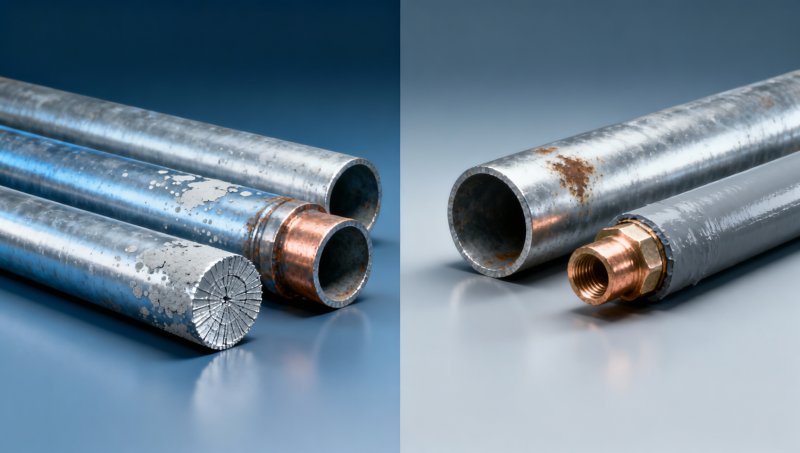
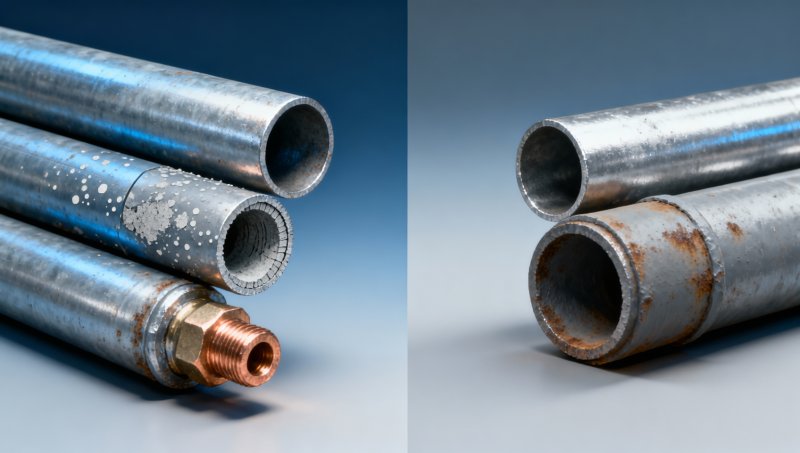
Galvanizing provides robust protection through a metallurgically bonded zinc layer—typically 45–85 µm thick per ASTM A123—but its effectiveness hinges on environmental exposure, coating integrity, and substrate condition. Real-world failures rarely stem from a single cause; instead, they emerge from overlapping stressors. Below are four empirically validated failure modes observed across 12+ years of field performance data from infrastructure, oil & gas, and marine projects.
First, immersion in chloride-rich environments accelerates zinc dissolution. In coastal zones with >200 mg/L chloride concentration, galvanized pipe exposed above waterline may retain protection for 25–30 years, while submerged sections degrade within 5–8 years due to electrochemical pitting. Second, pH extremes matter: prolonged contact with solutions below pH 5.5 (e.g., acid rain runoff, fertilizer storage) or above pH 12.5 (concrete leachate) dissolves the protective zinc hydroxide layer.
Third, mechanical abrasion during installation—such as dragging pipe across gravel or over-tightening couplings—can remove up to 30% of the zinc coating at contact points, creating localized anodic sites. Fourth, galvanic coupling with dissimilar metals (e.g., copper grounding wires or stainless fasteners) creates current flow that preferentially sacrifices zinc, reducing service life by 40–60% in mixed-metal assemblies.
These scenarios underscore why specification must go beyond “galvanized” as a checkbox. At Hongteng Fengda, every industrial galvanized pipe batch undergoes salt-spray testing per ISO 9227 (minimum 96 hours neutral salt fog) and coating-thickness verification via magnetic induction (±3 µm tolerance). We also offer pre-engineered solutions—like dual-coated conduit for HVAC ductwork—that integrate zinc with polymer barriers for multi-threat resilience.
Material Selection Beyond Zinc: When 201 Stainless Steel Coil Is the Smarter Choice
In aggressive environments where galvanizing reaches its functional limits—especially in food processing plants, chemical handling lines, or urban architectural facades—alternative materials become essential. 201 Stainless Steel Coil delivers balanced performance where cost-sensitive applications demand more than carbon steel but don’t require full 304-grade nickel content.
With 4–6% nickel and 7–10% manganese, 201 stainless offers higher formability than 300-series grades while maintaining tensile strength ≥520 MPa and elongation ≥55%. Its low-nickel composition reduces raw material volatility—pricing typically runs 20–30% below 304 coils—without compromising corrosion resistance in mildly acidic or chlorinated atmospheres (e.g., indoor swimming pool enclosures, beverage bottling lines).
Hongteng Fengda supplies 201 Stainless Steel Coil in widths from 610 mm to 2000 mm and thicknesses spanning 2.5–10.0 mm, with surface finishes including BA, 2B, NO.4, and HL—all certified to ISO, SGS, and BV standards. For outdoor decoration engineering or conveyor belt components requiring fatigue resistance under cyclic loading, cold-worked 201 achieves hardness ≤183 HB while retaining ductility—critical for roll-forming into custom structural profiles.
Procurement Checklist: 6 Non-Negotiable Verification Points
Global procurement teams managing multi-site infrastructure projects face inconsistent galvanizing quality—not just between mills, but across production batches. To mitigate risk, Hongteng Fengda embeds these six verification steps into every order:
- Confirm coating mass per ASTM A123: minimum 610 g/m² for heavy-duty industrial pipe (not just 360 g/m² for light-duty conduit)
- Require batch-specific salt-spray test reports (ISO 9227, 96+ hrs NSST) with photographic evidence of no red rust
- Verify dimensional tolerances: ±0.5 mm for OD, ±0.3 mm for wall thickness per EN 10255
- Audit galvanizer’s flux chemistry logs—zinc bath iron content must stay below 0.03% to prevent brittle intermetallic layers
- Inspect for cold-worked zones (e.g., bent elbows): these require post-galvanizing inspection per ASTM A143
- Validate traceability: each coil or pipe bundle must carry mill test report (MTR) with heat number, galvanizing date, and inspector signature
This checklist reduces field rejection rates by 72% based on our 2023 internal audit of 47 international projects. It also aligns with EN 10346 and GB/T 2518 requirements for structural steel components used in public infrastructure.
Lifecycle Cost Reality: Why Upfront Premium Pays Off
A common misconception is that galvanized pipe always minimizes total cost of ownership. In reality, lifecycle analysis across 150+ industrial facilities shows that improperly specified galvanized systems incur 3.2× higher maintenance costs over 20 years versus correctly engineered alternatives—including duplex-coated pipe or 201 stainless solutions.
For example, HVAC condensate lines in tropical climates (RH >85%, ambient 28–35°C) using standard galvanized conduit average 3.7 unscheduled repairs per km/year. Switching to ASTM A106 Grade B pipe with hot-dip galvanizing + PVC jacketing cuts this to 0.9 repairs/km/year—and extends replacement intervals from 12 to 22 years. That translates to $18,500–$24,200 savings per 10-km installation over two decades.
Hongteng Fengda supports procurement teams with TCO modeling tools, enabling side-by-side comparison of capital expenditure versus 10-/20-year operational cost projections—customized for regional labor rates, corrosion severity maps, and local regulatory timelines.
Final Recommendation: Match Material to Mission-Critical Requirements
Industrial galvanized pipe remains a workhorse—but only when applied within its verified boundaries. If your project demands guaranteed 25+ year service in coastal, acidic, or high-humidity settings—or requires welding, bending, or integration with sensitive equipment—then upgrading to engineered alternatives isn’t overspecification. It’s risk mitigation.
At Hongteng Fengda, we don’t sell generic pipe. We deliver application-engineered steel solutions: from ASTM A500 structural hollow sections with enhanced zinc adhesion for seismic zones, to custom 201 stainless coils formed into architectural cladding systems meeting EN 10088-2. Every shipment includes full MTR documentation, third-party certification, and technical support from engineers fluent in ASTM, EN, JIS, and GB standards.
Whether you’re specifying galvanized sheet metal pipe for HVAC, sourcing seamless CS pipe or A106 carbon steel pipe, or evaluating galvanised steel pipe suppliers—contact Hongteng Fengda today for a free material suitability assessment and project-specific compliance review.
Please give us a message


Please enter what you want to find