When a heavy-duty plant frame is underspecified, the problem rarely shows up on day one. It appears later—during installation, under vibration, after repeated thermal cycles, or when a corrosive atmosphere starts to attack connections and exposed surfaces. For technical evaluators, that is why choosing industrial structural steel is not a box-ticking exercise. Grade selection affects structural reliability, fabrication complexity, inspection requirements, coating strategy, and ultimately whether a project runs smoothly or becomes a long-term maintenance burden.
The challenge is that “stronger steel” is not always the better answer. A higher strength grade may reduce section size, yet create tighter welding controls, reduced toughness margin, or procurement complications if the required standard is not locally available. For heavy-duty plant frames, the right specification usually comes from balancing load demands with fabrication reality and service environment.
What technical evaluators are really deciding
At tender or design review stage, the grade callout often looks simple: ASTM A36, ASTM A572, S355, SM490, Q355, and so on. But behind that line item are several engineering decisions:
- What load combination governs the frame—static load, dynamic load, crane load, fatigue, or seismic action?
- Will the structure be welded, bolted, or a mix of both?
- Is the plant exposed to humidity, chemicals, salt-laden air, or process heat?
- How critical is low-temperature toughness?
- Which regional code and mill certification route will be accepted by the project owner?
These questions shape whether a common carbon structural grade is sufficient or whether a higher-strength, better-toughness, or corrosion-protected option is the safer specification.
Start with the loading reality, not the catalog
Heavy-duty plant frames are different from light commercial steelwork because they often carry more than gravity load. Equipment skids, suspended piping, maintenance platforms, conveyors, silos, hoppers, and overhead handling systems can introduce concentrated reactions and repeated operational stress. In some plants, frame members also experience local heat effects, impact, or vibration from rotating equipment.
That means the grade should be assessed in terms of:
- Yield strength for section efficiency and deflection control
- Tensile strength for overall resistance margin
- Toughness for brittle fracture resistance, especially in cold or cyclic service
- Ductility for redistribution of stress and fabrication tolerance
- Weldability for practical shop and site assembly
In many cases, moving from a basic mild structural grade to a medium-strength grade improves member economy without introducing excessive fabrication risk. But if the frame contains thick sections, complex welded nodes, or heavily restrained joints, weldability and heat-affected-zone behavior deserve as much attention as nominal strength.
How standards translate across global sourcing
Global projects often compare grades across ASTM, EN, JIS, and GB systems. While many of these grades are functionally similar, they are not automatically interchangeable. Yield strength levels may appear close, yet differences in chemical composition limits, toughness requirements, delivery condition, or test frequency can affect approval and performance.
For example, a buyer may compare ASTM A572 Grade 50, EN S355, JIS SM490, and GB Q355 for an industrial frame. On paper, they occupy a similar strength class. In practice, the evaluation should confirm:
- Minimum yield strength at the required thickness range
- Charpy impact testing requirements, if any
- Carbon equivalent and weldability implications
- Permitted chemical variation by standard
- Traceability and mill test documentation format
This is where sourcing discipline matters. A structural steel manufacturer serving export markets should be able to align material supply with project-standard documentation, not merely offer a “similar grade.” Hongteng Fengda, as a China-based structural steel manufacturer and exporter, supplies structural sections and customized components to projects working under ASTM, EN, JIS, and GB frameworks, which is often important when technical teams need both grade compliance and fabrication coordination from one source.
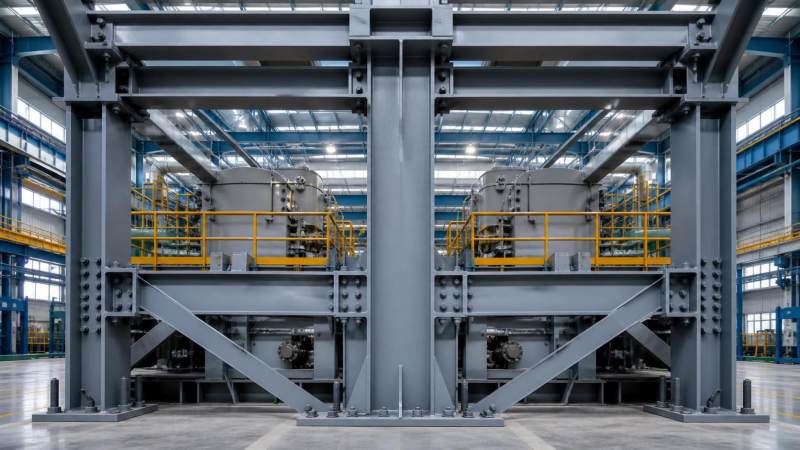
Strength is only one part of the specification
A frequent mistake in industrial frame design is over-prioritizing yield strength while underestimating shop constraints. If a higher-grade steel reduces section weight but increases preheat requirements, welding procedure qualification complexity, or inspection sensitivity, total project efficiency may actually decline.
Technical evaluators should review these trade-offs early:
1. Weldability and heat input control
Plant frames often involve substantial welded fabrication—base frames, built-up beams, stiffened columns, equipment supports, and connection assemblies. Steels with higher carbon equivalent can still be workable, but they demand tighter procedure control. For large projects, this can influence fabrication schedule, consumable selection, and rework risk.
2. Thickness effect on mechanical performance
Minimum yield values can vary by thickness. A grade that looks ideal for a moderate beam may behave differently when specified for thick plate in a highly loaded column splice or support node. Always verify the property range against actual section thickness, not only the headline grade name.
3. Toughness in exposed or cold service
Not every industrial site is at ambient, forgiving conditions. Outdoor installations, elevated structures, northern climates, and shock-loaded applications may need specified impact toughness. If the frame supports critical process equipment, brittle failure risk should be treated conservatively.
4. Connection design compatibility
Bolted and welded joints should not become the weak link. The grade selected for beams and columns should work logically with connection plates, anchor systems, and fasteners. Mixed-grade assemblies can be efficient, but only if the detailing team controls compatibility clearly.
Corrosion exposure often changes the grade decision
In many industrial environments, corrosion is not a secondary issue. Fertilizer plants, coastal terminals, wastewater facilities, chemical processing lines, and humid manufacturing buildings can all shorten steel life if protection is underspecified. In such cases, the evaluator should think beyond the base steel grade and define a complete durability strategy.
That strategy may include painting systems, hot-dip galvanizing, weathering steel where suitable, or galvanized and coated steel components in secondary framing and enclosure-related parts. For certain applications requiring moisture protection and longer service life, Coil Coated Galvanized Steel can be a practical complement within the broader plant package, especially for non-primary structural elements, cladding supports, or formed profiles where corrosion resistance and coating consistency are important.
The key point is simple: for heavy-duty plant frames, “steel grade” and “protection system” should be specified together. A strong frame without an environment-appropriate corrosion plan is not truly well specified.
When to choose common structural grades—and when not to
There is still a place for widely used structural grades in industrial work. Standard grades are often easier to source, faster to replace, and more familiar to fabricators. They can be the right answer where loading is straightforward and the environment is controlled.
They may be sufficient when:
- The frame is primarily static-loaded
- Fabrication must be straightforward across multiple workshops
- Section sizes remain practical without chasing higher yield strength
- Service temperature and corrosion exposure are moderate
- The project benefits from broad global availability
On the other hand, a more carefully engineered grade choice becomes necessary when:
- Member weight must be reduced without compromising capacity
- Dynamic, fatigue, or impact loading is present
- Low-temperature toughness is a design driver
- Corrosive exposure requires integrated material and coating planning
- Critical welded joints involve thicker material and restrained geometry
A practical review checklist for technical evaluation
Before locking the material specification, it helps to review the frame as a procurement-and-fabrication system, not just an engineering calculation. A concise but effective checklist includes:
- Confirm governing design code and accepted material standards
- Check minimum yield and tensile strength at actual thickness
- Review impact toughness requirements by temperature and service category
- Evaluate weldability, carbon equivalent, and preheat implications
- Align grade choice with available beam, channel, angle, and plate forms
- Verify whether rolled sections or built-up members are more realistic
- Define corrosion protection by exposure zone
- Require mill test certificates and traceability expectations in the RFQ
- Check if equivalent grades are acceptable, and under what approval route
- Coordinate with fabricator on cutting, forming, drilling, and welding constraints
This step often prevents one of the most expensive project mistakes: approving a technically acceptable grade that becomes difficult or inconsistent once fabrication begins.
The sourcing side of grade specification
For many evaluators, the technical decision does not end at material properties. Supply reliability matters just as much. Heavy-duty industrial frames are often delivered in packages that include beams, channels, angle steel, cold formed profiles, and custom structural components. If these come from multiple sources with uneven documentation, the project team may spend more time reconciling paperwork and dimensional issues than solving engineering problems.
That is why buyers often prefer manufacturers that can support both standard sections and customized structural steel under controlled quality systems. Hongteng Fengda supplies angle steel, channel steel, steel beams, cold formed profiles, and OEM structural components with reference to major international standards. For technical teams, that kind of supply model can reduce interface risk—particularly when the project requires a mix of standard grades, customized fabrication, and export documentation.
One more point about galvanized and coated materials
Although primary heavy-duty frames are commonly specified in conventional structural grades with project-specific protective systems, evaluators should not overlook adjacent steel items that influence maintenance cycles. In plant environments where moisture exposure is persistent, coated galvanized materials with controlled zinc layers and forming performance can support long-term durability in secondary applications. Depending on design intent, grades such as DX51D+Z through higher-strength coated variants may be relevant where corrosion resistance and manufacturability need to work together.
The right use of protective steel products is not a substitute for proper structural grade selection; it is part of a more complete specification strategy.
Better specifications usually come from better questions
The most reliable industrial structural steel specification for a heavy-duty plant frame is rarely the most aggressive or the most conservative option. It is the one that fits the actual loads, service conditions, fabrication route, and compliance framework of the project. Technical evaluators who ask the right questions early—about thickness, toughness, weldability, corrosion, and certification—tend to avoid downstream surprises.
In other words, the best grade is not just strong enough on paper. It is available in the right forms, workable in the shop, traceable to the required standard, and durable in the environment where the plant will actually operate. That is the difference between a material specification that looks complete and one that performs reliably over time.
Please give us a message


Please enter what you want to find