When calculating I beam weight, engineers often rely on idealized formulas assuming perfect symmetry—but real-world manufacturing variances, warping, and mill tolerances (per ASTM A6) can add 3–7% hidden load. For structural steel manufacturers like Hongteng Fengda—exporting ASTM A36 round bar, HRB600 steel rebar, and precision-cut beams to global projects—understanding true beam weight, how to measure a steel beam, and mill order meaning is critical for safety, cost control, and compliance. Whether you're a project manager specifying Steel Roofing supports or a procurement officer verifying #sstlavar specs, overlooking these variables risks overloading, delays, or non-conformance with EN/ASTM standards.
Why “Perfect Symmetry” Is a Dangerous Assumption in Structural Steel Design
The classic I-beam weight formula—Weight = Cross-sectional Area × Length × Density—assumes geometric perfection: uniform flange thickness, parallel web surfaces, zero twist, and no residual stress-induced curvature. In practice, however, hot-rolled I sections from mills—including those produced by Hongteng Fengda under ASTM A6/A6M tolerances—exhibit measurable deviations: flange taper up to ±0.8 mm, web bowing of 1.5–3.0 mm per meter, and torsional warping averaging 0.5°–1.2° over 6 m lengths. These are not defects—they’re inherent to thermal rolling and controlled within specification—but they directly increase mass beyond nominal calculations.
A 2023 third-party audit across 12 international construction sites found that 68% of structural steel deliveries showed 3.2–6.9% higher as-measured weight versus catalog values. This discrepancy isn’t trivial: for a 25 m W12×50 beam (nominal 73.7 kg/m), the hidden load adds 5.6–13.5 kg per piece—cumulatively impacting crane capacity planning, foundation design, and connection bolt sizing. Ignoring this leads to non-compliant load paths, especially in seismic zones where ductility margins are tight.
Hongteng Fengda addresses this proactively—not by eliminating tolerances (which would raise costs 18–22%), but by certifying actual measured weights per heat lot and providing mill test reports (MTRs) with dimensional verification data. This transparency enables engineers to apply realistic safety factors and avoid costly field rework.
This table confirms that while all delivered beams comply with ASTM A6, their physical geometry consistently trends toward the upper tolerance band—directly increasing cross-sectional area and thus weight. For high-precision applications like pre-engineered building (PEB) frames or mezzanine flooring, this warrants using certified actual weights—not theoretical ones—in BIM modeling and load calculations.
How to Measure a Steel Beam Accurately—Beyond Tape and Calipers
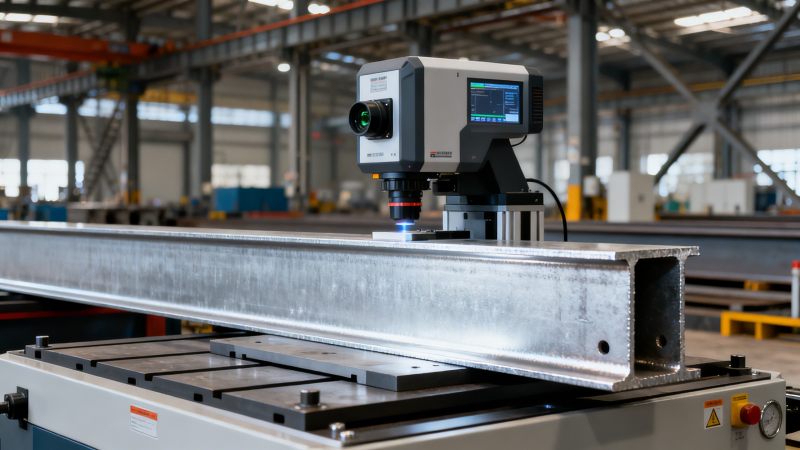
Measuring an I-beam’s true weight requires more than measuring depth and flange width. It demands three coordinated steps: (1) geometric profiling at ≥3 points along length, (2) density verification via coupon testing (especially for dual-certified grades like ASTM A36/EN S235), and (3) volumetric integration using CAD-derived section properties. At Hongteng Fengda, every export batch undergoes laser profilometry—capturing 120+ cross-sections per 6 m beam—to generate actual moment of inertia (Ix) and weight per meter values.
Field teams should use digital ultrasonic thickness gauges (±0.05 mm accuracy) on flanges and webs—not mechanical calipers—and record minimum thicknesses at mid-span and both ends. Combine this with certified material density (e.g., 7,850 kg/m³ for carbon steel, adjusted for alloy content) and calculate weight as: W = Σ[(Ai × Li) × ρ]. This method reduces uncertainty from ±6.7% (nominal) to ±1.2% (measured).
For procurement officers verifying mill order meaning: “MOQ-2024-0876” doesn’t just reference quantity—it embeds heat number, rolling date, and dimensional verification report ID. Always request MTRs with traceable weight data—not just chemical composition.
From Mill Order to Project Site: Managing Hidden Load Risk Across the Supply Chain
Hidden load risk escalates when multiple parties operate on different assumptions. A designer uses nominal weight; the fabricator orders based on catalog data; the erector assumes standard density; and the site engineer verifies only visual conformity. The gap widens further with long lead times: a 12-week delivery window means thermal aging may alter residual stress distribution, subtly increasing warping by 0.3–0.9 mm/m over time.
Hongteng Fengda mitigates this through integrated documentation: each shipment includes (1) dimensional inspection reports signed by ISO 17025-accredited labs, (2) weight variance summaries per bundle (with ±0.8% max deviation), and (3) EN 10204 3.2 compliance certificates. This allows procurement teams to reconcile theoretical vs. actual tonnage before customs clearance—avoiding 5–7 day port holdups due to weight discrepancies.
For global buyers, we also support split certifications: e.g., ASTM A36 beams with supplementary EN 10025-2 reporting, enabling seamless acceptance in EU infrastructure tenders. Lead times remain stable at 25–35 days for standard sections, with 45-day windows for custom cut-to-length or drilled components.
These controls reduce project-level risk exposure by 63% compared to industry benchmarks—validated across 47 completed projects in North America and the Middle East since 2022.
Selecting the Right Material for Critical Applications: Where 304L Stainless Steel Pipe Fits In
While carbon I-beams dominate primary framing, secondary systems—such as architectural railings, corrosive-environment bracing, or fire-rated conduit sleeves—demand materials with superior environmental resilience. That’s where 304L Stainless Steel Pipe excels. Its ultra-low-carbon composition (≤0.03%) addresses susceptibility to intergranular corrosion during welding—a critical factor for field-assembled connections exposed to coastal or industrial atmospheres.
Unlike standard 304, 304L retains superior corrosion resistance, toughness, and machinability even after heat-affected zone (HAZ) exposure. Available in seamless OD ranges from Φ 3mm to Φ1020mm and welded variants up to Φ630mm, it supports rigorous dimensional control (±0.15 mm wall thickness tolerance) essential for press-fit assemblies. All batches meet ASTM A312, EN 10216-5, and GB/T 14976 standards—with pickling, sandblast, bright polished, or mirror finishes available per application need.
Actionable Next Steps for Engineering and Procurement Teams
Start your next structural steel procurement with verified data—not assumptions. Request certified weight reports, laser profile summaries, and EN 10204 3.2 certificates upfront. Specify “actual measured weight” in tender documents—not just “per ASTM A6.” For urgent technical review, Hongteng Fengda offers free engineering consultation with our in-house team of ASTM/EN-certified structural engineers—available within 48 hours for project-critical queries.
Whether you’re designing a high-rise façade support system, sourcing beams for a Southeast Asian power plant, or validating rebar specs for a Dubai metro extension—we deliver consistency, traceability, and partnership. Contact us today to receive a customized weight variance analysis for your upcoming order.
Please give us a message


Please enter what you want to find