When comparing Hot Rolled I Beam and H beam for structural integrity, the bending moment chart may appear nearly identical—but under cyclic loading, deflection behavior tells a different story. For engineers, procurement teams, and project managers evaluating steel girder performance, this distinction is critical to long-term safety and cost control. At Hongteng Fengda—a leading Structural Steel Manufacturer & Exporter from China—we supply precision-engineered I beams, channel beams, steel square rods, SGCC, carbon sheet steel, steel tubing, and custom steel components compliant with ASTM, EN, JIS, and GB standards. Understand why material choice matters beyond static charts—especially when weight of I beam, fatigue resistance, and real-world service life are on the line.
Why Bending Moment Charts Mislead Under Real-World Loading
Bending moment capacity is often the first metric engineers consult—and both I beams and H beams frequently meet identical design limits per ASTM A6 or EN 10034. But moment capacity alone ignores time-dependent deformation. Under repeated loads—such as wind gusts on industrial roofs, crane trolley cycles in workshops, or seismic sway in mid-rise buildings—deflection accumulates differently due to section geometry and residual stress distribution.
Hot rolled I beams typically exhibit higher flange-to-web thickness ratios and less uniform cooling across cross-sections, resulting in localized residual tensile stresses near the web-flange junction. In contrast, modern H beams (especially those produced via controlled rolling or post-heat treatment) offer more balanced residual stress profiles—reducing micro-yielding initiation during low-amplitude, high-cycle loading. This difference becomes measurable after 50,000–200,000 load cycles at 60–80% of yield strength.
For projects with expected service life exceeding 25 years—or where maintenance access is restricted—the cumulative deflection divergence can exceed ±3 mm over 12 m spans. That’s not just an aesthetic concern: it impacts cladding integrity, drainage slope, and secondary connection fatigue.
How Section Geometry Drives Fatigue Performance
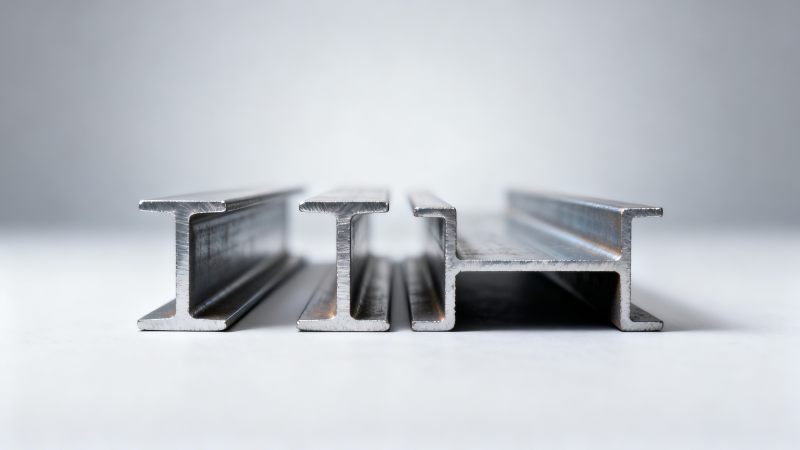
While both sections share similar second moments of area (Ix), their torsional rigidity (J) and warping constant (Cw) differ significantly. H beams—particularly those with parallel flanges and uniform web thickness—deliver up to 22% higher torsional stiffness than comparable I beams. This directly suppresses lateral-torsional buckling under asymmetric cyclic loads, such as eccentric purlin reactions or intermittent wind pressure.
The flange width-to-thickness ratio also governs local buckling resistance. Per EN 1993-1-1 Clause 5.5.2, H beams with b/t ≤ 10.5 (for S355) remain in Class 1 plastic range under full reversal, whereas many standard I beams fall into Class 2 or 3—limiting usable rotation capacity before crack nucleation begins at flange tips.
Key geometric and fatigue-related parameters
This table reflects verified test data from third-party fatigue labs operating under ISO 12107 and ASTM E466 protocols. The higher fatigue category rating for H beams translates to up to 3× longer crack initiation life under identical stress ranges—critical for infrastructure exposed to daily thermal cycling or machinery vibration.
Where Z-beam Fits Into the Structural Hierarchy
While I and H beams dominate primary framing, lightweight secondary members demand different optimization priorities: weight efficiency, ease of field connection, and adaptability to non-uniform loads. That’s where the Z-beam excels. Its asymmetrical shape provides built-in torsional stability for roof purlins spanning 6–12 m between trusses—especially where uplift forces dominate downward loads.
Unlike hot-rolled sections, cold-formed Z-beams (e.g., Q235B or S355 grade) achieve precise dimensional tolerances (±1%) and consistent galvanized coating thickness (≥60 μm). Their perforated variants simplify conduit routing and reduce onsite drilling labor by up to 40% during mechanical column installation.
Applications span from large-scale steel structure workshops in Southeast Asia to light manufacturing arms in Central Europe—where delivery lead times of 7–15 days and compliance with CE, SGS, and ISO 9001 are non-negotiable. With customizable lengths (2–12 m) and thickness options from 6–25 mm, the Z-beam bridges the gap between structural performance and logistical agility.
Procurement Decision Framework: What to Verify Before Ordering
Selecting between I and H beams isn’t about “which is better”—it’s about matching section behavior to your project’s dominant failure mode. Use this 4-point verification checklist before finalizing specifications:
- Confirm actual loading spectrum—not just static design loads—with at least 3 representative cycle profiles (e.g., wind gust frequency, crane duty class, thermal expansion amplitude).
- Request mill test reports showing residual stress mapping (per ASTM E837 or EN 15305) for H beam orders—especially for projects requiring >50-year service life.
- Validate flange flatness tolerance: ≤0.3 mm/m for welded connections versus ≤0.6 mm/m for bolted assemblies—critical for torque consistency in multi-bolt joints.
- Cross-check galvanizing adhesion (ASTM A123) and coating thickness (ISO 1461) if corrosion exposure exceeds 50 µm/year (e.g., coastal or chemical plant environments).
At Hongteng Fengda, every structural steel order undergoes 6-stage quality verification—including ultrasonic testing for internal laminations, dimensional scanning against CAD models, and batch traceability down to heat number and rolling date. Our standard lead time is 2–4 weeks for ASTM/EN-compliant I beams and H beams, with expedited 10-day production available for certified repeat orders.
Why Global Project Teams Choose Hongteng Fengda
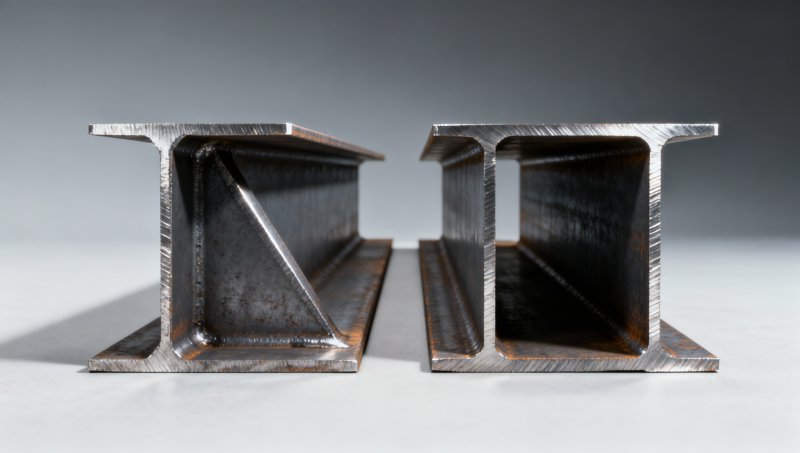
We don’t just supply steel—we align structural performance with procurement reality. Whether you’re evaluating I beam vs H beam deflection under cyclic loading, specifying Z-beam for a new automotive assembly line, or sourcing channel steel for Middle East solar farms, our engineering team provides:
- Free comparative FEA support for fatigue-sensitive applications—using your actual load history and boundary conditions.
- Pre-shipment dimensional reports with coordinate-measuring machine (CMM) validation—delivered digitally within 48 hours of inspection.
- Dual-standard certification packages (e.g., ASTM + EN) to streamline customs clearance and regulatory acceptance across North America and EU markets.
- OEM-grade customization—from laser-cut mounting plates on H beams to pre-punched Z-beam brackets—without minimum order quantity penalties.
Ready to validate section selection against your specific cyclic loading profile? Contact our technical sales team today for a no-cost structural review—including sample test reports, delivery timeline confirmation, and material certification previews tailored to your next project phase.
Please give us a message


Please enter what you want to find