When comparing I beam vs H beam strength for heavy-load applications, shape alone is not enough. Real selection depends on flange width, web thickness, load path, span, and stability.
In steel construction, beam demand is shifting toward higher load efficiency, tighter safety margins, and faster fabrication. That makes the topic of I beam vs H beam strength more important in current project planning.
For industrial buildings, bridges, equipment frames, and warehouses, the right beam section affects not only strength, but also welding cost, deflection control, and long-term structural reliability.
Why beam selection is changing in heavy-load steel projects
Heavy-load design standards are becoming stricter. More projects now require better resistance to bending, vibration, and local buckling under repeated or concentrated loads.
At the same time, owners want lighter structures without sacrificing safety. This creates a stronger focus on section efficiency when evaluating I beam vs H beam strength.
Another trend is wider global sourcing. Buyers compare ASTM, EN, JIS, and GB beam options, which increases attention to dimensional tolerance, steel grade, and actual section performance.
What really drives the I beam vs H beam strength difference
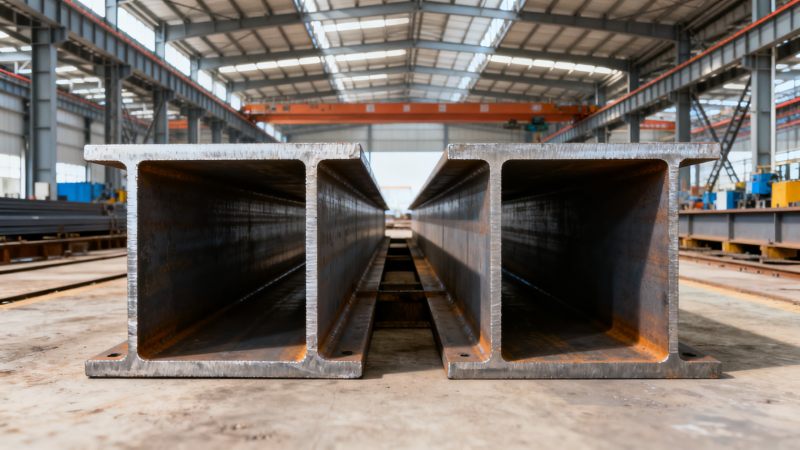
The main difference is geometry. An H beam usually has wider flanges and a thicker web, while an I beam often has narrower flanges and a more tapered profile.
That geometric difference changes how the section handles bending moments, shear forces, lateral stability, and axial compression in heavy structural systems.
Bending performance is often the first decision point
In many cases, H beams provide stronger bending resistance because more material is distributed farther from the neutral axis. That improves moment capacity under high vertical loading.
This is why discussions around I beam vs H beam strength often favor H beams for long spans, crane beams, and heavily loaded floor systems.
Shear and web performance also matter
When loads are concentrated near supports, web strength becomes critical. A thicker web can better resist shear stress and reduce the need for extra reinforcement.
This makes H beams attractive where heavy equipment, storage racks, transfer platforms, or dynamic machinery create severe support reactions.
How demand upgrades are influencing steel section choices
Current projects are no longer judged only by initial section strength. They are assessed by fabrication efficiency, weldability, supply consistency, and compliance with international standards.
- Longer spans require stronger moment resistance and deflection control.
- Heavier process equipment increases point-load concentration.
- Seismic and wind design increase demand for stable sections.
- Faster construction favors standardized, easy-to-connect steel profiles.
- Lifecycle cost analysis encourages durable and efficient steel solutions.
These changes mean I beam vs H beam strength should be evaluated together with procurement flexibility and supporting steel materials used across the same project.
For example, beam systems often work with bars, plates, and connection parts. In such assemblies, 45# Carbon Steel Round Bar can be relevant for structural accessories and machined components.
This carbon steel bar offers excellent strength and wear resistance. Common supply forms include hot rolled and cold rolled round bars with diameters from 5mm to 2500mm.
It also supports broad standard compatibility, including ASTM, DIN, JIS, GB, and EN, which helps integrated steel sourcing across construction and industrial fabrication projects.
Where I beam and H beam strength differences matter most
The choice becomes more critical as loading becomes more complex. Different applications stress steel sections in different ways.
Industrial buildings and factories
H beams are commonly preferred for main frames, columns, and transfer members. Their shape better supports combined bending and axial forces in heavy-duty buildings.
Warehouses and logistics structures
When high rack loads and forklift traffic influence floor and roof design, beam deflection becomes important. H beams often provide better stiffness for these demanding service conditions.
Bridges and platforms
For shorter spans or less complex secondary members, I beams may still perform well. However, heavy bridge elements usually require detailed section checks before final selection.
Equipment bases and support frames
Repeated vibration, impact, and asymmetrical loads can expose section weakness. In many such cases, H beam geometry provides a safer structural reserve.
Key points to examine before deciding I beam vs H beam strength
- Check actual section properties, not only the beam name.
- Compare bending moment, shear, and deflection requirements together.
- Review flange width for lateral stability performance.
- Assess web thickness under concentrated support loads.
- Confirm steel grade, standard, and dimensional tolerance.
- Consider welding, drilling, and connection detailing impacts.
- Evaluate supply continuity for large-volume or export projects.
This practical review helps avoid oversimplified decisions. The strongest option depends on the full loading case, not only on section appearance.
A clearer way to judge which beam fits heavy loads
In short, the answer to I beam vs H beam strength usually leans toward H beams for heavy loads, but final design must still verify section modulus, inertia, shear area, and buckling limits.
What to do next when selecting structural steel sections
Start with the actual load case, span, support condition, and design standard. Then compare beam properties, fabrication needs, and total material strategy across the project.
A reliable structural steel supplier can help align beam selection with standards such as ASTM, EN, JIS, and GB, while supporting customized sizes and stable delivery.
Hongteng Fengda, as a structural steel manufacturer and exporter from China, supplies steel beams, channels, angles, cold formed profiles, and customized structural components for global projects.
If your project requires a practical comparison of I beam vs H beam strength, the most effective next step is to match section data with real loading demands and sourcing conditions.
That approach reduces risk, controls cost, and improves structural performance from design through fabrication and final installation.
Please give us a message


Please enter what you want to find