When comparing I beam vs H beam, the differences go far beyond appearance. For engineers, buyers, and project managers, understanding load capacity, weight, cost, and application is essential before sourcing any steel beam. This guide explains what sets them apart, how to estimate I beam weight, and what to check when evaluating factory price, quality standards, and supply options for international projects.
What is the real difference between an I beam and an H beam?
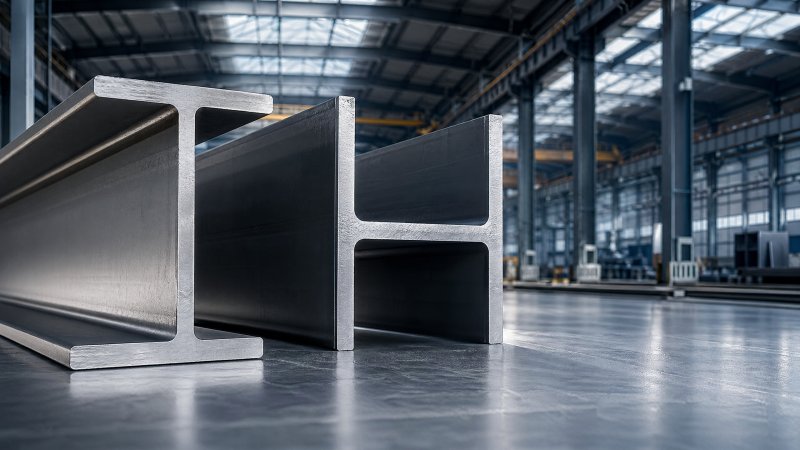
The short answer is this: an H beam is generally wider, heavier, and better suited for higher-load structural applications, while an I beam is often lighter, narrower, and more economical for certain spans and support conditions.
Although both are structural steel sections used to carry loads, they differ in geometry, mechanical behavior, and commercial use. In actual procurement and engineering decisions, the choice is rarely about shape alone. It usually comes down to five practical questions:
- How much load must the beam carry?
- What span length is required?
- Is weight a design constraint?
- What fabrication or connection method will be used?
- Which section gives the best balance of performance, availability, and cost?
If the project requires stronger flange support, better axial load resistance, and higher overall structural stability, H beams are often preferred. If the application needs a more compact section with lower material usage and cost efficiency for lighter-duty structures, I beams can be a practical choice.
How do I beam and H beam differ in shape and structural performance?
The most visible difference is the cross-section.
- I beam: typically has narrower flanges and a deeper web proportion, creating the classic “I” appearance.
- H beam: usually has wider flanges and a more balanced flange-to-web ratio, making the profile look closer to an “H”.
That geometry affects performance in important ways:
- Load-bearing capacity: H beams generally handle heavier loads more effectively, especially in columns, large frames, and heavy steel structures.
- Bending resistance: Both can resist bending well, but H beams often provide better section efficiency for large structural members.
- Stability: Wider flanges improve stability and make H beams more suitable where lateral resistance matters.
- Weight distribution: I beams can offer an economical section for applications where full H beam capacity is unnecessary.
For users and technical evaluators, this means the decision should be based on actual design loads and service conditions rather than appearance or naming conventions alone.
Which one is better for construction, industrial, and manufacturing projects?
Neither beam is universally “better.” The right choice depends on the project type.
I beams are often used for:
- Light to medium industrial structures
- Secondary framing
- Platform supports
- Warehouse members with controlled loading
- Projects where material economy is important
H beams are often used for:
- Heavy steel structures
- Main structural frames
- Longer spans
- Columns and high-load supports
- Large commercial and infrastructure projects
For procurement teams and project managers, the practical rule is simple: if under-specification could create safety, compliance, or lifecycle risk, H beam is often the safer choice. If the load case is moderate and cost optimization is a priority, an I beam may deliver better value.
How does I beam weight affect design, transportation, and total cost?
I beam weight matters far beyond engineering calculations. It directly influences raw material cost, fabrication, shipping, lifting requirements, installation efficiency, and even foundation load.
In general, beam weight depends on:
- Section dimensions
- Web thickness
- Flange width and thickness
- Steel grade
- Length per piece
For international buyers, heavier sections may improve structural performance but can also increase:
- Ocean freight cost
- Inland transportation cost
- Handling and crane requirements
- Import duties based on shipment value or weight
- Site installation complexity
This is why experienced sourcing teams compare not just unit price per ton, but total delivered cost per usable structural function.
A practical purchasing approach is to ask suppliers for:
- Theoretical weight per meter
- Dimensional tolerances
- Length options
- Material certificates
- Loading plan and packing method
That allows engineers, buyers, and finance approvers to evaluate whether a lower factory price actually leads to lower project cost.
What should buyers check when comparing steel beam factory price?
A low quoted price does not always mean lower sourcing cost. In steel beam purchasing, price must be evaluated together with specification accuracy, standard compliance, yield consistency, and delivery reliability.
Here are the main factors that affect steel beam factory price:
- Steel grade: such as Q235, Q345, A36, SS400, S235, or St52
- Section size and weight: larger and heavier sections cost more per piece
- Manufacturing process: hot rolled, welded, cut-to-length, punched, or custom fabricated
- Quantity: bulk orders usually receive better pricing
- Standard requirements: ASTM, EN, JIS, and GB compliance may affect cost
- Tolerance and quality control: tighter control can improve project reliability
- Surface condition and packaging: export packing and special treatment add cost
For business evaluators and decision-makers, the right question is not “Who is cheapest?” but “Which supplier can deliver the required quality with the lowest total risk?”
That includes checking:
- Mill test certificates
- Third-party inspection availability
- Production capacity
- Lead time stability
- Export experience
- After-sales responsiveness
What product specifications matter most when sourcing I beams?
When sourcing I beams for industrial structures, buyers should confirm more than the section name. The most important details are the actual dimensional and material specifications behind the order.
For example, I Shaped Beams can be supplied in carbon steel grades such as Q195-Q235, Q345, SS355JR, SS400, A36, ST37-2, S235J0, S235J2, and St52, depending on project requirements and target market standards.
Key specification points commonly reviewed include:
- Thickness: 4.5mm-15.8mm or custom requirement
- Length: 6-12m per piece or custom cut length
- Flange width: 100mm-400mm
- Flange thickness: 6mm-28mm
- Web width: 100mm-900mm
- Web thickness: 6mm-28mm
- Tolerance: ±1%
Available processing may include hot rolled molding, bending, welding, decoiling, punching, and cutting. For many industrial structure applications, this flexibility is important because buyers may need standard sections for immediate installation or customized processing for project-specific fabrication.
Quality-conscious buyers should also verify whether the supplier can meet major standards such as JIS, ASTM, DIN, GB, and EN. This is especially important for distributors, EPC contractors, and overseas importers working across multiple markets.
How can engineers and procurement teams choose the right beam more confidently?
A reliable decision usually comes from combining engineering logic with sourcing discipline.
For engineers and technical reviewers:
- Confirm design load, span, support condition, and connection method
- Compare section properties, not just nominal beam type
- Check whether weight optimization affects stability or safety margin
- Verify compliance with the required project code or national standard
For buyers and sourcing teams:
- Request a detailed quotation with full section data
- Compare price by specification, not by product name only
- Ask for production lead time and shipment schedule
- Confirm inspection documents and export packaging details
- Evaluate supplier consistency for repeat orders
For managers and financial approvers:
- Review total landed cost, not only ex-factory price
- Consider the cost of delays, rework, and non-conformance
- Balance material savings against structural performance and risk
- Choose suppliers with proven export and quality control systems
For global projects, a dependable structural steel partner can reduce sourcing uncertainty as much as a technically correct beam specification.
Final answer: I beam vs H beam—what really sets them apart?
What really sets them apart is not just shape, but structural role, loading capability, weight profile, and project value. H beams are generally stronger and more suitable for heavier structural demands. I beams are often more economical and practical for lighter or more controlled applications.
If you are selecting between the two, focus on the factors that truly affect project success: required load performance, beam weight, standard compliance, fabrication needs, delivered cost, and supplier reliability. That approach leads to better engineering decisions, safer structures, and more efficient procurement.
In short, the best beam is not the one with the most familiar name—it is the one that matches the real demands of the project.
Please give us a message


Please enter what you want to find