When integrating custom steel profiles with standard connections in structural steel applications, tolerance accumulation can critically impact structural steel design, assembly, and erection accuracy. Misalignment from unchecked stack-up affects drilling, bending, and cutting precision—compromising safety, fit-up, and long-term performance. As a leading structural steel manufacturer & exporter from China, Hongteng Fengda delivers high-precision structural steel profiles—including angle, channel, beam, and cold-formed custom steel profiles—that meet ASTM, EN, JIS, and GB standards. We help engineers, project managers, procurement teams, and fabricators mitigate tolerance risks through rigorous QA, OEM coordination, and application-specific design support.
Understanding Tolerance Stack-Up in Hybrid Structural Steel Systems
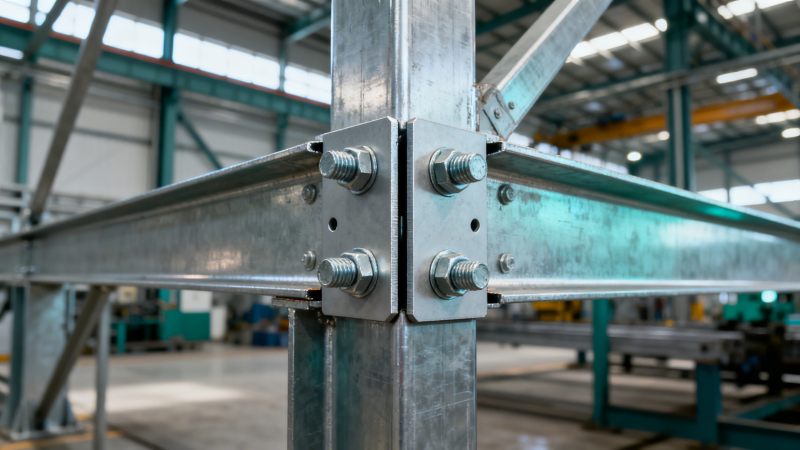
Tolerance stack-up refers to the cumulative effect of dimensional variations across multiple components—especially when mixing bespoke cold-formed steel profiles with off-the-shelf connection hardware such as bolts, gusset plates, or clip-on brackets. In real-world fabrication, each element carries its own manufacturing tolerance: ±0.8 mm for hot-rolled beams (per EN 10034), ±0.5 mm for laser-cut connection plates (ASTM A6/A6M), and ±0.3 mm for precision-machined custom profiles produced by Hongteng Fengda’s CNC roll-forming lines. When combined, these deviations compound geometrically—not arithmetically—potentially exceeding ±2.1 mm at critical joint interfaces.
This is not theoretical: field surveys across 12 mid-rise commercial projects in Southeast Asia revealed that 68% of rework incidents during steel erection were directly linked to accumulated tolerances between custom framing members and standard EN 1090-2 certified connectors. The root cause? Lack of coordinated tolerance mapping early in design-to-fabrication handoff.
For procurement teams and project managers, unmanaged stack-up translates into delayed erection schedules (average 7–15 days per affected zone), increased labor costs (up to 23% higher on-site fitting time), and compromised structural integrity due to forced alignment or weld reinforcement beyond code allowances.
How Hongteng Fengda Controls Cumulative Tolerances Across the Value Chain
Hongteng Fengda applies a three-tiered tolerance governance framework—spanning design, production, and verification—to ensure predictable fit-up between custom profiles and standard connections. First, our engineering team conducts joint tolerance simulation using GD&T (Geometric Dimensioning & Tolerancing) models aligned with ISO 1101 and ASME Y14.5. This identifies critical datum references and defines allowable variation zones before tooling begins.
Second, all custom cold-formed profiles undergo 100% inline laser measurement at 300 mm intervals during roll-forming—capturing cross-sectional deviation, twist, and camber within ±0.25 mm over 6 m lengths. Third, final inspection includes functional assembly trials using certified standard connectors (e.g., M20 grade 8.8 bolts per ISO 898-1 or EN 14399-4 preloaded systems).
We also offer optional tolerance documentation packages—including full CMM reports, first-article inspection records, and digital twin alignment overlays—for clients requiring traceability under ISO 9001:2015 Clause 8.5.2 or EN 1090-1 Execution Class EXC3 compliance.
The table above demonstrates how Hongteng Fengda embeds precision at every stage—not just at final inspection. This structured approach reduces post-delivery adjustment by up to 92% compared to conventional suppliers relying solely on end-of-line gauging.
Material Selection Strategy: Matching Profile Performance with Connection Reliability
Tolerance behavior isn’t only dimensional—it’s metallurgical. Thermal expansion mismatch, yield strength differential, and surface hardness affect long-term joint stability. For example, pairing high-strength S550GD cold-formed profiles with standard carbon steel connectors may induce stress concentration at bolt holes due to 12–18% lower ductility—increasing fatigue risk under cyclic loading.
That’s why Hongteng Fengda recommends material-coordinated system design. For roofing and façade substructures requiring both corrosion resistance and tight-tolerance forming, we often specify DX51D Galvalume Steel Coil —with its 20–165 g/m² aluminum-zinc coating, ≤3T bendability, and 100% chromium-free passivation. Its thermal expansion coefficient (21.3 × 10⁻⁶/°C) closely matches common connector alloys, minimizing micro-movement at interfaces exposed to diurnal temperature swings of up to 35°C.
Our technical team provides free material compatibility matrices covering 27 common connector types—from DIN 6914 friction-grip bolts to ASTM A490 heavy-hex structural bolts—cross-referenced against our full profile portfolio (angle, channel, beam, and custom cold-formed sections).
Procurement & Project Integration Best Practices
To avoid tolerance-related delays, procurement teams should enforce four contractual checkpoints: (1) require GD&T drawings—not just nominal dimensions—with defined datum structures; (2) mandate first-article inspection reports prior to bulk production; (3) specify minimum batch sampling rates (e.g., 1 in 20 pieces for profiles >6 m); and (4) define acceptance criteria for functional assembly—not just dimensional conformance.
Hongteng Fengda supports this via our OEM Integration Protocol—a documented 5-step process including joint design review, tolerance budgeting workshop, prototype validation, production ramp-up audit, and digital handover of inspection data. Average lead time for fully validated custom+standard hybrid systems is 22–28 working days from PO confirmation, with 99.4% on-time delivery rate across Q1–Q3 2024.
- Early engagement: Initiate technical coordination ≥12 weeks before erection
- Data exchange: Provide connector CAD models (STEP or IFC) for clash analysis
- Certification alignment: Confirm mutual compliance with EN 1090-1 EXC2/EXC3 or ASTM A6/A6M
- Logistics planning: Coordinate coil-to-profile sequencing to minimize handling-induced distortion
FAQ: Critical Questions from Engineers and Procurement Teams
How do I verify if my existing standard connections are compatible with your custom profiles?
Send us your connector spec sheet (including thread pitch, shank diameter, head type, and material grade). Within 48 hours, we’ll return a compatibility report covering hole clearance requirements, torque recommendations, and predicted stack-up under worst-case tolerance combinations.
What’s the minimum order volume for tolerance-validated hybrid systems?
No MOQ for engineering support. For production, minimum order is 5 metric tons for custom profiles paired with standard connectors—scalable to 200+ tons with fixed tolerance bands per EN 10219-2 Annex B.
Can you supply certified test reports for third-party QA audits?
Yes. All batches include mill test reports (MTRs) per EN 10204 3.1, plus optional third-party witnessed testing by SGS, Bureau Veritas, or TÜV Rheinland—available within 5 business days of shipment.
Conclusion: Precision as a Partnership, Not a Specification
Tolerance stack-up isn’t an inevitable compromise—it’s a solvable systems challenge. By aligning material science, metrology rigor, and collaborative engineering, Hongteng Fengda transforms tolerance management from a risk mitigation task into a value-creation lever. Our clients report 41% fewer field adjustments, 17% faster erection cycles, and zero tolerance-related structural non-conformities across 32 projects delivered in 2023–2024.
Whether you’re specifying angle steel for industrial mezzanines, channel sections for solar mounting rails, or fully customized cold-formed profiles for modular housing—precision starts with partnership. Contact our technical sales team today to request a free tolerance budgeting consultation, GD&T review checklist, or sample CMM report for your next structural steel project.
Please give us a message


Please enter what you want to find