Selecting high quality 304 stainless steel coil requires more than checking the grade stamp. Real evaluation depends on chemistry, surface finish, thickness accuracy, mechanical stability, corrosion behavior, and document traceability. For structural, industrial, and fabrication use, a clear checklist helps reduce sourcing risk, avoid downgraded material, and confirm that the coil will perform as expected under ASTM, EN, or JIS requirements.
Why a Checklist Matters for 304 Stainless Steel Coil
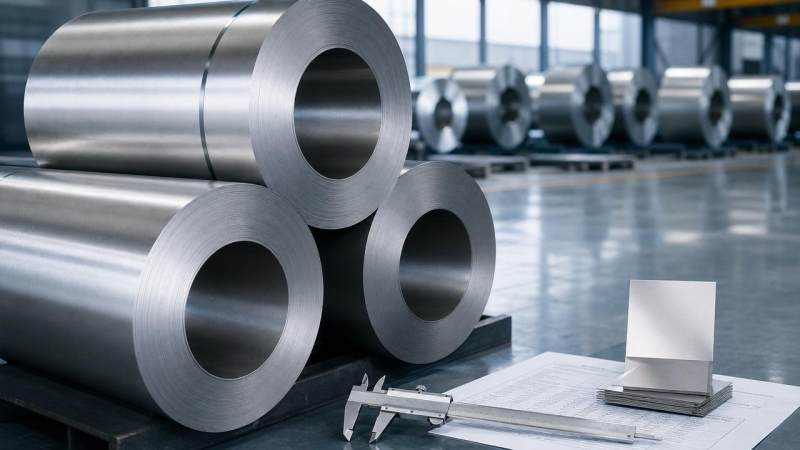
The label “304” alone does not guarantee consistent quality. Different mills may supply material with acceptable grade names but uneven composition control, weak surface protection, or poor flatness.
A checklist creates a practical filter. It helps compare suppliers, verify test reports, and identify whether the offered high quality 304 stainless steel coil is suitable for forming, welding, polishing, or corrosion-sensitive service.
Core Checklist: How to Spot High Quality 304 Stainless Steel Coil
- Verify chemical composition first. Confirm chromium and nickel ranges meet the relevant 304 specification, and check carbon, sulfur, and phosphorus values for consistency with the declared standard.
- Request the mill test certificate. Review heat number, grade, dimensions, tensile data, yield strength, elongation, and standard references before accepting any high quality 304 stainless steel coil.
- Inspect surface finish carefully. Look for uniform 2B, BA, No.1, or No.4 finish, and reject coils showing roller marks, scratches, stains, edge damage, or patchy reflectivity.
- Measure thickness tolerance across several points. Good coil should hold stable gauge across width and length, especially where precision forming or automated processing is required.
- Check width accuracy and edge condition. Mill edge or slit edge should be clean, without burrs, waviness, tearing, or shape defects that affect downstream fabrication.
- Confirm flatness and coil winding quality. A stable coil has even tension, neat wrapping, limited telescoping, and no severe camber that complicates decoiling or leveling.
- Review corrosion resistance expectations. Standard 304 performs well in many indoor, food, and general industrial environments, but chloride-heavy exposure may require tighter evaluation.
- Test magnetic response with caution. Slight magnetism can appear after cold working, so magnet attraction alone cannot determine whether a coil is true 304 stainless steel.
- Examine mechanical properties for the intended process. Deep drawing, bending, stamping, and welding all depend on suitable elongation, hardness, and forming consistency.
- Check packaging and traceability. Protective film, waterproof wrapping, pallet stability, tags, and heat identification all help preserve the coil and support later quality verification.
Key Standards to Review
Ask which standard governs the material. Common references include ASTM A240, EN 10088, and JIS G4305. Equivalent naming does not always mean identical tolerances or finish expectations.
A reliable supplier should explain the exact grade mapping, production route, and inspection basis. This is one of the fastest ways to confirm high quality 304 stainless steel coil rather than a generic substitute.
Practical Inspection Points During Receiving
Visual inspection should begin before uncoiling. Compare tag details with the purchase order, certificate, and packing list. Heat number mismatch is a direct warning sign.
Then inspect the outer wraps, edge condition, and surface cleanliness. Moisture intrusion, rust-like discoloration, oil contamination, or transport dents can reduce usable yield and indicate weak storage control.
In filtration, industrial screening, and architectural support systems, stainless material selection often extends beyond coil. For related corrosion-resistant applications, Stainless Steel Welded Mesh is available in SS 201, 304, 304L, 316, 316L, and 430, with mesh options from 2 to 635 mesh, wire diameter from 0.0008″ to 0.12″, and strong resistance to rust, acid, alkali, heat, and chemicals.
Simple Receiving Checklist
- Match heat numbers on tags, packing lists, and certificates before unloading into stock.
- Measure thickness, width, and inner diameter using calibrated tools, not estimated visual checks.
- Inspect several exposed layers for scratches, stains, pitting, roll marks, and inconsistent finish tone.
- Record photos of packaging, labels, and any defect zones for later claim support.
Application Notes for Different Use Cases
Structural and Fabrication Use
For brackets, covers, formed sections, and light structural components, flatness, thickness tolerance, and weldability matter more than appearance alone. Uneven gauge can distort bending angles and assembly accuracy.
If the coil will be laser cut or cold formed, ask for consistent hardness and elongation. These properties support stable processing and reduce cracking risk at tight bend radii.
Food, Clean Equipment, and Decorative Use
Surface quality becomes critical in visible or hygienic environments. A high quality 304 stainless steel coil for these uses should have uniform finish, easy-clean behavior, and minimal defect density.
Ask whether protective film, polishing compatibility, or specific roughness values are available. Small surface defects become much more obvious after fabrication or reflective finishing.
Chemical and Humid Environments
304 stainless steel performs well in many general corrosive settings, but not every chemical condition is equal. Chlorides, marine exposure, and concentrated cleaners may accelerate pitting or crevice attack.
When exposure is aggressive, compare 304 with 304L or 316 options. Quality selection should be based on service environment, not only on price or stock availability.
Commonly Overlooked Risks
Mixed-grade substitution: Some offers describe “304 equivalent” without listing the exact standard. Always request precise grade designation and certificate evidence before confirming the order.
Surface-only evaluation: Bright appearance does not prove internal quality. Chemistry, tensile values, and tolerance control are essential when identifying high quality 304 stainless steel coil.
Ignoring edge defects: Burrs and slit cracks often create failures during stamping, roll forming, or automated feeding. Edge quality should be part of every inspection routine.
Overlooking storage history: Poor warehousing can introduce contamination, water marks, or handling dents even when the original mill quality was acceptable.
Actionable Buying Tips
- Define the exact standard, finish, tolerance, and end use in the inquiry.
- Request sample photos, MTC copies, and inspection records before production or shipment.
- Compare not only price per ton, but also usable yield, defect rate, and processing stability.
- Use trial orders when changing source, especially for polished, formed, or corrosion-sensitive applications.
Hongteng Fengda, a structural steel manufacturer and exporter from China, supports global projects with reliable steel products, customized solutions, and strict quality control aligned with major international standards.
From standard steel sections to corrosion-resistant materials for industrial use, stable production capacity and dependable lead times help reduce sourcing uncertainty and improve project execution.
Conclusion
To identify high quality 304 stainless steel coil, check the material from four angles: verified chemistry, controlled dimensions, sound surface condition, and complete traceability. Then match those results to the real service environment.
A disciplined checklist turns stainless steel sourcing into a measurable process. Start with standards, inspect critical details, document findings, and confirm performance before scaling the order.
Please give us a message


Please enter what you want to find