Understanding galvanized steel sheet specifications is essential when comparing material quality, coating weight, thickness, and application suitability. Whether you are sourcing for construction, industrial fabrication, or manufacturing, reading these specifications correctly helps reduce purchasing risks and avoid costly mistakes. This guide explains the key terms and standards buyers should know before selecting galvanized steel sheet products.
What buyers really need to understand before reading a spec sheet
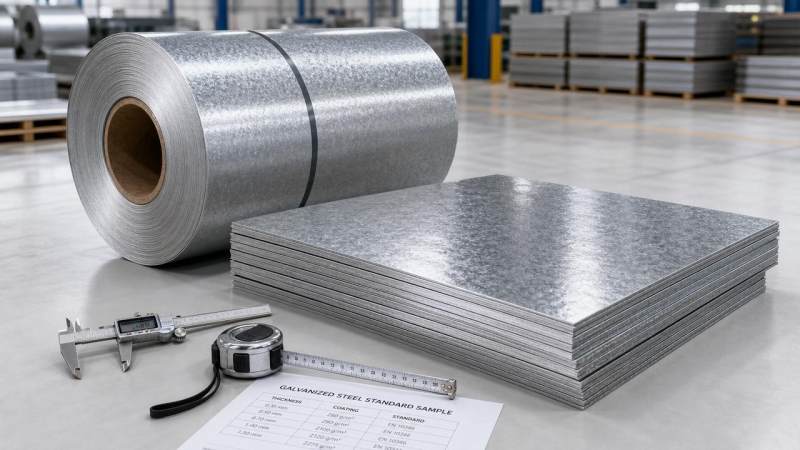
When people search for galvanized steel sheet specifications, they usually want more than definitions. They want to know how to compare offers, verify quality, and avoid ordering material that does not match the project.
The key point is simple: a specification sheet is not just a product description. It is a decision tool that tells you the steel grade, base thickness, zinc coating, width tolerance, standard, and intended use.
If you can read those items correctly, you can quickly judge whether two quotations are truly comparable. If you cannot, the lowest price may hide thinner steel, lower coating mass, or a different standard.
For information researchers, this matters because galvanized sheet is used across roofing, wall systems, ducts, cabinets, equipment housings, and fabricated parts. Small specification differences often create large differences in corrosion life, forming performance, and total cost.
Start with the most important line: standard, grade, and product type
The first thing to check in galvanized steel sheet specifications is the governing standard. Common references include ASTM, EN, JIS, and GB. The same sheet may look similar, but standard differences can change requirements significantly.
For example, one supplier may quote ASTM A653, another EN 10346, and another a local equivalent. These standards may define coating designation, mechanical properties, chemical composition, tolerances, or testing methods in different ways.
Next, identify the steel grade. The grade indicates the base steel’s strength and formability. Some grades are intended for general forming, while others are made for structural performance or deeper drawing applications.
Then confirm the product type. Galvanized sheet may be hot-dip galvanized, electro-galvanized, corrugated, plain, coil, or cut sheet. If the format is not clearly stated, buyers may compare products that are not functionally equivalent.
In practical sourcing, a complete first line often includes standard, steel grade, coating designation, thickness, width, and finish. If any of those are missing, ask for a revised technical offer before making decisions.
How to read thickness correctly and avoid one common pricing mistake
Thickness is one of the most misunderstood items in galvanized steel sheet specifications. Buyers should confirm whether the quoted thickness refers to base metal thickness or total thickness including the zinc coating.
In many markets, suppliers quote base metal thickness because coating thickness is relatively small. However, some commercial offers are less clear, especially in cross-border trade. That can create confusion when comparing weight, price, and performance.
For example, a 0.50 mm sheet is not always directly comparable to another 0.50 mm offer unless both refer to the same measurement basis. A small difference can affect stiffness, yield strength in use, and actual metal content per square meter.
You should also review thickness tolerance. A standard-compliant product may legally vary within a certain range. If a buyer only checks nominal thickness but ignores tolerance, the received material may still feel different from expectations.
For industrial users, thickness also affects forming behavior. Thinner sheets may save cost, but they can reduce dent resistance, load capacity, or service life depending on the application. A lower price is not a better value if performance drops.
Why zinc coating weight matters more than many first-time buyers expect
After thickness, the next critical item is coating weight or coating mass. This is central to understanding galvanized steel sheet specifications because the zinc layer largely determines corrosion resistance in actual service conditions.
Coating is often shown as a designation such as Z120, Z180, Z275, G60, or G90, depending on the standard system used. These numbers indicate the mass of zinc coating per square meter or per square foot.
Higher coating weight generally means better corrosion protection, especially in outdoor, humid, coastal, or industrial environments. However, higher coating also affects cost, and not every application requires the maximum available level.
A common buying mistake is comparing a cheaper low-coating sheet with a higher-coated offer without noticing the difference. On paper they may both be called galvanized steel sheet, but their expected service lives may be very different.
Buyers should also clarify whether the coating value is total both sides or one side. Most standard designations refer to total coating mass on both surfaces, but assumptions should never replace direct confirmation in procurement.
Surface finish, spangle, and treatment: details that affect fabrication and appearance
Many buyers focus on thickness and zinc only, but surface finish also deserves attention. Galvanized steel sheet specifications often include terms such as regular spangle, minimized spangle, zero spangle, chromated, oiled, dry, or passivated.
Spangle refers to the visible crystallized pattern formed during galvanizing. For purely functional uses, spangle may not matter much. For visible panels, appliances, or painted parts, finish consistency can be important.
Surface treatment matters for storage and downstream processing. Oiled surfaces may help reduce temporary staining during transport. Passivation can improve short-term protection. For painting, the pretreatment requirement should be checked in advance.
If the sheet will be bent, stamped, or welded, finish and treatment may also influence fabrication results. A material that looks acceptable in inventory may not perform well if the downstream process requirements were not reviewed first.
These details are especially important when buyers source for manufacturing rather than simple resale. The right finish can reduce rework, improve product appearance, and make later coating or assembly processes more stable.
Mechanical properties: when strength and formability become the deciding factor
Not every galvanized sheet is selected mainly for corrosion resistance. In many applications, the base steel’s mechanical properties are equally important. That is why good galvanized steel sheet specifications include yield strength, tensile strength, and elongation.
For general construction or cladding, standard commercial quality may be sufficient. For cold forming, deep drawing, or precision fabrication, buyers often need better ductility and more tightly controlled properties.
If the material will be profiled, punched, folded, or stamped, insufficient elongation can lead to cracking or surface damage. In those cases, focusing only on coating designation without checking formability is risky.
Likewise, if the sheet is used in load-bearing or semi-structural parts, a stronger grade may be necessary. The correct grade depends on the application, not just on what is cheapest or most commonly stocked.
Experienced suppliers usually help buyers match grade selection with end use. This matters across international sourcing, where standards vary and one grade name does not always mean identical performance under another system.
Dimensional tolerances, coil weight, and flatness: the practical details that affect production
In real purchasing, operational details often matter as much as basic material properties. Galvanized steel sheet specifications should include width tolerance, length tolerance for cut sheets, flatness, camber, and sometimes coil inner diameter and coil weight.
These factors influence how efficiently the material can be processed. A sheet that meets strength and coating requirements may still create waste or machine issues if flatness is poor or width variation exceeds the line’s tolerance.
For exporters and global buyers, packaging and delivery form also matter. Ask whether the product will be shipped in coil, sheet, slit coil, or custom cut size. That affects logistics, handling, and internal production planning.
Even buyers focused on galvanized sheet may compare it with other steel products used in adjacent applications. For example, anti-slip flooring may require patterned plate rather than galvanized flat sheet in certain industrial areas.
In such cases, a product like S335JR Patterned steel plate may be more suitable for transportation, machinery platforms, shipbuilding access areas, or floors around equipment where anti-skid performance is required.
Its typical parameters include thickness from 2 to 8 mm, width from 600 to 1800 mm, length from 2 to 12 m, and patterned height not less than 0.2 times substrate thickness, with support for ASTM, DIN, JIS, BS, GB/T, and ISO-related requirements.
How to compare international standards without making false one-to-one assumptions
One of the hardest parts of reading galvanized steel sheet specifications is comparing products across regions. Suppliers in different countries may quote according to ASTM, EN, JIS, or GB, and direct equivalence is not always exact.
Buyers should avoid assuming that similar numbers automatically mean the same chemistry, coating, or mechanical range. Instead, ask suppliers to provide standard references, equivalent grade explanations, and full technical data sheets.
This is especially important for importers managing multiple markets. A product accepted in one region may need different compliance documents in another. Certification, test reports, and mill inspection documents should be reviewed early.
Professional manufacturers serving export markets usually support this process by aligning products with major international standards and by explaining differences clearly. That reduces sourcing risk and shortens technical clarification cycles.
For construction, manufacturing, and industrial buyers, working with a supplier that understands cross-standard communication can save time and prevent disputes after shipment, especially when custom processing or OEM supply is involved.
A practical checklist for reading galvanized steel sheet specifications before ordering
To make faster and safer decisions, buyers can use a simple review sequence. First, confirm the applicable standard. Second, verify steel grade. Third, check base thickness and tolerance. Fourth, confirm zinc coating designation and test basis.
Fifth, review width, length, coil weight, and dimensional tolerances. Sixth, check surface finish and treatment. Seventh, confirm mechanical properties if forming or structural performance matters. Eighth, ask for testing and certification documents.
Ninth, compare packaging, delivery condition, and lead time. Tenth, confirm the exact end-use application with the supplier. A sheet suitable for dry indoor fabrication may not be suitable for a coastal exterior application.
This checklist helps buyers move from generic inquiry to technically comparable procurement. It also makes supplier quotations easier to evaluate because each offer can be measured against the same specification framework.
For information researchers, this approach gives a clear way to understand value. The best offer is not simply the cheapest sheet, but the one that matches the application, expected life, fabrication needs, and compliance requirements.
Final takeaway
Reading galvanized steel sheet specifications correctly means understanding how standard, grade, thickness, coating weight, finish, tolerance, and mechanical performance work together. Each item affects quality, usability, and long-term cost.
If you only compare price, you may overlook major differences in corrosion resistance or fabrication suitability. If you compare the full specification, you can identify the right material faster and reduce sourcing mistakes.
For buyers in construction, industrial fabrication, and manufacturing, that knowledge leads to better supplier discussions, more accurate quotations, and stronger purchasing decisions. In short, specifications are where product value becomes visible.
Before placing an order, always ask one final question: does this exact specification fit the real service environment and processing requirement? If the answer is clear, you are already sourcing more professionally than many competitors.
Please give us a message


Please enter what you want to find