How to read 12-inch I-beam weight per foot in a W designation
Searching for “12 i beam weight per foot” can be confusing because a 12-inch nominal beam depth does not identify a single weight. For wide-flange steel beams, the W designation provides the key: W12×26 indicates a nominal 12-inch depth and a nominal weight of 26 pounds per linear foot. Actual dimensions vary by section, so depth alone is not enough for sourcing or estimating. This guide explains how to read W designations, check published section data, and calculate beam weight for material planning and purchasing.
The distinction matters before any price comparison begins. Two suppliers can both offer a “12-inch beam” while quoting different sections, different weights, and different connection dimensions. Neither quotation is necessarily wrong; the description is simply incomplete.
The number after the multiplication sign is the weight
In the US customary designation W12×26, each part has a specific meaning:
- W identifies a wide-flange structural shape.
- 12 identifies the nominal depth family in inches.
- 26 identifies the nominal weight in pounds per linear foot, commonly written as lb/ft.
The final number is not flange width, thickness, steel grade, or allowable load. It is also not the weight of the complete beam unless that beam is one foot long. A 20-foot W12×26 has a nominal section weight of 520 pounds before plates, bolts, coatings, or other additions are considered.
You may see the same section written as W12x26 in drawings or spreadsheets. The lowercase “x” is a practical substitute for the multiplication sign, not a different designation. However, confirm the unit system: metric section labels use different numerical values, and a number expressed in kg/m must not be read as lb/ft.
Why “I-beam” needs clarification
“I-beam” is often used casually for several I-shaped steel sections. In formal US shape nomenclature, a W shape is a wide-flange beam, while an S shape is an American Standard beam. Their flange geometry and section properties differ. A welded I-section is another possibility and may be specified by dimensions rather than a standard rolled-shape designation.
If a drawing calls for a W section, a similarly deep S section or fabricated beam is not automatically an acceptable replacement. Match the section family first, then the complete designation.
A W12 is a depth family, not one physical size
The “12” is nominal. It does not promise that every W12 section measures exactly 12.000 inches from the outside of one flange to the outside of the other. Actual depth, flange width, web thickness, and flange thickness vary within the family.
That variation explains why there is no single answer to “How much does a 12-inch I-beam weigh?” The following examples illustrate how the designation itself supplies the nominal unit weight.
These are examples, not a complete W12 availability list. Published dimensions and section properties should be checked in the AISC Shapes Database or the applicable steel construction manual. Supplier stock availability is a separate question.
A cross-section drawing makes the distinction easier to see: depth is measured vertically across the section, flange width across the horizontal plates, and web thickness through the central vertical element.
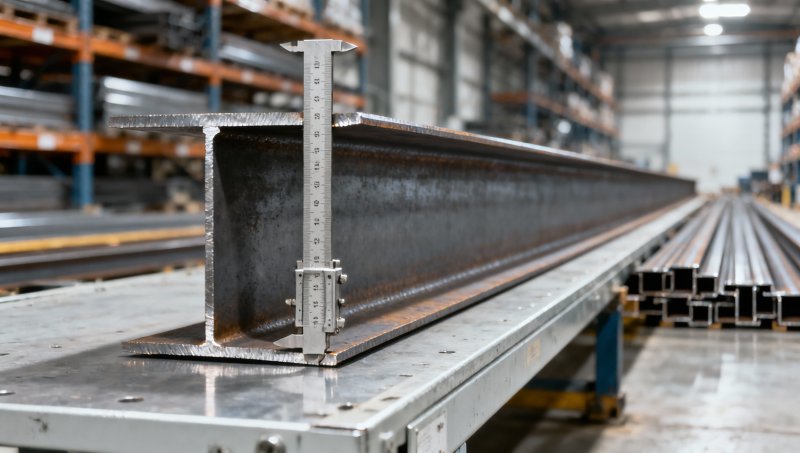
For connection detailing, those dimensions can matter as much as weight. A flange-width difference may change a plate layout; a depth difference may affect clearance. Ordering by nominal depth alone leaves these issues unresolved.
Read the section-table row, not just the beam name
Once the designation is known, locate its exact row in a recognized section table. The dimensions commonly shown include d for actual depth, bf for flange width, tw for web thickness, and tf for flange thickness. Check the table legend because symbols and units can vary between publications.
The row also contains cross-sectional area and engineering properties such as moments of inertia and section moduli. These describe how material is distributed around the section, which is why equal depth does not imply equal bending performance.
For estimating, nominal weight and length may be sufficient. For fabrication, actual dimensions and detailing clearances are needed. For structural approval, the engineer needs section properties, material grade, loading, and restraint conditions. Those are three different tasks; a weight chart only completes the first.
Also distinguish the shape designation from the material specification. W12×26 identifies geometry and nominal weight, but it does not independently establish ASTM A992, ASTM A36, or another grade. The specified grade must appear separately in the project documents and be verified through the required material records.
Calculate piece weight without mixing units
For a straight, unmodified section, the estimating calculation is simple:
Nominal piece weight = nominal weight per unit length × beam length
Consider an illustrative order of eight W12×26 beams, each 30 feet long. One beam weighs nominally 26 × 30 = 780 pounds. Eight beams total 6,240 pounds, or approximately 2,830 kilograms. This is a calculation example, not a shipment record.
For metric planning, use 1 lb/ft ≈ 1.48816 kg/m. A W12×26 therefore corresponds to approximately 38.69 kg/m. A 9-meter piece weighs nominally about 348 kilograms. Do not combine 26 lb/ft directly with a length in meters; convert one side first.
Use the actual ordered length rather than a rounded estimate. Thirty feet is 9.144 meters, not 9 meters. Across many pieces, seemingly minor length assumptions can create a noticeable difference in the material total.
Theoretical weight is not necessarily shipping weight
Multiplying the designation weight by length gives a nominal bare-section estimate. Fabricated assemblies can include end plates, stiffeners, brackets, weld metal, and coatings. Cutting and drilling can remove material, while packaging and transport supports add shipment weight.
Rolled products also have permitted dimensional and mass variations under their governing requirements. Do not invent a universal tolerance percentage. Check the applicable specification and agree whether invoicing uses theoretical weight, measured weight, or another stated basis.
For lifting plans, use verified assembly weights and an approved lifting procedure. A section-table calculation is useful for early planning, but it is not a substitute for confirming the item actually being lifted.
Weight does not tell you the allowable span
A heavier W12 generally contains more steel, but that does not produce a universal safe-load or span rating. Performance depends on bending direction, support conditions, lateral bracing, load distribution, steel grade, deflection limits, and connection behavior.
A beam supporting a uniformly distributed floor load is not the same problem as one carrying a concentrated machine load. Even when strength is adequate, deflection or vibration may govern. Lateral-torsional buckling can also limit an insufficiently braced member.
Treat weight as a material-planning parameter, not a design approval. If the specified section is unavailable, an alternative should be reviewed by the responsible engineer rather than chosen solely because its pounds-per-foot figure is higher.
Keep cross-border descriptions precise
International sourcing adds another source of confusion: a supplier may offer an EN, JIS, or GB section with a depth close to the requested W shape. Similar depth and weight do not establish equivalence. Flange proportions, section properties, tolerances, and material requirements still need comparison.
For Hongteng Fengda, a China-based structural steel manufacturer and exporter supplying beams, angles, channels, cold-formed profiles, and customized components, a useful inquiry starts with the full section designation and governing standard. Its international supply scope makes the distinction between shape standard, material grade, and inspection documentation particularly relevant. Referencing ASTM, EN, JIS, or GB alone is not enough; identify the applicable specification and edition where required.
Keep separate product forms separate in the material schedule, too. A project may need structural beams for its frame and 430 Stainless Steel Coil for kitchen panels or decorative components. The latter is specified by stainless grade, thickness, width, and finish—such as 2B or No. 4—not by a W designation. Its corrosion exposure and forming requirements need their own review; it is not a substitute for a structural beam.
Before comparing quotations, confirm the complete section, grade, piece count, cut lengths, fabrication requirements, inspection documents, and weight basis. Then confirm availability and delivery timing for that exact specification rather than for a generic “12-inch beam.”
The practical answer is straightforward: in W12×26, read 26 as the nominal pounds per foot and 12 as the nominal depth family. Use the published section row to verify dimensions, multiply by the correct length for estimating, and keep structural suitability and shipping weight as separate checks.
Please give us a message


Please enter what you want to find