Choosing the right high carbon steel wire for spring making is critical for technical evaluators who need consistent strength, fatigue resistance, and processing stability. This guide explains how to judge material quality through chemical composition, mechanical performance, surface condition, dimensional accuracy, and compliance with international standards, helping buyers reduce risk and select reliable steel wire for demanding spring applications.
What technical evaluators are really judging when selecting spring wire
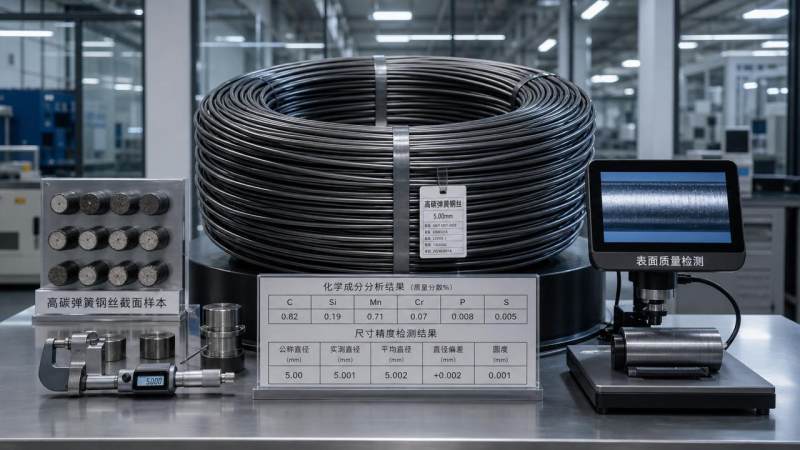
When buyers search for high carbon steel wire for spring making, they usually do not need a basic definition. They need a reliable evaluation method.
The core question is simple: can this wire deliver repeatable spring performance without causing failures during coiling, heat treatment, or end use?
For technical evaluators, that means looking beyond price and nominal grade. A suitable wire must combine proper chemistry, stable tensile properties, clean surface quality, and controlled dimensional accuracy.
In practical sourcing, the best wire is not always the hardest or the strongest. It is the wire that performs consistently under forming and cyclic loading.
If the material looks acceptable on paper but varies from coil to coil, spring production efficiency drops. Scrap rates rise, tool wear increases, and downstream risk becomes harder to control.
So the right judgment framework should focus on performance reliability, process compatibility, and standard compliance rather than only mill claims or generic certificates.
Start with the material grade and chemical composition
The first step in judging high carbon steel wire for spring making is confirming whether the selected grade matches the target spring application.
High carbon spring wire commonly relies on controlled carbon content to achieve the required hardness, strength, and elastic recovery after processing and heat treatment.
In many cases, carbon content around medium-high to high ranges supports spring performance, but carbon alone is not enough for technical evaluation.
Manganese, silicon, phosphorus, sulfur, and sometimes chromium also affect hardenability, strength consistency, surface quality, and fatigue behavior.
Technical evaluators should pay close attention to phosphorus and sulfur limits. Excessive levels can reduce ductility and increase the risk of cracking during forming.
Chemical composition should be reviewed against the relevant standard, such as ASTM, EN, JIS, or GB, depending on the customer market and application requirements.
A good supplier should provide a mill test certificate with heat number traceability, not just a general statement that the wire is “spring steel.”
If the spring will work in dynamic, high-cycle, or safety-related conditions, tighter chemistry control is usually more valuable than broad grade naming.
Check tensile strength, ductility, and reduction of area together
Many buyers focus first on tensile strength, but spring wire evaluation should never stop there. A single strength value does not tell the full forming story.
High tensile strength is important because springs need load-bearing capacity and elastic recovery. However, wire that is too brittle may fail during coiling.
That is why elongation and reduction of area should also be checked. These indicators show whether the wire still has enough formability for manufacturing.
For technical teams, the ideal property window depends on spring type, diameter, coiling method, and post-forming heat treatment route.
Ask whether the tensile values are average numbers, guaranteed ranges, or tested coil by coil. Process stability depends on variation control, not just peak performance.
Large property fluctuations between batches can lead to inconsistent springback, setup adjustments, and non-uniform finished spring behavior.
It is also useful to confirm whether the supplier can provide torsion test results, wrap test data, or reverse bend performance where relevant.
These tests often reveal brittleness or internal quality problems that may not be obvious from tensile strength figures alone.
Surface condition is a major predictor of fatigue life
For springs, surface quality directly affects fatigue resistance. Small defects often become the starting points for crack initiation under repeated stress cycles.
That means evaluators should inspect the wire for seams, laps, scratches, rust, pits, scale, decarburization, and drawing marks.
Even if the wire meets nominal strength requirements, poor surface condition can shorten service life and create unexpected field failures.
Surface cleanliness also influences lubrication, coiling smoothness, and heat treatment response during production.
A high-quality spring wire should show a uniform finish, without obvious surface discontinuities that can concentrate stress.
For critical applications, visual inspection should be supported by metallographic examination, eddy current testing, or other non-destructive checks where appropriate.
Technical evaluators should also ask how the supplier controls pickling, drawing, cleaning, and storage conditions, because these steps influence final surface integrity.
If the wire arrives with oxidation or mechanical damage from poor packaging, the real production cost can become much higher than the purchase price suggests.
Dimensional accuracy and roundness matter more than many buyers expect
Spring making requires wire with stable diameter, good roundness, and controlled coil consistency. These factors strongly affect machine setup and final product uniformity.
If the wire diameter varies too much, spring index, pitch control, and load consistency may all shift during production.
Poor roundness can create uneven stress distribution in the finished spring and may also reduce coiling efficiency on automatic equipment.
Ask for dimensional tolerance standards and actual inspection records, not only a nominal size declaration.
For small-diameter spring wire in precision uses, even minor dimensional variation may produce measurable differences in spring rate and fatigue performance.
Coil cast and helix condition should also be considered, especially in high-speed spring manufacturing lines where feed stability matters.
If possible, request sample coils for trial production. This often reveals issues that cannot be fully understood from certificates alone.
A technically acceptable wire should run smoothly, maintain consistent forming behavior, and support predictable finished spring dimensions across the batch.
Do not overlook decarburization and microstructure control
One of the most important hidden quality factors in high carbon steel wire for spring making is decarburization.
Excessive decarburization weakens the surface layer, reduces fatigue strength, and can compromise spring performance even when bulk tensile strength appears acceptable.
For this reason, technical evaluators should request decarburization limits and test methods, especially for springs exposed to repeated loading.
Microstructure is equally important. A uniform, well-controlled pearlitic structure generally supports better drawability and performance consistency in carbon steel spring wire.
Abnormal structures, segregation, or inconsistent heat treatment history can create unpredictable behavior during forming and service.
Metallographic review is especially valuable for demanding applications, large procurement volumes, or new supplier qualification.
If a supplier cannot explain how it controls rod quality, patenting, drawing, and final inspection, buyers should treat consistency claims with caution.
In spring wire evaluation, many failures start from metallurgical details that are not visible in a simple sales quotation.
Standards, traceability, and test documentation reduce sourcing risk
Technical evaluators often work under quality systems that require objective evidence. That is why standards compliance and traceability are essential.
The supplier should clearly state which international or regional standard the wire follows, such as ASTM, EN, JIS, or GB.
More importantly, documentation should match the supplied batch. Generic certificates with no heat or coil traceability offer limited practical value.
At a minimum, buyers should request chemical composition, tensile properties, diameter tolerance, and inspection results tied to the delivered material.
For critical spring uses, it is wise to define additional acceptance items in the purchase specification, including decarburization, surface quality, and fatigue-related checks.
This approach helps avoid disputes later, because both supplier and buyer judge the material using the same measurable criteria.
Reliable exporters with modern quality control systems are usually better positioned to support such documentation and repeatability across international shipments.
For global procurement teams, that consistency is often as important as the wire’s nominal technical grade.
How to compare suppliers beyond the basic quotation
When several suppliers offer similar high carbon steel wire for spring making, the real difference often appears in process control rather than in headline specifications.
Technical evaluators should compare raw material sourcing, wire drawing capability, heat treatment control, inspection frequency, packaging quality, and complaint response mechanisms.
Ask whether the supplier can support customized tolerances, mechanical property windows, or packaging formats that fit your production line.
It is also useful to review previous export experience and familiarity with destination market standards.
A supplier serving multiple international markets is often better prepared to align with customer documentation, testing expectations, and delivery discipline.
Stable lead time matters too. In spring production, quality problems are costly, but delayed replacement material can be equally disruptive.
Manufacturers with strict quality systems and reliable production planning can help buyers reduce total sourcing risk, not just unit price.
That is especially relevant for industrial buyers who need long-term consistency instead of one-time spot purchases.
A useful mid-project reference: when galvanized wire is the right alternative
Although spring applications often require high carbon material, technical evaluators may also handle adjacent wire sourcing needs for packaging, mesh, barriers, or general industrial use.
In those cases, a corrosion-resistant low carbon option may be more appropriate than spring-grade wire, especially where flexibility and surface protection are prioritized.
For example, Steel Wire Galvanized is available in Q195 and Q235 low carbon steel grades for construction, handicrafts, wire mesh, packaging, decoration, industry, breeding, and barrier isolation.
Typical diameter ranges from 0.25 mm to 5.0 mm, with zinc coating thickness of 8 to 25 g/m2 and tensile strength around 350 to 550 MPa.
Its advantages include good corrosion resistance, strong flexibility, smooth surface appearance, and lower production cost compared with hot-dip galvanized alternatives.
For technical teams, this is a reminder that correct wire selection always depends on service conditions. Not every project needs spring-grade high carbon wire.
Matching the wire type to the actual load, forming, and exposure environment is one of the most effective ways to control both cost and performance risk.
A practical checklist for final evaluation before purchase approval
Before approving a supplier, technical evaluators should use a structured checklist rather than relying on isolated data points.
First, confirm the grade, chemical composition range, and applicable standard. Second, verify tensile strength together with ductility-related indicators.
Third, inspect or request evidence for surface quality, including freedom from seams, scratches, rust, and harmful defects.
Fourth, review dimensional tolerance, roundness, and coil consistency. Fifth, confirm decarburization limits and microstructure suitability if the application is demanding.
Sixth, check documentation traceability, test method clarity, and whether the reported values are batch-specific.
Seventh, if possible, perform a forming trial under actual spring production conditions. This is often the most practical validation step.
Finally, assess the supplier’s responsiveness, customization ability, and quality consistency across repeat orders, not just the first sample coil.
This evaluation sequence helps transform sourcing from a price comparison exercise into a controlled technical decision.
Conclusion
To judge high carbon steel wire for spring making effectively, technical evaluators should focus on the factors that directly affect spring reliability and manufacturability.
These include chemical composition, tensile and ductility balance, surface integrity, dimensional precision, decarburization control, and verifiable standards compliance.
The best choice is not the wire with the most impressive single number, but the one that delivers stable, repeatable performance throughout forming and service.
By applying a disciplined evaluation method and working with suppliers that offer strong quality control and traceable documentation, buyers can reduce defects, improve production consistency, and lower long-term sourcing risk.
For teams responsible for industrial steel procurement, this is the most practical way to judge whether a spring wire offer is truly fit for purpose.
Please give us a message


Please enter what you want to find