Repairing weld defects in heavy-duty H-beam structures is not a simple matter of melting additional filler metal into a void. For maintenance engineers, the immediate instinct is to restore load-bearing capacity quickly. However, a haphazard repair on thick-section structural steel can introduce severe residual stresses, hydrogen-induced cracking, or brittle fracture in the heat-affected zone (HAZ). The fundamental rule of repairing heavy-duty H-beams is that the repair process must be treated as a controlled metallurgical event, not just a mechanical patch. Before any arc is struck, the defect must be fully characterized, and the repair procedure must be engineered to manage heat input and cooling rates.
Defect Characterization and Repairability Assessment
Visual inspection is insufficient for evaluating weld flaws in heavy structural members. The first step is to determine the exact nature, depth, and orientation of the defect using Non-Destructive Testing (NDT). Ultrasonic Testing (UT) is typically required for internal volumetric defects like lack of fusion or slag inclusions, while Magnetic Particle Testing (MT) or Penetrant Testing (PT) is used for surface-breaking flaws.
Understanding the root cause of the defect dictates the repair strategy. If the flaw is a cold crack, the underlying issue likely involves excessive joint restraint, high diffusible hydrogen, or a brittle microstructure in the HAZ. Simply gouging out and re-welding a cold crack without addressing the thermal and metallurgical conditions will almost certainly result in the crack reappearing.
Engineers must also verify the base metal specification. Heavy-duty H-beams are frequently manufactured from high-strength low-alloy (HSLA) steels, such as ASTM A572 Grade 50 or Q345. Calculating the carbon equivalent (CE) of the specific heat of steel is critical. A higher CE indicates greater hardenability, meaning the steel is more susceptible to forming brittle martensite in the HAZ during the rapid cooling that follows welding. This calculation directly determines the mandatory preheat and interpass temperatures for the repair.
Defect Removal and Joint Preparation
Once the defect is mapped, it must be completely removed. For thick-section H-beams, carbon arc gouging is the most efficient method. The gouging process must be carefully controlled to avoid damaging the adjacent base metal. The arc should not be held in one place, and the gouge must extend beyond the visible ends of the defect to ensure complete removal.
A critical and often overlooked step follows carbon arc gouging: the removal of the carburized layer. The carbon arc process leaves a thin, hard, high-carbon layer on the surface of the gouge. If welding is performed directly over this layer, the excess carbon will be drawn into the weld pool, leading to severe porosity and solidification cracking. The entire gouged area must be mechanically ground to bright, clean metal before any welding begins.
The prepared groove must also be shaped correctly. A smooth U-shaped or shallow V-shaped profile is required. Sharp corners or abrupt transitions at the toes of the gouge act as stress concentrators and can initiate new cracks under cyclic loading. The blend into the base metal must be gradual and smooth.
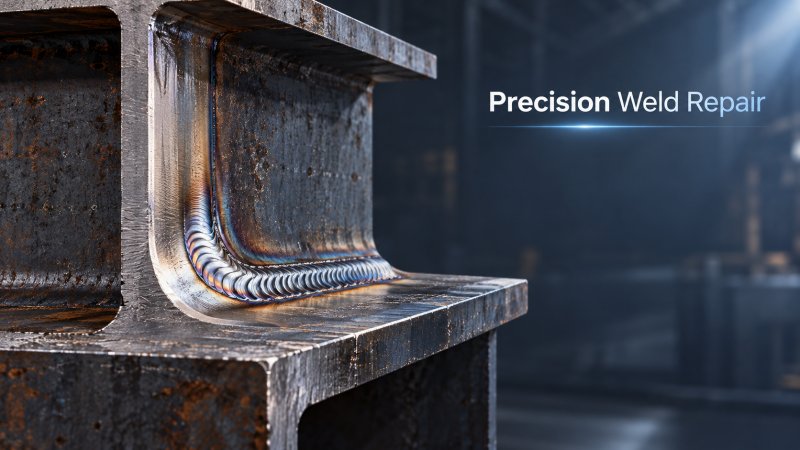
Thermal Management During Repair Welding
Thermal management is where most field repairs fail. Thick H-beam sections act as massive heat sinks, drawing heat away from the weld zone rapidly. Without proper thermal control, the HAZ cools too quickly, trapping hydrogen and forming brittle microstructures.
Preheating is non-negotiable for heavy-duty sections. The primary purpose of preheat is to slow the cooling rate after welding. This slower cooling allows hydrogen to diffuse out of the weld metal before it can cause cracking, and it promotes the formation of tougher microstructures like bainite or fine pearlite instead of martensite. The exact preheat temperature must be derived from the steel’s carbon equivalent, the thickness of the thickest part being joined, and the ambient temperature, strictly following recognized codes such as AWS D1.1.
Interpass temperature must be monitored continuously using temperature-indicating crayons or contact pyrometers. Allowing the temperature to drop below the minimum preheat requirement between passes invites cracking. Conversely, exceeding the maximum interpass temperature can degrade the toughness of the base metal in the HAZ through excessive grain growth.
Heat input during the welding process must also be strictly controlled. Using a stringer bead technique rather than wide weave beads helps manage the volume of the weld pool and limits the total heat input. Keeping the heat input within the qualified range prevents the HAZ from becoming overly coarse and brittle.
Filler Metal Selection and Welding Technique
When selecting filler metal for a repair, the goal is to match the toughness and ductility of the base metal, not necessarily just the tensile strength. In many heavy-duty repair scenarios, using a slightly lower-strength but highly tough filler metal is advantageous. This allows the weld metal to yield slightly and absorb residual stresses without cracking.
Low-hydrogen consumables are mandatory for repairing HSLA H-beams. These electrodes or wires must be baked according to the manufacturer's specifications to drive out moisture and stored in holding ovens at the required temperature until the moment of use. Exposing low-hydrogen electrodes to ambient air for extended periods defeats their purpose and reintroduces the risk of hydrogen-induced cracking.
The welding technique requires discipline. Start and stop points of the weld beads are highly vulnerable to defects. Ensure proper fusion at the toes of the weld and the junction of successive passes. If a crater crack forms at the end of a pass, it must be completely ground out before depositing the next layer. Grinding between passes also removes any slag entrapment and provides a clean surface for the subsequent bead.
Post-Weld Treatment and Broader Structural Context
After the final pass is completed, the thermal management process is not over. For thick, highly restrained H-beam joints, immediate post-heating (dehydrogenation treatment) is often required. Holding the joint at a specific temperature (typically between 200°C and 250°C) for a calculated duration based on the thickness allows any remaining residual hydrogen to escape the weld metal.
Following post-heating, the joint must be allowed to cool slowly to room temperature, often insulated with thermal blankets. Performing final NDT while the weld is still warm can yield false indications or miss delayed hydrogen cracking, which can take 24 to 48 hours to manifest. Final UT or MT should only be conducted after the joint has fully cooled and the waiting period has elapsed.
When maintaining heavy-duty H-beam structures, the scope of repair often extends beyond the steel members themselves. If the repaired H-beam is part of a larger framework anchored to civil engineering foundations, the integrity of the concrete base and its reinforcement must be verified. In such foundation repair or auxiliary structural support scenarios, utilizing high-quality Wire rod for rebar tying and structural reinforcement ensures the underlying support system remains as robust as the steel superstructure. The connection between the steel framework and its civil foundation is a critical load-transfer point, and neglecting the base materials can render a perfect steel repair useless.
Final Verification and Documentation
A repair is only as good as its verification. Comprehensive documentation is required for liability, quality assurance, and future maintenance planning. The file should include the initial NDT reports detailing the defect, the approved Welding Procedure Specification (WPS) used for the repair, preheat and interpass temperature logs, filler metal batch numbers, and the final NDT reports confirming the defect's removal and the soundness of the repair weld.
Restoring the structural integrity of a heavy-duty H-beam requires more than just filling a gap. It demands a systematic approach that respects the metallurgical behavior of the steel, controls the thermal history of the joint, and rigorously verifies the final result. By adhering to these engineering principles, maintenance teams can ensure the repaired structure performs safely under its design loads for the remainder of its operational life.
Please give us a message


Please enter what you want to find