Choosing the right Steel Beam for construction depends on more than section size or unit weight. Load and span tables are the working reference that shows whether a beam can safely carry design loads across a given distance.
For project review, these tables help compare options before ordering, fabrication, or approval. They also reduce the risk of selecting a member that looks suitable on paper but fails serviceability or strength checks in actual use.
In structural steel procurement, especially across international supply chains, reading tables correctly matters because standards, load assumptions, and section naming can vary. A careful review creates a better link between design intent and delivered material.
What load and span tables really show
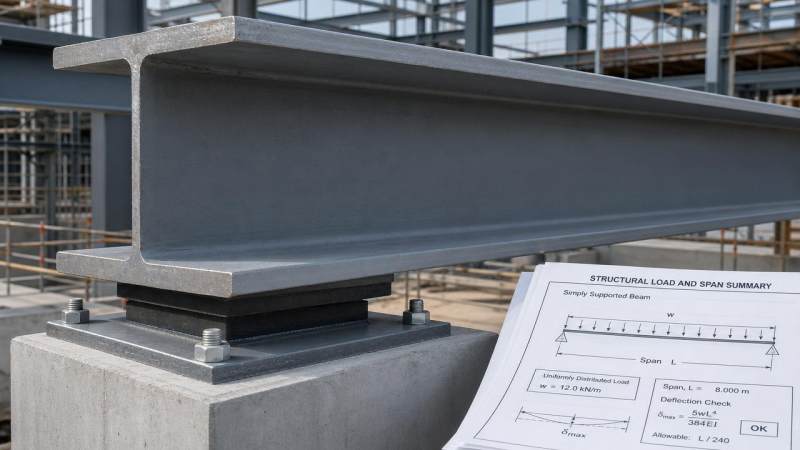
A load and span table is a summary of beam performance under defined conditions. It usually relates beam section, span length, support condition, and allowable load.
For a Steel Beam for construction, the table is not a generic promise of capacity. It is a result based on assumptions such as steel grade, lateral restraint, deflection limit, and loading type.
That is why two beams with similar depth may perform differently. Flange width, web thickness, section modulus, and moment of inertia all affect what the table reports.
Common table elements
- Beam designation, such as I-beam, H-beam, UB, UC, or W section
- Span length, usually in meters or feet
- Allowable uniform load or point load
- Deflection criteria, such as L/240, L/360, or L/500
- Steel grade or material standard
- Support condition, often simply supported or continuous
Why accurate reading matters in current projects
Construction projects are under pressure to control weight, cost, and installation time. A smaller beam may save money, but only if it still satisfies loading and stiffness requirements.
This is where load and span tables become useful beyond design offices. They support technical comparison during bid review, sourcing evaluation, and substitution assessment.
For global steel supply, consistency is also important. Hongteng Fengda, a structural steel manufacturer and exporter from China, works with ASTM, EN, JIS, and GB standards, which makes cross-standard checking a practical part of project evaluation.
When reviewing a Steel Beam for construction from different mills or regions, the table should always be matched with the exact standard and grade. Similar dimensions do not automatically mean equal structural performance.
How to read a table without missing the critical assumptions
Start with the beam section listed in the first column. Confirm that the designation matches the project drawing and the applicable national or international section system.
Then check the span row or column. Span is usually the clear or effective distance between supports, not the total member length delivered to site.
Next, identify whether the load shown is a uniform distributed load or a concentrated point load. This changes the bending moment and the beam response significantly.
After that, review the notes below the table. The notes often contain the most important limitations, including lateral support requirements and load duration assumptions.
A practical reading sequence
The difference between strength and serviceability
One common mistake is assuming that the highest listed load is always acceptable. In many cases, the governing limit for a Steel Beam for construction is deflection, not ultimate strength.
A beam may be strong enough to avoid failure, but still bend too much for flooring, cladding, equipment support, or finishing requirements. That can lead to vibration, cracking, drainage problems, or alignment issues.
This distinction becomes more important in long-span industrial buildings, mezzanines, and equipment platforms. The beam must work structurally and functionally at the same time.
How related steel components affect beam evaluation
A beam is rarely assessed alone. In real projects, its performance depends on the surrounding steel system, including columns, bracing, purlins, plates, and connected pipe or tubular sections.
For example, support framing or utility integration may require additional carbon steel products with consistent standards and processing quality. That is where solutions such as Carbon Steel Pipe Supplier become relevant within the broader package.
Available grades such as Q345B, Q345e, and ASTM A106 Gr.B are used across construction, machinery, municipal works, and chemical engineering. Thickness ranges from 2.0mm to 80mm with ±1% tolerance.
Round, API, EMT, and thick wall options support welding, punching, cutting, bending, and decoiling. For technical review, that matters because connection design and fabrication feasibility should align with the beam strategy.
The point is not to replace beam selection with pipe data. It is to evaluate whether the overall steel package can be manufactured, certified, and integrated under the same quality framework.
Typical situations where table reading changes the decision
Load and span tables are especially useful when several beam sizes appear close in weight and cost. Small differences in section properties can create a large difference in span capacity.
- Warehouse roofs where long spans need low self-weight
- Factory platforms carrying equipment loads
- Commercial floors with stricter deflection limits
- Pre-engineered buildings using standardized steel members
- Export projects where equivalent sections are proposed
In these cases, the best Steel Beam for construction is not simply the strongest option. It is the section that satisfies the design basis, fabrication route, availability, and project timeline together.
Common errors that create review risk
Several review problems appear repeatedly in steel projects. Most are caused by reading the numbers without reading the assumptions.
- Using a table for a different steel grade
- Ignoring whether compression flange restraint is provided
- Mixing up dead load, live load, and total load values
- Comparing metric and imperial sections as if they were identical
- Assuming published capacities already include connection effects
- Overlooking serviceability limits for floors or facades
A disciplined review process avoids these errors early, before fabrication drawings or purchase orders lock the project into the wrong section.
A better way to compare options across suppliers
When evaluating a Steel Beam for construction from multiple sources, build the comparison around a common checklist. This makes section substitution more reliable and easier to document.
Useful comparison points include section properties, grade equivalency, compliance standard, tolerance control, available processing, and delivery consistency. These are often as important as nominal capacity.
Suppliers with stable production and clear quality records can simplify this step. Hongteng Fengda supports standard and customized structural steel components for international markets, which is valuable when sections must align with different project specifications.
Turning table data into a practical next step
A load and span table is most useful when converted into a clear decision path. Confirm the project loads, support conditions, span basis, and deflection limit before comparing any beam sizes.
Then match those requirements with the published section data, the manufacturing standard, and the available steel grade. If substitutions are needed, document the assumptions behind each comparison.
That approach helps narrow down the right Steel Beam for construction with fewer surprises during detailing, procurement, and installation. It also creates a stronger basis for reviewing related structural steel items within the same package.
Before moving forward, it is worth organizing beam schedules, applicable standards, and required tolerances in one review sheet. That single step makes later technical validation faster and more consistent.
Please give us a message


Please enter what you want to find