How to Prevent Rebar Corrosion in High-Moisture Environments
High-moisture environments accelerate the electrochemical degradation of concrete structures, with rebar corrosion acting as the primary mechanism for structural failure. For maintenance personnel, the challenge lies in the隐蔽 nature of this degradation; by the time visible symptoms like concrete spalling or rust staining appear, significant cross-sectional loss of the steel has already occurred. Preventing and managing this corrosion requires a systematic approach that moves beyond superficial repairs to address the underlying moisture ingress and electrochemical conditions.
The fundamental requirement for rebar corrosion is the simultaneous presence of oxygen, moisture, and an electrolyte (such as chlorides or carbonates). In high-moisture environments, the concrete pores remain saturated or near-saturated, providing an ideal conductive path for ionic movement. When the passive alkaline film protecting the steel is broken down—either through carbonation reaching the rebar depth or chloride ion ingress—anodic and cathodic sites form. The resulting iron oxides occupy up to six times the volume of the original steel, generating internal tensile stresses that crack and delaminate the surrounding concrete.
### Field Diagnostics and Risk Assessment
Effective prevention begins with accurate field diagnostics. Maintenance personnel must rely on Non-Destructive Testing (NDT) to evaluate the corrosion probability and moisture state before planning interventions. Visual inspection alone is insufficient for assessing internal rebar conditions.
Half-cell potential testing (ASTM C876) is the standard method for mapping the likelihood of active corrosion. By measuring the electrical potential difference between a copper/copper sulfate electrode and the rebar matrix, personnel can identify anodic areas where corrosion is actively occurring. However, in highly saturated concrete, the electrical resistivity is low, which can sometimes skew potential readings. Therefore, this method must be combined with electrical resistivity testing.
Concrete resistivity directly indicates the ease with which corrosive agents and moisture can move through the matrix. High resistivity values suggest a dense, relatively dry concrete structure where corrosion rates will be inherently slow, even if chlorides are present. Conversely, low resistivity in high-moisture environments confirms that the concrete is highly permeable to water and ions, signaling an urgent need for moisture-blocking interventions. Additionally, measuring the carbonation depth using phenolphthalein indicator helps determine whether the alkaline reserve of the concrete has been depleted to the level of the rebar.
### Interrupting Moisture Ingress Pathways
The most effective long-term strategy for preventing rebar corrosion in damp conditions is to切断 the moisture supply. This involves both treating the concrete surface and, in severe cases, installing external physical barriers.
For concrete surfaces exposed to high humidity but not direct hydrostatic pressure, penetrating sealers such as silanes and siloxanes are highly effective. Unlike film-forming coatings that can trap moisture inside the concrete and cause blistering, penetrating sealers react chemically with the substrate to line the pores. This creates a hydrophobic layer that repels liquid water while allowing water vapor to escape, maintaining the internal breathability of the structure.
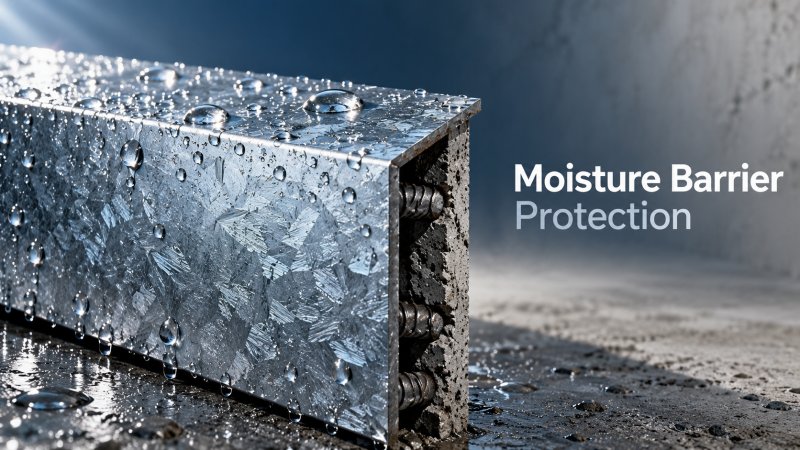
For external structural elements in extreme moisture zones, such as retaining walls, basement perimeters, or marine splash zones, relying solely on concrete permeability reducers may be insufficient. In these applications, installing a robust external physical barrier is often required. Utilizing Galvanised Steel Sheet Metal as an external protective cladding or moisture isolation layer provides a highly effective physical shield. The zinc coating delivers strong resistance to atmospheric and moisture-induced corrosion, preventing direct liquid water contact with the concrete substrate and thereby cutting off the primary moisture supply to the internal rebar. This approach is particularly valuable in areas subject to physical impact or continuous capillary water rise, where traditional surface coatings would quickly degrade.
 ### Chemical and Electrochemical Interventions
When moisture ingress cannot be entirely eliminated, or when active corrosion has already initiated, maintenance personnel must deploy chemical or electrochemical mitigation strategies.
Migrating Corrosion Inhibitors (MCIs) offer a practical solution for maintenance scenarios where large-scale concrete removal is undesirable. Applied to the surface of the concrete, MCIs migrate through the pore structure via vapor and liquid phase transport until they reach the rebar. Once at the steel surface, they adsorb onto the metal, altering the electrochemical reactions and either forming a protective molecular layer (anodic inhibitors) or reducing the cathodic reaction rate. MCIs are particularly useful in extending the service life of structures in high-moisture environments where access is limited, though their effectiveness depends heavily on the concrete's permeability and the existing moisture content.
For structures with active, severe corrosion in continuously wet environments, Cathodic Protection (CP) is the most reliable technical intervention. CP works by making the entire rebar network the cathode of an electrochemical cell, thereby suppressing the anodic dissolution of iron.
Sacrificial anode systems, typically using zinc or aluminum alloys embedded in the concrete or attached to the surface, are suitable for structures with low electrical resistance (high moisture) and moderate corrosion rates. They require minimal maintenance and no external power source. For larger infrastructure or structures with highly resistive concrete patches, Impressed Current Cathodic Protection (ICCP) systems are necessary. ICCP uses an external power supply and inert anodes (such as mixed metal oxide titanium mesh) to provide a continuous, adjustable protective current. The selection between these systems requires careful calculation of the current demand, which is directly influenced by the moisture and chloride content of the concrete.
### Execution of Repairs and Quality Control
When corrosion has caused concrete spalling, the physical repair process must be executed with strict adherence to technical standards to prevent premature recurrence. A common failure in maintenance is the "patch repair" approach, where damaged concrete is removed and replaced without addressing the surrounding corrosion or the moisture source. This often leads to "incipient anodes" forming at the boundary of the new patch, accelerating localized corrosion.
Before any repair material is applied, the exposed rebar must be cleaned to a high standard. Surface preparation typically requires abrasive blasting to achieve a minimum of SSPC-SP6 (Commercial Blast) or Sa 2.5, removing all rust, mill scale, and contaminated concrete dust. If the rebar has suffered significant cross-sectional loss, structural engineering assessment is required to determine if supplementary steel or carbon fiber reinforcement is needed.
Following cleaning, a zinc-rich or calcium sulfonate primer must be applied to the rebar immediately to prevent flash rusting, which is highly rapid in high-humidity conditions. The repair mortar selection is critical. Traditional Portland cement mortars are often unsuitable due to their high water-cement ratio and shrinkage potential. Polymer-modified mortars or low-water-cement-ratio micro-concretes should be used. These materials provide low permeability, high bond strength, and minimal shrinkage, ensuring a dense matrix that restricts future moisture and chloride ingress.
During the curing process, environmental controls are mandatory. High ambient humidity can delay the evaporation of excess mixing water in cementitious repairs, while low humidity can cause plastic shrinkage cracking. Maintenance personnel must ensure that the repair area is protected from direct rain, running water, and extreme temperature fluctuations until the material has achieved sufficient strength.
### Shifting to Predictive Maintenance
Preventing rebar corrosion in high-moisture environments ultimately requires a shift from reactive patching to predictive maintenance. By establishing a baseline of concrete resistivity, half-cell potentials, and moisture content, maintenance teams can track the rate of degradation over time.
Embedding permanent corrosion sensors or smart aggregates during the initial construction or major rehabilitation phases allows for continuous, real-time monitoring of the rebar's electrochemical state. This data enables maintenance personnel to schedule interventions—such as reapplying penetrating sealers, replacing sacrificial anodes, or adjusting ICCP outputs—precisely when needed, rather than waiting for visible structural distress. Understanding the specific moisture dynamics of the structure and implementing targeted, multi-layered defense strategies ensures the long-term integrity and safety of the concrete asset.
Previous page: Already the first one
Next page: Already the last one
Please give us a message


Please enter what you want to find