How to Choose Color Coated Steel for Outdoor Panels in Coastal Environments
Choosing the right color coated steel for outdoor panels in coastal environments requires more than comparing price or appearance. Salt spray, humidity, UV exposure, and temperature changes can quickly affect panel durability and maintenance costs. For technical evaluators, understanding coating performance, substrate quality, and corrosion resistance is essential to selecting materials that meet project standards, extend service life, and reduce long-term sourcing risk.
In coastal projects, the wrong choice usually does not fail all at once. It starts with edge discoloration, fastener staining, slight chalking, or coating blistering around cut edges and joints. These are the details that tell you whether the material is genuinely suitable for the environment or just looks good on the sample board. That is why the selection process should always begin with service conditions, not with the color card.
What coastal exposure really changes
A panel installed a few hundred meters from the shoreline faces a different risk profile than one used inland. Chloride-laden air accelerates corrosion once moisture reaches defects in the coating. High humidity slows drying after rain or condensation, which means any weak point stays wet longer. Strong UV does not corrode steel directly, but it breaks down topcoats over time, especially if the resin system is not matched to outdoor exposure.
For technical teams, the practical question is not whether the material is “weatherproof.” It is how the coating system behaves after repeated wet-dry cycles, how well it resists salt fog near fasteners and seams, and whether the substrate can tolerate site fabrication without exposing vulnerable steel.
Start with the substrate, not just the finish
Many buyers focus on the visible top layer, but the base steel matters just as much. A coating can only perform within the limits of the substrate preparation and zinc protection beneath it. For outdoor panels, galvanized or zinc-coated bases are commonly chosen because they provide a sacrificial layer if the surface is scratched during transport or installation. The real issue is consistency: coating weight, surface cleanliness, and forming quality all affect how long the panel stays stable in service.
If a project involves frequent cutting, bending, or punching on site, the edge protection story becomes even more important. That is where some teams specify additional sealing, special edge treatment, or a heavier protective system. There is no universal answer here; the right balance depends on geometry, fabrication method, and how close the project is to direct marine exposure.
Why coating type matters more than color
The name “color coated steel” can cover a broad range of systems, but not all coatings behave the same outdoors. A darker color may absorb more heat, which can increase thermal movement and stress at joints. A glossy finish may look sharp at handover, yet it can show chalking, dust, and uneven weathering sooner than a more forgiving finish. In coastal settings, surface appearance should be treated as the last layer of the decision, not the first.
For technical evaluators, it helps to ask three questions: what is the expected exposure category, what maintenance interval is realistic, and what failure mode would be most costly for the owner? That may sound basic, but in practice it prevents over-specifying a premium finish where it adds little value, or under-specifying a system that will need replacement too early.
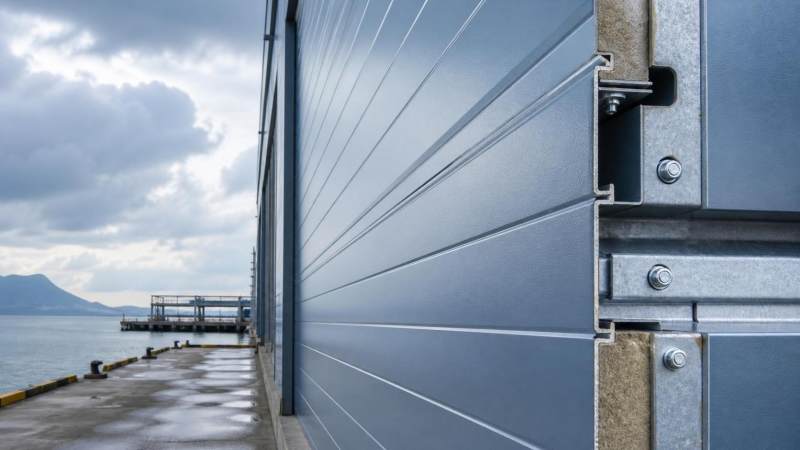
A sample comparison under real light is often more useful than a brochure. Outdoor panels near the coast are read by the site, not by the showroom. A material that looks uniform indoors may reveal waviness, pigment variation, or weak gloss retention once it is installed in full sun.
Practical selection points for project teams
One useful way to screen suppliers is to separate visual preference from performance criteria. The finish should be checked against a short list of project realities: coastal distance, wind-driven rain, expected cleaning frequency, installation method, and the likelihood of field modification. If the project includes highly exposed facades, mechanical rooms near the shoreline, or industrial buildings with airborne chemicals, the coating choice should be treated more conservatively.
It also helps to compare how the supplier handles formability. Some panels are rolled, bent, or stamped after coating, and not every system tolerates that well. When the coating cracks at bends, corrosion starts sooner than most owners expect. This is where production experience matters. A manufacturer that regularly supplies structural steel and customized components for export projects is usually more accustomed to balancing fabrication demands, lead times, and quality control across different standards and market expectations.
That kind of sourcing discipline is also useful when related components are being specified together. For example, support frames, fixings, and reinforcement details may involve items such as Galvanized Stainless Steel Wire in mesh, isolation, or binding applications. The product itself is not a substitute for the panel coating, of course, but it reflects the same logic: corrosion resistance, ductility, and predictable processing matter more near the coast than in ordinary indoor use.
Common mistakes that show up later
A frequent mistake is choosing based on sample appearance alone. Another is ignoring edge and fastener zones, which often fail before the broad field of the panel. Some teams also compare only unit price and miss the hidden cost of rework, premature cleaning, or warranty disputes. In coastal projects, those costs often appear slowly, which makes them easy to underestimate during procurement.
There is also a tendency to overspecify. Not every seaside project needs the most aggressive coating system available. If the panel is sheltered, rarely washed by salt spray, and installed with controlled detailing, a mid-range solution may be enough. The smarter choice is the one that matches exposure, not the one that sounds strongest in a datasheet.
What to confirm before release for procurement
Before approving color coated steel for outdoor panels, technical reviewers should confirm the base metal specification, coating type, forming behavior, thickness tolerance, and the supplier’s packing method. Coastal shipments are often long and handling-sensitive, so surface protection during transport can matter more than people think. Scratches, moisture intrusion, and poor packing can undo a good specification before the material ever reaches site.
For international projects, compatibility with the project standard is another practical point. Depending on destination and design basis, ASTM, EN, JIS, or GB requirements may apply to different parts of the steel system. It is usually better to verify this early than to discover a mismatch after fabrication has started. A supplier with stable production and export experience can help reduce that risk, but the project team still needs to check the actual submittal documents line by line.
In short, coastal panel selection is a corrosion problem, a fabrication problem, and a logistics problem at the same time. If those three pieces are judged together, the result is usually far more reliable than chasing the lowest quotation. And if one detail feels uncertain, it probably deserves one more round of review before release.
Please give us a message


Please enter what you want to find