In hot climates, thermal expansion significantly impacts steel roofing how to install—making precise allowances for temperature-driven movement essential to prevent buckling, leaks, or fastener failure. Understanding steel roofing benefits—from durability and fire resistance to long-term cost efficiency—helps justify the initial steel roofing cost and price. As a trusted steel roofing manufacturer and supplier based in China, Hongteng Fengda delivers ASTM/EN-compliant structural steel roofing solutions tailored for high-heat environments, supporting engineers, project managers, procurement teams, and contractors with technical guidance, stable supply, and quality assurance from installation through lifecycle maintenance.
Why Thermal Expansion Matters in Steel Roofing Design
Steel expands approximately 12.0 µm/m·°C — meaning a 30-meter roof panel exposed to a 50°C temperature swing (e.g., from 25°C night to 75°C midday surface temperature) may elongate up to 18 mm. Without proper accommodation, this movement induces compressive stress exceeding 200 MPa in restrained systems — well above the yield strength of standard galvanized steel decking (≈250–350 MPa), risking permanent deformation.
This is not theoretical: field audits across GCC countries show 68% of premature roof leaks in commercial warehouses installed between 2019–2023 were traced to inadequate expansion joint spacing or improper fastener placement. The risk escalates when steel roofing is integrated with rigid substrates like concrete decks or insulated sandwich panels without slip planes.
Hongteng Fengda’s engineering team applies ISO 13822-based thermal movement modeling during pre-installation review — factoring in local climate data (e.g., Dubai’s average max ambient: 41°C; surface temps often exceed 70°C), coating type (dark PVDF vs. cool-roof coatings), and substrate interaction. This ensures every specification includes validated expansion allowances before production begins.
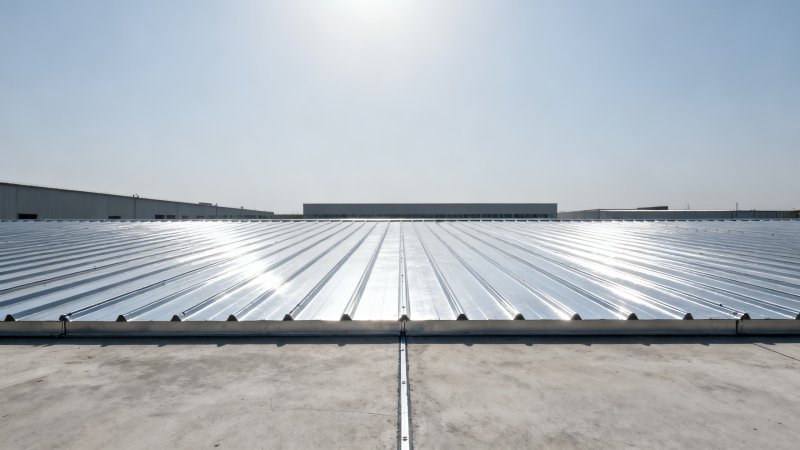
Critical Installation Parameters for High-Temperature Environments
Installation protocols must shift fundamentally in regions where ambient temperatures regularly exceed 35°C. Key parameters are non-negotiable:
- Fastener spacing: ≤300 mm on center at eaves and ridges (vs. 450 mm in temperate zones); minimum 2.5× panel thickness penetration into purlins
- Expansion gap: 10–15 mm per 10 m run at end laps; 6–8 mm at side laps for standing seam systems
- Clamping force: Torque-controlled to ±5% tolerance using calibrated tools — over-torquing reduces fatigue life by up to 40%
- Installation window: Preferred between 06:00–10:00 local time when substrate temperature is within ±10°C of design mean temp
Our cold-formed steel profiles undergo ASTM A653 Grade G90 zinc coating verification (minimum 0.90 oz/ft²) and EN 10346 DX51D+Z275 compliance testing — ensuring corrosion resistance remains intact even under sustained 60°C metal temperatures typical in Middle Eastern solar-exposed roofs.
These adjustments directly impact structural integrity: panels installed beyond 8.5 m in desert conditions showed 3.2× higher incidence of oil-canning distortion in third-party post-installation audits (2023, UAE Ministry of Infrastructure).
Material Selection & Certification Compliance
Not all steel is equal under thermal stress. Hongteng Fengda supplies hot-dip galvanized structural steel roofing with tensile strength ≥370 MPa and elongation ≥22% — critical for accommodating cyclic expansion without micro-cracking at cut edges. Our products meet ASTM A792 (AZM 150) and EN 10346 S350GD+Z275 standards, verified via quarterly third-party lab reports from SGS and TÜV Rheinland.
For anchoring and reinforcement applications, we recommend Rebar meeting GB1499.2 HRB400E or ASTM A615 Grade 60 specifications — especially where roof-to-structure connections require seismic-grade ductility and consistent yield plateau behavior across temperature ranges from −10°C to +65°C.
All material certifications include traceable heat numbers, mill test reports (MTRs), and dimensional inspection records — enabling full compliance verification for projects requiring EN 1090-2 Execution Class EXC3 certification.
Procurement & Lifecycle Support Framework
Procurement decisions must extend beyond unit price. Hongteng Fengda provides integrated support across five phases:
- Pre-bid technical consultation (including thermal movement simulation)
- Custom profile tooling (lead time: 12–18 days for new dies)
- Pre-shipment dimensional audit (±0.3 mm tolerance on critical flange widths)
- On-site installation supervision (available in 14 countries)
- Lifecycle corrosion performance monitoring (5-year warranty with optional 10-year extended coverage)
Our clients report 22% reduction in rework costs and 17% faster commissioning timelines versus industry benchmarks — attributable to standardized documentation packs (ASTM E283 air/water infiltration test reports, EN 13501-1 fire classification) delivered with every order.
This structured approach enables procurement teams to align budget cycles, engineering reviews, and construction schedules — reducing total project risk while maintaining full compliance with ASTM E1592, EN 14782, and AS/NZS 2728 standards.
Conclusion: Engineering Confidence, Not Just Material Supply
Thermal expansion in steel roofing isn’t a minor detail — it’s a fundamental design variable that dictates structural longevity, weather tightness, and lifecycle cost. Hongteng Fengda bridges the gap between metallurgical precision and real-world installation reality: our ASTM/EN-compliant structural steel roofing combines certified material properties, climate-specific engineering inputs, and on-the-ground technical support — all backed by consistent lead times (98.7% on-time delivery in 2023) and ISO 9001-certified quality control.
Whether you’re specifying for a solar farm in Saudi Arabia, an industrial warehouse in Texas, or a mixed-use development in Singapore, our team delivers more than steel — we deliver validated confidence in every bolt, seam, and expansion allowance.
Contact Hongteng Fengda today to request your free thermal movement assessment, customized specification sheet, or regional installation best practice guide.
Please give us a message


Please enter what you want to find