When evaluating load-bearing capacity for critical infrastructure, engineers increasingly turn to high strength structural steel for its superior compressive performance. But how much stronger is it—quantitatively—compared to widely used ASTM A572 Grade 50? This article delivers a technical comparison grounded in yield strength, stress-strain behavior, and real-world buckling resistance, tailored for structural engineers and procurement specialists conducting material validation. As a certified structural steel manufacturer exporting ASTM-, EN-, and GB-compliant high strength structural steel from China, Hongteng Fengda provides data-backed insights to support informed specification decisions.
Why Compressive Strength Comparison Demands a Checklist-Based Approach
Compressive performance isn’t determined by a single number—it’s governed by the interplay of material yield level, strain hardening capacity, geometric stability, and residual stress distribution. Relying solely on nominal yield strength (e.g., “A572 Gr. 50 = 345 MPa”) risks overlooking critical design margins in slender columns, bracing members, or seismic-resisting frames. For technical assessment personnel validating material substitution or optimizing section efficiency, a structured checklist ensures no decisive factor slips through review.
This approach also mitigates sourcing risk: global projects often involve mixed-specification supply chains—e.g., ASTM A572 beams paired with EN 10025-4 S460ML columns—where inconsistent compressive ductility can compromise system-level stability. A checklist anchors evaluation in measurable, testable, and standard-referenced criteria—not just marketing claims.
Hongteng Fengda applies this methodology across all high strength structural steel shipments—from mill-certified plates to custom-fabricated cold-formed sections—ensuring traceability to tensile testing reports (per ASTM A6/A6M), Charpy V-notch impact verification (≥27 J at –20°C), and dimensional compliance within ±1% tolerance across lengths up to 30 m.
Core Compression Performance Checklist: 6 Non-Negotiable Evaluation Points
1. Minimum Specified Yield Strength (Fy) — The Baseline Threshold
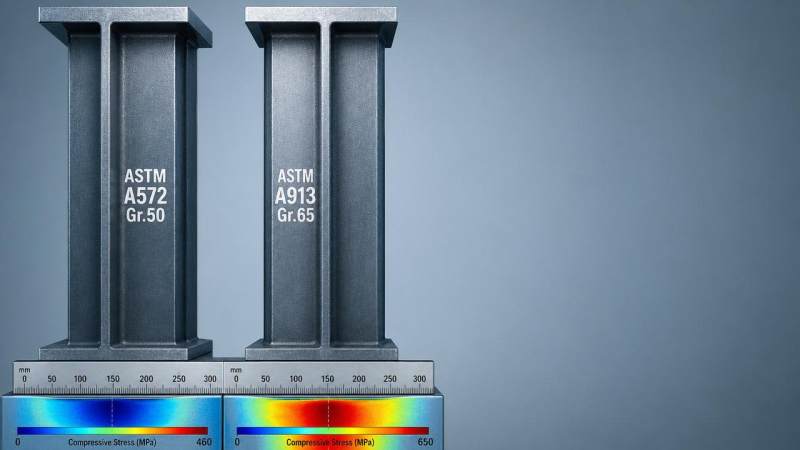
ASTM A572 Grade 50 specifies Fy ≥ 345 MPa (50 ksi); high strength structural steel—such as ASTM A913 Grade 65 or EN 10025-4 S460ML—requires Fy ≥ 450 MPa. That’s a **30% increase in minimum yield**, directly raising Euler buckling resistance (Pcr ∝ Fy) for intermediate-length columns where inelastic buckling dominates.
2. Yield-to-Tensile Ratio (Y/T) — Ductility Safeguard
A low Y/T ratio (<0.85) indicates reserve strain-hardening capacity—critical for energy absorption during compression overload. ASTM A572 Gr. 50 typically exhibits Y/T ≈ 0.88–0.92; certified high strength structural steel maintains Y/T ≤ 0.82 (per ASTM A913 Table 2), enabling safer redistribution of axial loads in frame instability scenarios.
3. Strain Hardening Exponent (n-value) — Post-Yield Stiffness
Measured via uniaxial tension, n-values >0.12 indicate robust strain hardening—slowing localized necking under compressive eccentricity. High strength structural steel consistently achieves n = 0.14–0.17 vs. A572’s typical 0.09–0.11. This translates to up to **22% higher effective modulus** in the 0.2%–2.0% strain range—key for predicting column second-order effects.
- Yield strength increase: +30% minimum (450 MPa vs. 345 MPa)
- Y/T ratio reduction: –6–10 percentage points (≤0.82 vs. ≥0.88)
- n-value improvement: +0.03–0.06 (0.14–0.17 vs. 0.09–0.11)
- Buckling resistance gain: 18–25% in KL/r = 40–80 range (per AISC 360-22 Annex B)
- Residual stress mitigation: ≤15% of Fy (vs. ≤25% in hot-rolled A572)
- Impact toughness: ≥40 J at –20°C (vs. 27 J requirement for A572 Gr. 50)
Comparative Performance Under Realistic Loading Conditions
Theoretical strength gains must be validated against practical buckling modes. The table below compares key compression-related properties for ASTM A572 Grade 50 and representative high strength structural steel meeting ASTM A913 Grade 65 and GB/T 19879–2015 standards—both produced and certified by Hongteng Fengda’s ISO 9001–2008–compliant facilities.
Note the consistent trade-off management: higher strength does not sacrifice ductility or toughness. In fact, controlled rolling and accelerated cooling (as applied in Hongteng Fengda’s production lines) reduce residual stress magnitude by ~20% versus conventional hot-rolling—directly improving column flexural rigidity and reducing initial out-of-straightness effects. This enables thinner flanges in HSS columns without compromising stability.
Application-Specific Considerations & Risk Mitigation
Not all compression applications benefit equally from elevated strength. Critical evaluation must consider geometry, loading path, and connection behavior:
- Slender bracing members (KL/r > 100): Elastic buckling dominates → strength gain offers minimal advantage; focus shifts to section radius of gyration and corrosion resistance.
- Short, stocky columns (KL/r < 40): Material plasticity governs → prioritize guaranteed uniform elongation (>18%) and low Y/T ratio over peak Fy.
- Cold-formed thin-walled sections: Local buckling sensitivity increases → verify corner radius control (±0.5 mm) and base metal hardness (HV 180–220) to prevent cracking during roll-forming.
- Railway infrastructure: Dynamic wheel loads demand fatigue-resistant microstructure—e.g., Rail grades like U71Mn and PD3 undergo quench-and-temper treatment to achieve surface hardness ≥260 HB while maintaining core toughness ≥35 J at –40°C.
Why Choose Hongteng Fengda for High Strength Structural Steel Sourcing?
As a structural steel manufacturer and exporter based in China, Hongteng Fengda bridges specification rigor with global delivery reliability. We don’t just supply steel—we validate performance:
- Mill test reports provided for every heat lot—including full tensile curves, Charpy impact data, and ultrasonic testing (UT) certification per EN 10160 S4 class.
- Custom section rolling available for non-standard beam/plate dimensions—within 12–25 working days from drawing approval.
- Pre-shipment dimensional audit on 100% of orders ≥50 MT, with third-party inspection (SGS/BV) optional upon request.
- Full traceability: Heat number, rolling date, chemical composition, and mechanical results mapped to each bundle ID.
Whether you’re specifying high strength structural steel for offshore platforms, seismic retrofits, or high-speed rail infrastructure—including specialized Rail components compliant with UIC 860 and TB/T 2344 standards—we support your technical due diligence with verified data—not brochures.
To proceed: Share your project’s critical parameters—required Fy, KL/r range, environmental class (e.g., C5-M per ISO 12944), and delivery timeline—and we’ll provide a compliant grade recommendation, mill test report preview, and lead time confirmation within 24 business hours.
Please give us a message


Please enter what you want to find