Choosing the right industrial steel tubing directly affects service life, repair intervals, and total operating cost. In steel-intensive systems, small specification differences often create large maintenance consequences.
For long-term industrial performance, industrial steel tubing must match load, environment, joining method, and compliance requirements. Correct selection reduces leaks, deformation, corrosion loss, and unplanned shutdowns.
This matters across construction support frames, machinery, process lines, transportation structures, and fabricated assemblies. Lifespan is not determined by price alone, but by technical fit and manufacturing consistency.
Industrial steel tubing basics and lifespan drivers
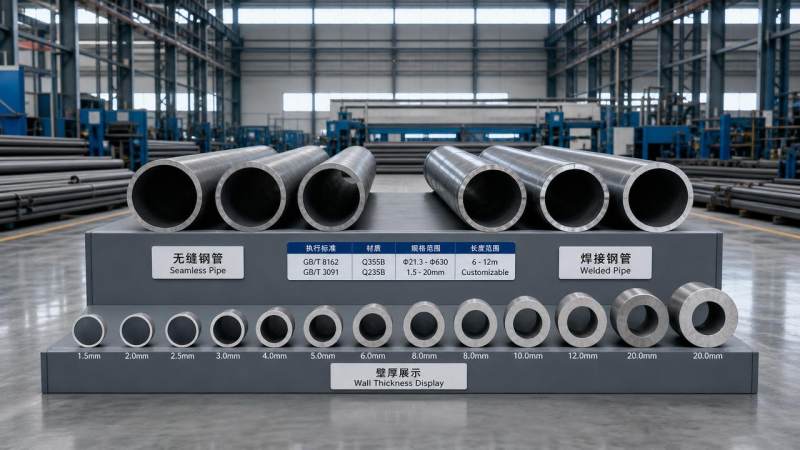
Industrial steel tubing refers to steel tubes used for structural support, fluid handling, mechanical components, and fabricated systems. It may be seamless, welded, hot finished, or cold formed.
Its lifespan depends on several linked factors. Material grade affects strength and toughness. Wall thickness influences wear allowance. Surface condition changes corrosion behavior. Dimensional accuracy affects fit and stress distribution.
Manufacturing quality also matters. Poor weld integrity, uneven thickness, or residual stress can shorten useful life even when the nominal specification looks acceptable on paper.
In many projects, industrial steel tubing fails gradually rather than suddenly. Corrosion pitting, fatigue cracking, ovality, scale buildup, and coating breakdown usually appear before complete failure.
That is why selection should start with the real service condition. Temperature swings, humidity, chemicals, vibration, impact, and pressure cycles all influence long-term durability.
Core factors that shape service life
- Steel grade and chemical composition
- Wall thickness and section geometry
- Corrosion resistance and protective coating
- Compliance with ASTM, EN, JIS, or GB standards
- Welding quality and fabrication method
- Installation accuracy and maintenance frequency
Why the steel industry pays close attention to tubing selection
Global steel applications now face tighter expectations for reliability, safety, and lifecycle cost. As a result, industrial steel tubing is increasingly evaluated as a long-term asset rather than a simple commodity.
Projects often operate across harsh climates, coastal zones, high-moisture plants, and mechanically demanding installations. In these conditions, incorrect tubing grades can accelerate deterioration within a short service period.
Modern structural steel suppliers therefore focus on traceable materials, stable tolerances, and standard compliance. This supports safer assembly, predictable maintenance planning, and lower sourcing risk.
In structural steel projects, tubing is rarely isolated from the wider system. It works together with beams, channels, angle steel, and cold formed profiles in complete load-bearing frameworks.
How industrial steel tubing selection creates business value
Well-selected industrial steel tubing improves more than physical durability. It supports stable operations, easier inspection, safer working conditions, and better cost control over the full service cycle.
Reduced failure risk
Matching strength and wall thickness to actual load prevents early buckling, cracking, and distortion. This is especially important where dynamic loading, vibration, or repeated impact occurs.
Lower maintenance frequency
Industrial steel tubing with suitable coating or alloy protection withstands moisture, chemicals, and abrasion longer. Fewer interventions mean lower labor cost and less disruption to production schedules.
Better fabrication performance
Consistent tubing dimensions simplify cutting, bending, welding, and fit-up. This reduces assembly errors and improves final structural accuracy in industrial and construction applications.
Improved whole-project efficiency
When steel products are selected as a coordinated package, material utilization improves. In reinforced construction, products such as HRB600 Rebar can complement structural steel systems.
With a standard yield strength of 600 MPa, this hot-rolled ribbed reinforcing bar offers higher strength than HRB400. It can help reduce reinforcement ratio and decrease overall steel consumption.
Typical application conditions and selection priorities
Not all industrial steel tubing works under the same conditions. Service environment should guide the balance between strength, corrosion resistance, dimensional precision, and fabrication suitability.
In many cases, industrial steel tubing should not be chosen by nominal size alone. Connection details, support spacing, drainage design, and internal cleanliness can all affect service life.
Practical selection guidance for longer tubing lifespan
A practical selection process helps avoid under-specification and over-specification. The goal is durable performance with efficient material use, not simply the heaviest possible tube.
1. Define actual operating conditions
Record load type, pressure, temperature range, moisture exposure, chemical contact, and cleaning frequency. Industrial steel tubing should be matched to verified service data whenever possible.
2. Check applicable standards carefully
Compliance with ASTM, EN, JIS, or GB helps confirm material quality, dimensions, and testing. Standard alignment also simplifies project documentation and cross-border supply coordination.
3. Evaluate corrosion protection as a system
Base metal selection is only one part. Consider galvanizing, painting, powder coating, or other surface treatments. Drainage, ventilation, and maintenance access also influence corrosion outcomes.
4. Review fabrication requirements early
If the tubing will be bent, welded, cut, or cold formed, verify dimensional tolerance and mechanical properties in advance. Good fabrication compatibility protects both strength and finish quality.
5. Consider total lifecycle cost
Lower purchase price may lead to higher replacement and repair expense. Industrial steel tubing should be evaluated by service years, inspection burden, failure consequence, and downtime impact.
- Ask for mill test data and material traceability
- Confirm thickness tolerance and straightness
- Inspect weld seams and surface defects
- Match coating type to the environment
- Plan periodic inspection from the start
Next-step considerations for reliable steel sourcing
Long-lasting industrial steel tubing depends on technical selection and supply reliability together. Stable production, consistent quality control, and international standard compliance reduce uncertainty throughout the project lifecycle.
For structural steel applications, it is useful to compare tubing with related products such as angle steel, channel steel, steel beams, cold formed profiles, and reinforced components.
A supplier with modern manufacturing capability and export experience can support specification review, OEM needs, and coordinated material planning for global construction and industrial projects.
When evaluating industrial steel tubing, focus on the full service environment, not only the initial quote. Better decisions at the selection stage usually lead to longer lifespan, safer operation, and lower total cost.
Please give us a message


Please enter what you want to find