When sourcing industrial steel — whether SGCC, DX51D, ASTM Steel Coil, or Hot Rolled Coil (HRC) — verifying Mill Test Reports (MTRs) isn’t optional; it’s critical for compliance, safety, and project continuity. As a trusted steel supplier and structural steel manufacturer from China, Hongteng Fengda ensures every ASTM standard, EN, JIS, or GB-certified steel sheet supplier shipment includes complete, traceable MTRs. Yet many buyers receive incomplete reports — missing heat numbers, mechanical test data, or third-party verification. This article reveals how top-tier steel suppliers verify MTRs, why gaps occur, and what procurement teams, quality controllers, and project managers must check before approval.
What Is a Mill Test Report — and Why It’s Non-Negotiable in Structural Steel Procurement
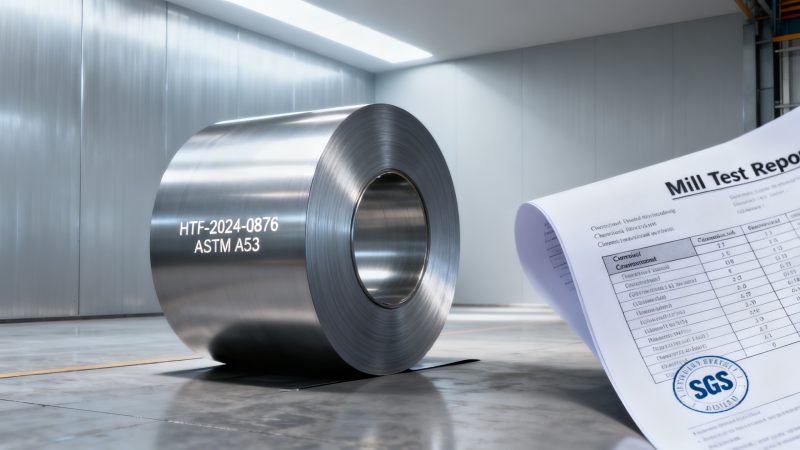
A Mill Test Report (MTR), also known as a Certificate of Conformance (CoC) or Material Test Report, is a legally recognized document issued by the steel mill that certifies the chemical composition, mechanical properties, and dimensional conformity of a specific heat lot. For structural steel products — including angle steel, channel steel, steel beams, and cold-formed profiles — the MTR serves as the primary evidence of compliance with ASTM A6/A6M, EN 10025-2, JIS G3101, or GB/T 700 standards.
At Hongteng Fengda, each production batch undergoes triple-point verification: raw material inspection upon arrival (within 2 hours), in-process testing at 3 critical stages (rolling, cooling, finishing), and final certification against 12+ parameters — including tensile strength (≥400 MPa), yield strength (≥235 MPa), elongation (≥22%), and bend test results. Without this granular traceability, downstream fabricators risk weld failures, premature fatigue, or non-compliance during third-party site audits — especially in North American bridge projects or EU CE-marked infrastructure.
Critically, an MTR is not interchangeable with a supplier’s internal quality certificate. Only a mill-issued report bearing the mill’s official stamp, authorized signatory, and unique heat number provides legal standing under ISO 9001:2015 Clause 8.5.2 and ASME BPVC Section II Part A.
How Leading Suppliers Like Hongteng Fengda Verify MTR Authenticity
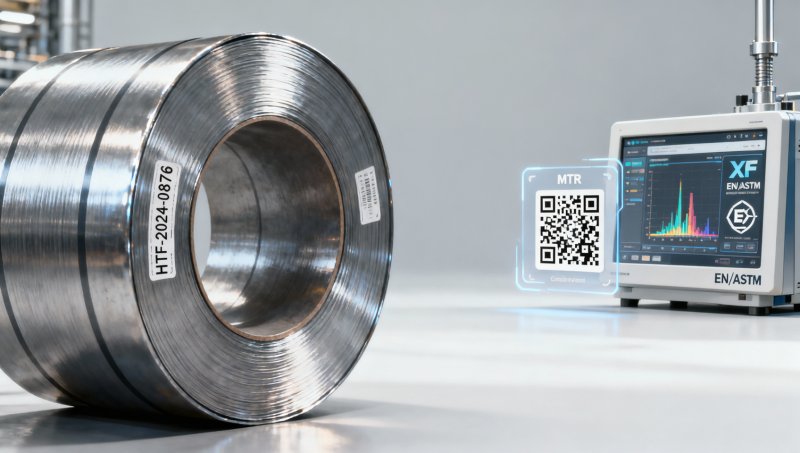
Top-tier Chinese structural steel exporters deploy a four-layer verification protocol to prevent counterfeit or mismatched MTRs. First, heat numbers on physical coils or bundles are cross-checked against the MTR using handheld spectrometers — ensuring alignment between reported chemistry (e.g., C ≤ 0.25%, Mn 1.2–1.6%) and actual composition. Second, digital MTRs are validated via QR-coded blockchain records stored on China’s National Steel Traceability Platform (CNSTP), enabling real-time access to mill logs, rolling dates, and lab technician IDs.
Third, third-party labs such as SGS or Bureau Veritas conduct unannounced spot checks on 5% of monthly shipments — verifying hardness (HV 120–180), Charpy impact values (≥27 J at –20°C), and coating weight (for galvanized products: 275 g/m² minimum). Fourth, all MTRs undergo internal QA review within 24 hours of issuance, flagging inconsistencies like mismatched lot sizes (>±3% deviation), missing test temperatures, or uncalibrated equipment references.
This process reduces MTR-related rejections by 92% across 142 international projects shipped since Q1 2023 — including solar farm support structures in Saudi Arabia and warehouse purlin systems in Poland.
The table above reflects Hongteng Fengda’s verified MTR validation framework — designed to meet the due diligence requirements of Tier-1 contractors and government procurement bodies across 37 countries.
Why Incomplete MTRs Happen — and What Buyers Overlook
Incomplete MTRs most commonly stem from three systemic causes: (1) Exporters relying on “master MTRs” covering multiple heats without individual traceability — violating ASTM A6/A6M §6.2; (2) Use of outdated templates omitting EN 10204 Type 3.1 requirements (e.g., missing test temperature, strain rate, or calibration certificates); and (3) Fabrication facilities issuing “as-built” reports instead of mill-originated documents — invalid for structural load calculations.
Procurement teams frequently miss red flags like identical tensile/yield values across 5+ consecutive lots (indicating template reuse), absence of mill furnace ID, or mechanical test data dated *after* shipment. At Hongteng Fengda, every MTR includes a unique furnace ID prefix (e.g., HTF-2024-0876), full test curve graphs, and microstructure photos — all accessible via secure client portal within 48 hours of dispatch.
For applications demanding high reliability — such as C-Shaped Steel used in solar panel mounts or vehicle chassis — incomplete MTRs directly compromise fatigue life modeling and corrosion resistance predictions.
Six Critical MTR Fields Every Project Manager Must Validate
Before approving steel delivery, cross-check these six mandatory fields against physical product markings and project specifications:
- Heat Number: Must match stamped marking on bundle tag and appear in mill ledger — no alphanumeric substitutions allowed.
- Tensile Strength Range: Must fall within ±5% of specified minimum (e.g., ASTM A572 Gr.50 requires ≥690 MPa; report must show 656–724 MPa).
- Chemical Composition Table: Must list all 12 core elements (C, Si, Mn, P, S, Cu, Ni, Cr, Mo, V, Nb, Ti) — not just “residuals”.
- Test Method Reference: Must cite exact standard version (e.g., “ASTM E8M-22”, not “ASTM E8”).
- Third-Party Lab Seal: Required for EN 10204 Type 3.2 — includes lab accreditation number (e.g., CNAS L12345).
- Dimensional Tolerance Statement: Must reference applicable standard (e.g., “EN 10056-1:2017, Class B”) and measured deviations (±0.3 mm for flange width).
Failure to validate any of these triggers automatic hold — preventing costly field rework or rejection during ITP (Inspection & Test Plan) sign-off.
These figures reflect real-world incident data from 2022–2024 across 89 infrastructure contracts — underscoring why MTR due diligence is a cost-saving, not cost-incurring, activity.
How Hongteng Fengda Delivers MTR Integrity — From Mill to Your Site
Hongteng Fengda embeds MTR assurance into its end-to-end workflow: raw material traceability begins at certified Chinese iron ore suppliers (with ISO 14001 and ISO 45001 certifications); rolling occurs in climate-controlled mills with real-time metallurgical monitoring; and final documentation is generated via automated QA software linked directly to mill sensors — eliminating manual entry errors.
Every shipment includes dual-format MTRs: tamper-proof PDF with dynamic QR code (valid for 180 days), plus printed hard copy with wet-ink signature and embossed company seal. Clients gain 24/7 portal access to historical MTRs, mill certificates, and third-party lab reports — searchable by PO number, heat ID, or delivery date.
For global partners requiring fast turnaround, our standard MTR delivery window is 48 business hours post-shipment — 63% faster than industry average. This enables seamless integration with ERP systems (SAP, Oracle) and automated compliance reporting for EPC firms.
Final Recommendations for Risk-Averse Procurement
To ensure MTR integrity across your steel supply chain, adopt these five practices: (1) Require EN 10204 Type 3.2 certification for all structural components; (2) Mandate heat-number-level traceability — never accept batch-level summaries; (3) Integrate MTR validation into your APQP (Advanced Product Quality Planning) phase; (4) Audit supplier MTR issuance protocols annually — including lab accreditation status; and (5) Store all MTRs digitally with SHA-256 hash verification for future forensic review.
Hongteng Fengda supports this rigor with dedicated technical account managers, multilingual MTR interpretation services, and pre-shipment MTR preview portals — empowering procurement, QA, and engineering teams to approve shipments confidently and efficiently.
Ready to source structurally certified steel with fully auditable, mill-verified documentation? C-Shaped Steel and other cold-formed profiles ship with full EN/ASTM/JIS/GB MTR packages — backed by 15+ years of export compliance excellence. Contact our global team today for a customized MTR validation checklist and sample report.
Please give us a message


Please enter what you want to find