For technical evaluators working on marine and shoreline developments, hot dip galvanized coil is often a key material choice for balancing corrosion resistance, service life, and cost control.
In coastal projects, salt spray, humidity, and wind-driven exposure can rapidly attack exposed steel.
That is why understanding how hot dip galvanized coil performs is essential for safer specifications and more predictable lifecycle planning.
Its performance is not defined by zinc coating alone.
Environmental severity, design details, forming quality, maintenance strategy, and standard compliance all influence results in real coastal service.
Coastal exposure is changing material expectations faster than before
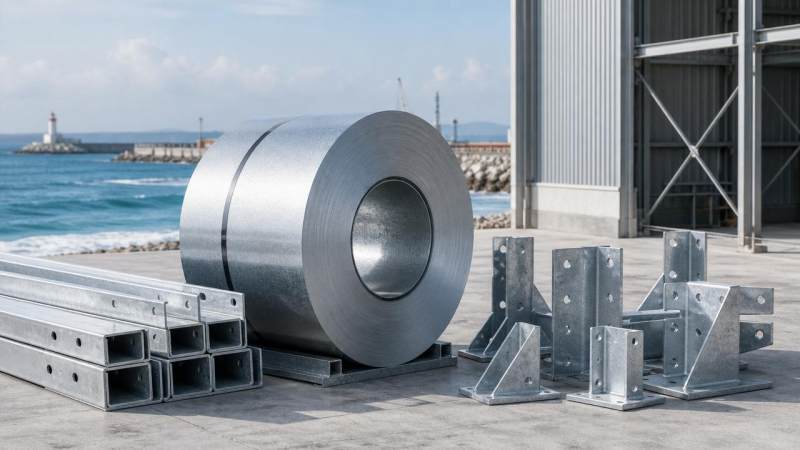
Across ports, bridges, warehouses, seawalls, and transport facilities, exposure conditions are becoming more demanding.
Projects now face stronger durability targets, tighter maintenance budgets, and longer design-life expectations.
In this context, hot dip galvanized coil remains widely specified because it offers practical corrosion protection with controlled initial cost.
However, coastal performance is no longer judged only by whether galvanized steel resists rust at installation.
The focus has shifted toward coating durability, cut-edge behavior, repairability, and total ownership cost over time.
This shift matters for steel-intensive projects using purlins, framing members, support brackets, cladding substructures, and formed sections.
Why hot dip galvanized coil still holds a strong position near the sea
Hot dip galvanized coil protects steel through a zinc coating that acts as both a barrier and a sacrificial layer.
When the surface is scratched, zinc can corrode preferentially and slow red rust formation on the base steel.
That mechanism gives hot dip galvanized coil an advantage over uncoated carbon steel in wet, salty environments.
For many coastal structures, it delivers a practical balance between fabrication flexibility and corrosion resistance.
It also supports roll forming, bending, and fabrication into channels, angles, and light structural members.
Main drivers behind continued use
Performance in coastal zones depends on more than zinc thickness
A common mistake is assuming all hot dip galvanized coil performs similarly in every shoreline application.
Actual durability changes with distance from the sea, chloride deposition, wet-dry cycles, and trapped moisture.
Open-air members may age differently from enclosed spaces with condensation and poor ventilation.
Fastener interfaces, cut edges, overlaps, and crevices often become the earliest corrosion points.
That means design detailing can influence service life almost as much as coating weight.
Key factors shaping service behavior
- Coating mass and coating uniformity
- Base steel quality and surface preparation
- Distance from surf zones and prevailing wind direction
- Crevice formation, drainage design, and water retention
- Damage during forming, transport, and installation
- Contact with incompatible metals in wet conditions
Where splash, tidal action, or concentrated salt loading is severe, alternative materials or duplex systems may be more appropriate.
The market is moving toward material matching instead of one-size-fits-all selection
Current project specifications increasingly separate atmospheric exposure from direct marine contact.
This is changing how hot dip galvanized coil is evaluated in design and procurement decisions.
For roofs, wall girts, cable trays, and inland-facing structural accessories, galvanized coil often remains a strong option.
For aggressive chemical washdown areas or permanent saltwater proximity, stainless solutions may be justified.
In some mixed-material projects, evaluators compare galvanized steel with stainless steel for isolated high-risk zones.
One example is 316 Stainless Steel Coil, often considered for severe corrosion environments.
It is used in chemical, food, medical, outdoor decoration, transportation, and ship-related components where stronger corrosion resistance is required.
Typical specifications include thickness from 2.5mm to 10.0mm and widths from 610mm to 2000mm.
That comparison does not replace hot dip galvanized coil.
Instead, it highlights a growing trend toward exposure-based material zoning inside the same project.
What these changes mean for fabrication, installation, and lifecycle cost
The performance of hot dip galvanized coil affects more than corrosion charts.
It influences forming methods, edge treatment, storage practices, and maintenance planning.
If coils are heavily worked into sharp profiles, local coating stress can change field behavior.
If moisture is trapped during transport or site storage, white rust may appear before installation.
If dissimilar metal contact is overlooked, galvanic corrosion risk may undermine expected durability.
Practical effects across project stages
The most important checks before specifying hot dip galvanized coil
A strong specification should connect environment, component function, and expected design life.
Without that link, hot dip galvanized coil may be under-specified or unnecessarily upgraded.
- Define whether exposure is coastal atmospheric, splash-prone, or directly immersed.
- Confirm applicable standards such as ASTM, EN, JIS, or GB for steel and coating requirements.
- Check forming radius and profile geometry to reduce coating stress concentration.
- Review edge sealing, touch-up materials, and fastener compatibility.
- Plan storage conditions that prevent condensation and standing moisture on coils or formed parts.
- Estimate inspection intervals based on local chloride load and wetness duration.
Reliable steel partners can support this process through stable production, standard compliance, and customized structural solutions.
Hongteng Fengda, a structural steel manufacturer and exporter from China, supplies angle steel, channels, beams, cold formed profiles, and OEM components.
With modern facilities and strict quality control, products can be aligned with international standards and project-specific requirements.
A better coastal strategy is to judge hot dip galvanized coil by exposure detail
Hot dip galvanized coil performs well in many coastal projects when the exposure is properly classified and the detailing is correct.
It is especially effective where atmospheric corrosion is the main concern and direct seawater attack is limited.
The future direction is clear.
Projects are moving from generic material selection toward targeted corrosion engineering.
That means evaluating hot dip galvanized coil not as a default answer, but as part of a location-specific durability system.
The next practical step is to compare exposure zones, component functions, coating requirements, and maintenance assumptions before final specification.
With that approach, hot dip galvanized coil can deliver dependable service life, manageable cost, and stronger confidence in coastal steel performance.
Please give us a message


Please enter what you want to find