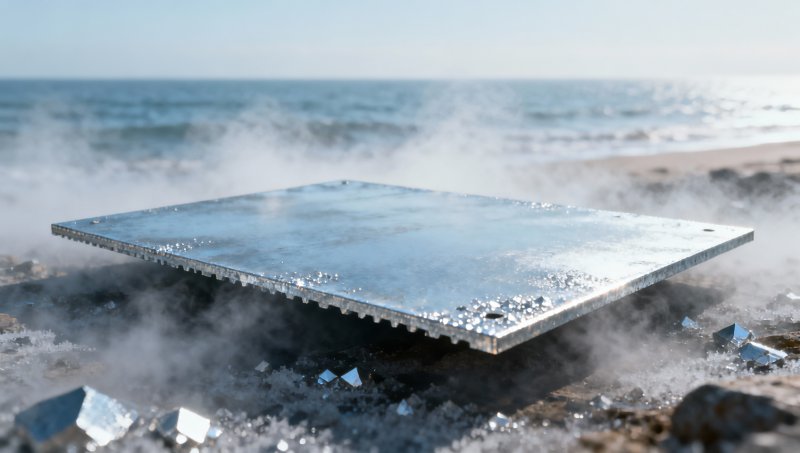
Galvanized steel sheet for roofing delivers reliable corrosion resistance in most environments—but coastal salt exposure presents a distinct challenge that directly impacts service life, maintenance frequency, and long-term structural integrity. For project managers overseeing commercial buildings, industrial facilities, or infrastructure projects within 5 km of marine coastlines, premature white rust, localized pitting, or coating delamination isn’t just an aesthetic concern. It signals early-stage zinc depletion, which accelerates base steel corrosion and may compromise roof system performance before design life is reached.
The core issue lies not in galvanizing itself, but in how standard zinc coatings interact with the combined stressors of chloride-laden air, high humidity, frequent condensation cycles, and airborne salt deposition. Unlike inland or urban settings where atmospheric corrosion follows predictable patterns, coastal zones introduce aggressive electrochemical conditions that accelerate zinc consumption—especially at cut edges, fastener points, and areas with minor coating damage during handling or installation. Without intentional specification adjustments, even ASTM A653-compliant galvanized steel sheet for roofing can show visible degradation within 3–5 years in high-salinity microclimates like those found along the Gulf Coast, the Arabian Peninsula, or Southeast Asian archipelagos.
Zinc Coating Thickness Is the Primary Determinant of Coastal Durability
Coastal performance hinges less on substrate grade than on measurable zinc mass per unit area. Standard G90 (0.90 oz/ft², ~275 g/m²) coatings—common in general-purpose roofing—are often insufficient for sustained marine exposure. Field experience across North America and the Middle East shows that G185 (1.85 oz/ft², ~550 g/m²) or higher provides a meaningful buffer against rapid chloride-driven zinc loss. This isn’t theoretical: accelerated salt-spray testing per ASTM B117 confirms that doubling zinc mass extends time-to-first-red-rust by 2.3× under continuous 5% NaCl fog exposure. More critically, thicker coatings maintain barrier function longer at vulnerable edge zones where cathodic protection is weakest.
However, thickness alone isn’t enough. Uniformity matters. Poorly controlled hot-dip processes can yield uneven coating distribution—thin spots near coil ends or across wide sheets become initiation sites for localized attack. That’s why reputable manufacturers apply strict process controls across line speed, bath temperature, and withdrawal rate—and verify results via cross-sectional microscopy and gravimetric testing per ASTM A90/A90M. At Hongteng Fengda, all galvanized steel sheet for roofing intended for coastal use undergoes mandatory coating weight verification at three points per coil: start, mid-length, and tail. Deviations beyond ±5% from nominal target trigger full rework—not spot correction.
Surface Condition and Post-Galvanizing Handling Directly Influence Real-World Performance
A pristine zinc layer means little if compromised before or during installation. Scratches, abrasions, or bending-induced microcracks expose bare steel, creating galvanic cells where zinc sacrificially corrodes at an accelerated rate to protect the exposed iron. In humid, salty air, this localized corrosion propagates laterally beneath adjacent intact coating—a phenomenon known as underfilm creep. The result? Discolored halos around fasteners or cut edges, followed by visible red rust within months.
Proper handling mitigates this. Coils should remain wrapped until just prior to uncoiling. Sheets must be lifted—not dragged—across staging surfaces. Cutting tools require sharp, clean blades; dull shears cause smearing and micro-tearing. Where mechanical fastening is unavoidable, pre-punched holes with deburred edges outperform field-drilled holes. And critically: never use carbon steel fasteners. Stainless steel (A2/A4) or aluminum-compatible coated screws are mandatory—otherwise, dissimilar metal contact creates galvanic corrosion pathways independent of ambient salinity.
Environmental Microclimates Demand Localized Specification Adjustments
“Coastal” isn’t monolithic. A project 500 m inland from a sheltered bay faces markedly different exposure than one on an open headland subject to direct sea spray and prevailing onshore winds. Key variables include:
- Distance to shoreline: Risk rises exponentially within 1 km; remains elevated up to 5 km depending on topography and wind patterns.
- Wind exposure: Structures facing dominant marine winds receive 3–5× more salt deposition than leeward sides.
- Sheltering: Dense vegetation, adjacent buildings, or terrain features reduce salt loading—but don’t eliminate it.
- Roof geometry: Low-slope roofs (<5°) retain moisture and salt residue longer than steeper profiles, increasing dwell time for corrosive reactions.
For projects in high-risk microclimates, specifying G235 (2.35 oz/ft², ~700 g/m²) or duplex systems—hot-dip galvanizing plus a compatible polymer topcoat—adds measurable redundancy. These aren’t universal upgrades; they’re risk-mitigation decisions based on site-specific exposure assessment—not marketing claims.
When Structural Components Share the Same Exposure Environment, Material Consistency Matters
Roofing systems rarely operate in isolation. Railings, parapet caps, support brackets, and anchoring systems often share identical environmental stressors. Using mismatched materials—e.g., G90 roofing paired with untreated carbon steel railings—creates differential corrosion rates that compromise both aesthetics and structural continuity. Galvanized components exposed to the same salt-laden air should share comparable coating mass and surface treatment. For example, Rail used in coastal bridge handrail applications benefits from the same G235+ passivation treatment applied to roofing sheets—ensuring uniform zinc depletion rates and eliminating preferential corrosion at connection points.
Maintenance Isn’t Optional—It’s Predictable and Quantifiable
Even optimized galvanized steel sheet for roofing requires periodic inspection—not because it fails unpredictably, but because zinc consumption follows measurable kinetics. Annual visual checks for white rust (zinc hydroxychloride), brown staining (early iron oxide), or coating blistering provide actionable data. Spot measurements using portable XRF analyzers quantify remaining zinc mass. When readings fall below 150 g/m² at critical locations, recoating or targeted replacement becomes cost-effective versus waiting for through-thickness corrosion.
This isn’t reactive maintenance. It’s lifecycle management grounded in material science—not guesswork. Project managers who integrate coating thickness verification, microclimate assessment, and scheduled zinc mass monitoring reduce unplanned downtime by up to 60% compared to those relying solely on warranty periods or generic “marine-grade” labeling.
Final Verification Requires Third-Party Test Reports—Not Just Mill Certificates
Mill certificates confirm compliance with ASTM A653/A792—but they don’t guarantee performance under real-world coastal conditions. Request certified test reports from independent labs showing actual salt-spray results (ASTM B117), adhesion testing (ASTM D3359), and coating thickness mapping across sample sheets. These documents validate process control—not just paper compliance. Reputable suppliers provide them without delay; those who cite “standard practice” or “customer request only” often lack traceable quality verification protocols.
Ultimately, selecting galvanized steel sheet for roofing for coastal use isn’t about choosing a product—it’s about aligning material specifications with quantified environmental stress. Thickness, uniformity, handling discipline, and system-level material consistency form the foundation. Everything else—warranties, branding, delivery timelines—is secondary to these technical anchors. When those anchors are verified, documented, and applied deliberately, service life extends predictably beyond 20 years—even where salt hangs thick in the air.
Please give us a message


Please enter what you want to find