How galvanized steel sheet for construction handles thermal expansion in high-rise façade systems
Thermal expansion isn’t a theoretical concern on the 60th floor—it’s what makes panels buckle at noon, cracks open in sealant joints by autumn, and triggers costly rework during commissioning. For façade engineers and installers working with galvanized steel sheet for construction, the real question isn’t whether thermal movement occurs (it always does), but whether the material’s dimensional response is predictable, controllable, and compatible with the rest of the cladding system.
The short answer: hot-dip galvanized steel sheets—when properly manufactured and applied—don’t “handle” thermal expansion by resisting it. They accommodate it reliably. That distinction matters. Resistance implies rigidity; reliability comes from controlled compliance—consistent coefficient of thermal expansion (CTE), low residual stress, and stable coating adhesion across temperature cycles. Where untreated or poorly processed steel warps unpredictably, well-specified galvanized sheet maintains panel flatness, joint tolerances, and interface integrity over decades—even in façades exposed to +50°C summer sun and -15°C winter winds.
Why CTE alone doesn’t tell the full story
Yes, steel expands at ~12 × 10⁻⁶ /°C—and zinc coating adds negligible deviation. But two factors dominate real-world performance far more than CTE alone: internal stress state and coating-substrate bond stability.
Cold-rolled base steel, especially in thinner gauges (0.5–1.2 mm), often carries significant rolling-induced residual stresses. When cut, drilled, or bent on-site—or worse, when exposed to uneven solar gain across a façade panel—these stresses release asymmetrically. The result? Subtle but cumulative distortion: edge curl, center bow, or diagonal twist that defeats precise alignment and compromises gasket compression. This isn’t thermal expansion per se—it’s thermally triggered stress relaxation.
Galvanizing itself can exacerbate this if not stress-relieved *before* dipping. Zinc bath temperatures (~450°C) anneal some stresses—but inconsistently, and only near the surface. Unrelieved core stresses remain, then re-manifest as temperature gradients develop across the panel thickness. That’s why façade-spec galvanized sheet from manufacturers like Hongteng Fengda undergoes controlled stress-relief annealing *after* cold rolling and *before* galvanizing—not as an afterthought, but as a defined process step aligned with ASTM A653/A653M and EN 10346 requirements.
Three practical conditions where galvanized sheet performs—or fails—under thermal cycling
- Joint design mismatch: Using rigid mechanical fasteners (e.g., fixed screws without slotted holes) with galvanized sheet assumes zero movement. In reality, a 3-meter-wide panel can expand/contract up to 3.6 mm over a 100°C range. Without designed clearance or sliding interfaces, force transfers into adjacent components—bending subframes, fracturing stone anchors, or rupturing silicone bonds. Galvanized sheet won’t prevent this; it will faithfully transmit the load.
- Coating delamination under cyclic shear: Thermal gradients don’t just stretch the sheet—they create differential expansion between zinc layer and steel substrate, especially at cut edges or near weld zones. If the zinc coating lacks ductility or intermetallic layer control (e.g., excessive brittle ζ-phase), micro-cracking initiates. Over hundreds of cycles, this progresses to spalling—exposing bare steel beneath, accelerating localized corrosion even while the bulk remains intact.
- Substrate thickness inconsistency: A 0.8 mm sheet with ±0.08 mm tolerance has a 10% thickness variation. That translates directly to variable stiffness and non-uniform thermal strain distribution. On large-format rainscreen panels, such inconsistency causes differential movement between adjacent sheets—visible as ripples or shadow lines under low-angle light. It’s not corrosion. It’s geometry failing under predictable physics.
These aren’t hypothetical failures. They’re recurring root causes in façade defect reports from Singapore to Dubai—where high solar gain, rapid diurnal swings, and tight architectural tolerances expose material behavior limits.
What to verify—not assume—before specifying
Don’t rely on “galvanized” as a quality proxy. Demand documentation that confirms three things:
- Stress relief certification: Not just “annealed,” but proof of post-rolling stress-relief per ASTM A653 Annex A3 or EN 10346 Clause 7.2. Ask for mill test reports showing yield strength consistency across width and length—variance >5% signals residual stress issues.
- Zinc coating mass and phase control: Minimum 180 g/m² for façade use (ASTM A653 G90 or EN 10346 Z275), with Fe–Zn intermetallic layer thickness ≤10 µm. Thicker brittle layers increase risk of cracking during bending or thermal cycling.
- Flatness tolerance: ≤1.5 mm/m for sheets ≥1.0 mm thick (per EN 10142). Request flatness measurements taken at both ambient and elevated temperatures (e.g., 60°C)—some mills only test at room temp, missing heat-induced warp.
And one critical cross-system check: ensure your structural framing—especially perimeter supports and vertical mullions—uses materials with matched or lower CTE. Pairing galvanized steel sheet with aluminum framing (CTE ~23 × 10⁻⁶ /°C) without engineered slip joints invites long-term fatigue at connections. In super high-rise buildings, where façade systems must outlive multiple interior renovations, this compatibility isn’t optional—it’s foundational.
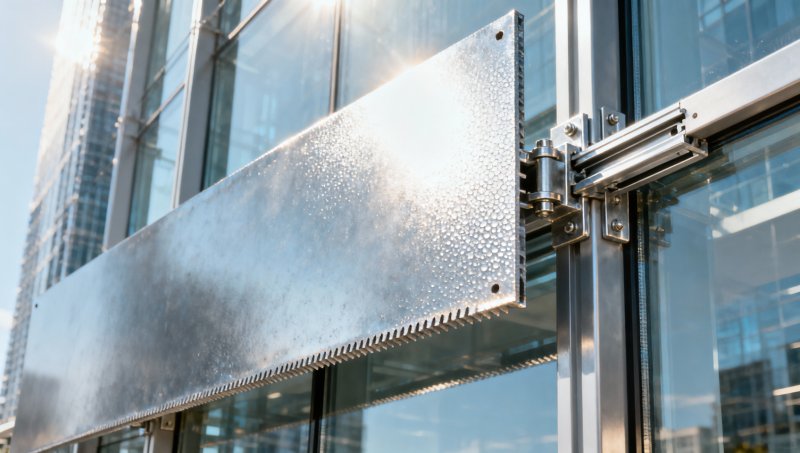
Where galvanized sheet fits—and where it doesn’t—in the broader structural strategy
Galvanized steel sheet excels as a durable, dimensionally stable cladding substrate—but it’s rarely the sole structural element in high-rise façades. Its role is typically non-load-bearing: a weather-resistant skin supported by a separate framing system. That framing, however, demands materials capable of carrying seismic and wind loads over the building’s lifetime. Here, high-strength reinforcement like HRB500 Rebar becomes essential in the concrete cores, outriggers, and transfer structures that anchor the entire façade assembly. While the sheet manages surface-level thermal response, the rebar ensures the underlying structure absorbs dynamic forces without compromising the façade’s geometric stability.
This layered responsibility is why façade durability isn’t solved at the sheet level alone. It’s the outcome of coordinated material selection: galvanized sheet that moves predictably, framing that accommodates that movement, and primary structure that remains immovable under load. Compromise any one, and the others bear unintended consequences.
For installers, the takeaway is operational: inspect sheet flatness on arrival—not just for dents, but for subtle edge lift using a straightedge. For façade engineers, it’s procedural: require thermal movement calculations that include substrate stress relaxation, not just CTE. And for procurement teams, it’s contractual: specify stress-relief and coating-phase requirements explicitly—not as “recommended,” but as mandatory pass/fail criteria.
Thermal expansion in high-rise façades isn’t a problem to eliminate. It’s a physical law to respect. Galvanized steel sheet for construction earns its place not by being immune, but by behaving with enough consistency that you can design *around* it—not against it.
Please give us a message


Please enter what you want to find