How flange thickness affects 200 mm I-beam weight per meter
A 200 mm I-beam’s nominal depth alone does not determine its weight per meter. Flange thickness is a key variable affecting cross-sectional area, material cost, and structural performance. When evaluating 200 i beam weight per meter, compare flange width, web thickness, and the applicable section standard rather than assume all 200 mm beams are equivalent.
This matters when a drawing specifies only “200 mm I-beam,” or when two quotations show different kilogram-per-meter values for apparently similar material. The difference may be legitimate: the suppliers could be quoting different section families, flange geometries, or manufacturing routes. Before treating the heavier offer as overpriced—or the lighter offer as more efficient—identify exactly which cross-section each price covers.
What “200 mm” tells you—and what it leaves out
The 200 mm description generally refers to nominal section depth. It does not uniquely identify flange width, flange thickness, web thickness, root radius, or mass. Depending on the designation system, actual depth may also differ from the nominal size used to identify the series.
A narrow-flange I-section and a wide-flange H-section near the same depth can have substantially different cross-sectional areas. Even within one section family, heavier variants may change several dimensions together. A mass difference cannot automatically be attributed to flange thickness alone.
Flange geometry also changes how dimensions should be interpreted. Parallel-flange sections have comparatively straightforward thickness dimensions. Tapered-flange sections have varying thickness across the flange width, so a single quoted thickness must be read according to the relevant section drawing. Applying a rectangular-flange formula to that value without checking its definition can produce a misleading estimate.
For a reliable comparison, obtain the complete designation and a dimensioned cross-section. “200 I-beam” is a starting description, not a complete technical specification.
How flange thickness changes theoretical mass
Theoretical mass per meter comes from cross-sectional area multiplied by steel density. Using the conventional calculation density of 7,850 kg/m³, an area expressed in square millimeters converts as follows:
Mass per meter, m = A × 0.00785
Here, m is in kg/m and A is in mm². This is a theoretical calculation, not a guarantee that every delivered beam will weigh exactly the tabulated amount.
For an idealized, symmetrical I-section with rectangular parallel flanges and no root fillets, the area is:
A = 2btf + (h − 2tf)tw
- h: overall section depth
- b: flange width
- tf: thickness of each flange
- tw: web thickness
The web height is reduced by the two flange thicknesses because the overall depth includes both flanges. This avoids counting the web-to-flange intersection twice.
If overall depth, flange width, and web thickness remain fixed, increasing the thickness of both flanges by Δtf changes mass by:
Δm = 2(b − tw) × Δtf × 0.00785
The subtraction of web thickness is small but important. Simply calculating the added area as 2b × Δtf ignores the reduction in clear web height when overall depth stays constant. If a fabricated section instead keeps its clear web height constant, increasing flange thickness increases overall depth, and a different comparison applies.
A worked comparison—not a standard section table
Consider an illustrative section with overall depth 200 mm, flange width 100 mm, and web thickness 6 mm. The following values use the simplified rectangular model. They are calculation examples, not published weights for a named rolled section.
In this example, each 1 mm increase in both flange thicknesses adds approximately 1.48 kg/m. Moving from 8 mm to 10 mm adds about 2.95 kg/m, or 17.7 kg over a 6 m beam. Across a beam schedule, this becomes a measurable difference in ordered tonnage, lifting weight, and transport planning.
That sensitivity belongs to these dimensions only. Wider flanges produce a larger mass increase for the same thickness change. A different web thickness changes the result too. There is no universal “kilograms per extra millimeter” value for all 200 mm beams.
Why published section weights can differ from your calculation
Hot-rolled sections include root fillets and may have flange taper or other geometric features absent from the simplified model. For specification work, use the area and mass published for the exact section designation in the applicable standard or verified manufacturer’s table. Use the rectangular calculation as a reasonableness check, not as a replacement.
Standards also have different jobs. EN 10365 provides dimensions and masses for specified hot-rolled channel, I, and H sections. EN 10034 addresses shape and dimensional tolerances for structural steel I and H sections within its scope. ASTM A6/A6M contains general requirements for rolled structural steel products, while JIS G 3192 and GB/T 706 are relevant references for section dimensions and related requirements in their respective systems. Confirm the applicable edition and scope rather than assuming these references define interchangeable beams.
A material grade standard is another part of the specification. It identifies requirements such as mechanical properties and chemistry; it does not, by itself, establish the cross-sectional dimensions. Selecting a higher-strength grade does not materially change theoretical mass when geometry remains the same.
When two tables disagree, check the section family, designation, units, radii, and nominal dimensions before investigating rounding. A value in kg/m is not directly comparable with lb/ft, and an approximate depth designation is not proof of dimensional equivalence.
More flange material changes performance—but weight is not a design check
Flanges carry much of the longitudinal stress in major-axis bending. Adding material away from the neutral axis generally increases the second moment of area and section modulus. Thicker flanges can therefore improve bending stiffness and resistance, subject to the section geometry and design method.
The gain is not simply proportional to the increase in kg/m. With overall depth fixed, thicker flanges also move their centroids inward and reduce the clear web height. The resulting section properties should be taken from an authoritative table or calculated for the actual geometry.
Flange thickness also affects flange slenderness and local buckling checks. However, it does not remove the need to assess lateral-torsional buckling, unrestrained length, load position, connections, or web resistance under concentrated loads. A heavier beam can still be unsuitable for a particular support arrangement.
For a proposed substitution, compare section properties, steel grade, stability conditions, and connection details—not just mass. A wider, thinner-flange section may behave differently from a narrower, thicker-flange section even when their weights are close.
Separate bare-steel mass from coating and delivered weight
Published section masses normally describe the steel cross-section, not an arbitrary coating system. If beams are supplied hot-dip galvanized, coating contributes additional mass. That contribution depends on coated surface area and coating requirements, not simply on the beam’s nominal depth.
Projects combining structural beams with galvanized cladding or secondary components should keep those specifications separate. For example, Galvanized Steel Coil Sheet is offered in thicknesses of 0.12–3.5 mm and widths of 600–1,500 mm for relevant sheet applications. Its sheet gauge and zinc-coating designation are not substitutes for an I-beam’s flange thickness or a fabricated beam’s galvanizing specification.
Delivered mass can also differ from theoretical mass because of permitted dimensional variation, actual cut length, and fabrication additions. Ask whether the quotation and invoice use nominal section mass or actual weighed mass, and whether coating, plates, weld metal, and packaging are included. These distinctions matter when reconciling a theoretical take-off with shipping documents.
What to verify before approving a supplier’s section
A useful technical submission makes the quoted weight traceable to a specific section. Request the following information together:
- Full section designation: including series, size, and whether the beam is rolled or fabricated.
- Dimensioned drawing: showing depth, flange width, web and flange thicknesses, plus relevant radii or taper.
- Mass reference: the governing section table, calculation basis, or agreed weighing method.
- Specification references: material grade, dimensional tolerances, and required inspection documentation.
- Supply condition: cut lengths, coating, fabrication scope, quantity basis, and acceptance criteria.
For international sourcing, this is more useful than a general statement that material follows “ASTM, EN, JIS, or GB.” Hongteng Fengda, a China-based structural steel manufacturer and exporter supplying beams, channels, angles, cold-formed profiles, and customized components, can be evaluated against the same document-based requirements. Standard and OEM offers should identify which requirements govern the actual supplied item.
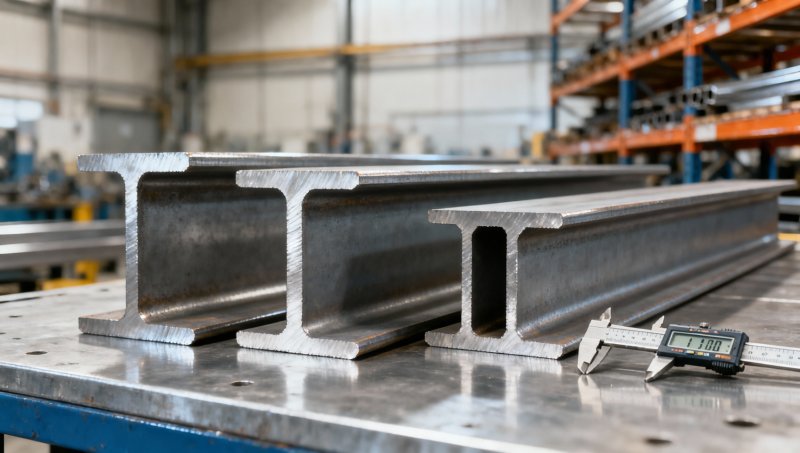
A flange-thickness measurement can help resolve a discrepancy, but it must be taken at the location defined for that section geometry. Root fillets and tapered surfaces can distort an informal caliper reading. Acceptance should follow the applicable tolerance and inspection provisions, not an isolated measurement without context.
The practical conclusion is straightforward: there is no single defensible answer to “200 i beam weight per meter” without a section designation. Establish the geometry first, verify the published theoretical mass, and review structural properties before approving any lighter or heavier alternative. That sequence keeps a sourcing comparison from becoming an unintended design change.
Please give us a message


Please enter what you want to find