When specifying food-grade SS pipe, understanding how the price of SS pipe varies between cold-drawn and seamless grades is critical for cost control and compliance. For buyers seeking competitive ss 304 pipe price per meter, factors like manufacturing method, ASTM steel pipe certification, and surface finish directly impact both performance and budget. As a trusted industrial steel supplier from China, Hongteng Fengda offers precision-cold-drawn and seamless SS 304/316 pipes meeting FDA and ISO 20858 standards—backed by rigorous QA and scalable cold rolled steel plate integration. Discover how material choice affects total project cost, hygiene assurance, and long-term ROI.
Why Manufacturing Method Directly Shapes Cost & Hygiene Performance
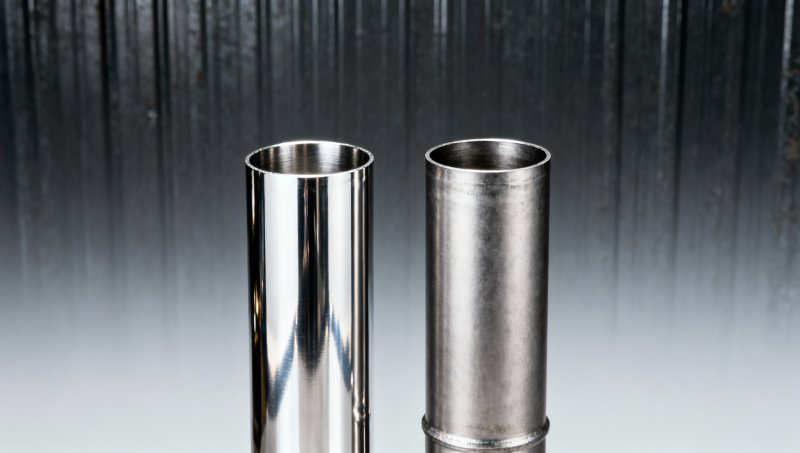
Cold-drawn and seamless stainless steel pipes serve overlapping food-grade applications—but their production pathways create distinct cost structures and functional boundaries. Seamless pipes are formed via piercing and hot extrusion, delivering uniform wall thickness and high pressure tolerance (up to 25 MPa at 20°C), yet require extensive post-processing for surface polish (Ra ≤ 0.4 μm) to meet FDA 21 CFR 178.3570 requirements. Cold-drawn pipes undergo multiple cold reduction passes followed by bright annealing in controlled atmospheres—achieving tighter dimensional tolerances (±0.05 mm OD), superior surface smoothness (Ra ≤ 0.25 μm), and enhanced corrosion resistance without pickling.
From a procurement standpoint, cold-drawn SS 304 pipe typically commands a 12–18% premium over seamless equivalents of identical grade and size. This reflects higher energy input, stricter process controls, and lower yield rates—especially for diameters under 50 mm and wall thicknesses below 2.0 mm. However, this premium often delivers ROI through reduced cleaning downtime, extended service life in CIP/SIP cycles, and fewer rejection incidents during third-party audit inspections.
Hongteng Fengda maintains dual-track production lines: one dedicated to ASTM A312 seamless tubing (EN 10216-5 compliant), and another optimized for ASTM A269 cold-drawn sanitary tubing. Both lines integrate automated surface roughness measurement and helium leak testing at 10⁻⁹ mbar·L/s sensitivity—ensuring zero micro-porosity in weld-free zones.
How Price Differentials Translate Across Key Procurement Dimensions
The “price per meter” of SS pipe isn’t a static figure—it shifts dynamically based on four interdependent variables: dimensional precision, surface finish grade, certification depth, and order volume. For example, a 32 mm OD × 1.5 mm WT SS 304 pipe priced at $8.20/m for standard seamless grade rises to $9.60/m when specified with Ra ≤ 0.3 μm electropolished finish and full traceability (heat number + mill test report + FDA compliance statement).
Below is a comparative breakdown of typical cost drivers across 10 common procurement scenarios:
Note: These ranges reflect typical lead times and tolerances for orders between 500–5,000 meters. Smaller batches (<200 m) incur +15–22% surcharges due to setup recalibration and QA sampling overhead.
Where Galvanized Stainless Steel Wire Fits Into Broader Food-Grade Infrastructure
While cold-drawn and seamless pipes form the core fluid conveyance system, auxiliary components like Galvanized Stainless Steel Wire play critical supporting roles in food-grade environments—particularly for mesh filtration, equipment guarding, and hygienic fastening solutions. Though not intended for direct product contact, its zinc-coated low-carbon steel construction (Q195/Q235) provides robust mechanical integrity while resisting ambient moisture and cleaning agent exposure.
With wire diameter options spanning 0.25 mm to 5.0 mm and zinc coating thickness ranging from 8–25 g/m², this material balances ductility and corrosion resistance across diverse installation contexts—from stainless steel wire mesh enclosures (ISO 20858 Class II compliant) to tensioned barrier isolation systems in packaging lines. Its ability to retain coating integrity after cold forming (bending, stamping, rolling) makes it ideal for custom-fabricated guards and fixtures requiring frequent sanitation.
Hongteng Fengda supplies this wire in coil formats (50–1,000 kg) with plastic film inner wrap and woven bag outer packaging—ensuring protection during transit and warehouse handling. Tensile strength consistently falls within 350–550 MPa, enabling reliable performance under dynamic load conditions typical in high-speed packaging or breeding facility applications.
What Technical Buyers Should Verify Before Finalizing an Order
To avoid costly rework or compliance gaps, technical evaluators and procurement teams must jointly validate five non-negotiable checkpoints before contract signing:
- Mill Test Report (MTR) includes full chemical composition (Cr ≥ 18.0%, Ni ≥ 8.0% for 304; Cr ≥ 16.0%, Ni ≥ 10.0%, Mo ≥ 2.0% for 316) and mechanical properties (Yield ≥ 205 MPa, UTS ≥ 515 MPa)
- Surface finish verification via calibrated profilometer—not visual inspection alone—and documented Ra value matching specification
- Traceability documentation linking each pipe length to its heat number, annealing batch, and final inspection record
- Third-party certification copies (e.g., SGS or TÜV) confirming compliance with FDA 21 CFR 178.3570 and ISO 20858:2016 Annex B
- Delivery packaging meets EN 1092-1 flange sealing requirements if pipe ends are threaded or beveled for welding
Hongteng Fengda’s quality assurance protocol includes 100% ultrasonic testing (UT) for seamless pipes >25 mm OD and eddy current testing (ECT) for all cold-drawn tubing—ensuring detection of subsurface discontinuities down to 0.15 mm depth.
Why Global Buyers Choose Hongteng Fengda for Food-Grade SS Pipe Sourcing
Beyond competitive pricing and dual-process capability, Hongteng Fengda delivers three operational advantages that reduce total cost of ownership for food, beverage, and pharmaceutical clients:
- Integrated Material Traceability: Each shipment includes QR-coded labels linking pipe batches to raw material mill certificates, in-process QA logs, and final inspection reports—cutting audit prep time by up to 40%.
- Scalable Cold-Rolled Plate Sourcing: Our in-house cold rolled steel plate production ensures consistent substrate quality for cold-drawn pipe—eliminating variability from external coil suppliers.
- Regional Compliance Support: We pre-certify products for key markets: NSF/ANSI 51 for North America, EC 1935/2004 for EU, and SASO 2752 for Saudi Arabia—reducing client-side certification lead time by 3–6 weeks.
Ready to compare exact pricing for your required dimensions, finish grade, and certification scope? Contact our technical sales team today for a customized quote—including sample availability, delivery schedule (standard: 18–25 days), and OEM marking options.
Please give us a message


Please enter what you want to find