A lower steel wire gauge number normally means a thicker wire, and thicker wire has a larger metal cross-section to resist pulling, bending, abrasion, and localized damage. That relationship is central to fence strength, but gauge alone does not define whether a fence will perform well. Wire material, tensile grade, coating, mesh pattern, post spacing, corner construction, and the load applied to the fence all change the result.
For a simple comparison, a thick low-gauge wire generally carries more tension before permanent elongation than a thin high-gauge wire of the same steel grade. It also loses less section from surface wear or corrosion before its remaining strength becomes unacceptable. Yet a heavy wire installed with weak terminal posts or poor bracing can still fail before a lighter wire on a properly designed fence line.
Gauge changes the wire's resistance to load
Fence wire is loaded in several different ways. A tensioned line wire is pulled lengthwise between end assemblies. A welded or woven mesh fence spreads a pushing or impact load through intersecting wires. A barbed-wire line is subject to tension, vibration, and occasional sudden force. Gauge affects each condition because wire diameter changes both cross-sectional area and bending stiffness.
Axial tensile capacity rises as the steel area increases. A small change in diameter can create a meaningful change in area because area is based on the square of the diameter. This is why two wire sizes that look similar by eye can behave differently when stretched over a long run or hit by equipment, livestock, wind-borne debris, or repeated gate-side contact.
Bending stiffness increases even faster as diameter grows. Thin wire bends readily around a post, but it also deforms more easily when pressed or climbed on. Heavier wire is harder to kink and holds a straighter line under service load. That benefit matters at the bottom of a fence, near gates, and in locations where the mesh is regularly pushed sideways.
Strength should be separated from stiffness. High-tensile steel wire can carry substantial longitudinal tension at a relatively small diameter, while a softer, heavier low-carbon wire may feel more rigid against a sideways push. A specification that states only the gauge leaves out this distinction. The steel grade and stated tensile property must be read alongside the diameter.
Why a gauge number cannot be interpreted by itself
Wire gauge systems are not universally interchangeable. A gauge designation can refer to different nominal diameters under different regional systems, product categories, or supplier conventions. The correct purchasing and installation reference is the actual wire diameter, usually stated in millimeters or inches, together with its tolerance. When replacing a damaged roll or joining new mesh to an existing fence, matching the printed gauge without confirming diameter can produce uneven tension and inconsistent appearance.
Coating also changes what is measured. Galvanized wire has a zinc layer over the steel core; polymer-coated wire has an additional outer layer. A nominal finished diameter may include that coating, while the underlying steel core determines much of the tensile load capacity. A heavier-looking coated wire is not automatically stronger than a smaller-diameter bare or galvanized high-tensile wire. Product documentation should make clear whether the diameter applies to the core wire or the finished wire.
Welded mesh introduces another qualification. The wire can be sound while the weld intersection becomes the controlling point under severe deformation. Mesh made from thinner wire with reliable welds and suitable panel supports may outlast a poorly welded heavier mesh. For chain-link fabric, the diamond geometry, selvage treatment, tension bar engagement, and fabric tension also influence the final barrier strength.
Fence loads are rarely uniform
A fence seldom fails because every wire reaches its limit at once. Loads concentrate at particular points: terminal posts, corners, gate openings, line-post connections, low spots, changes in direction, and damaged sections. Steel wire gauge should therefore be selected with the critical load path in mind rather than by the average condition along the route.
Long fence runs
On long, tensioned runs, wire elongation and seasonal movement deserve attention. A smaller-diameter high-tensile wire can be effective when end assemblies are adequately braced and tension is set within the product guidance. It remains taut with fewer intermediate supports than soft wire in certain fence designs, but it stores considerable energy. A failed splice, damaged insulator, or loosened termination can release suddenly. Splices and grips must be compatible with the wire's tensile grade, not merely its diameter.
Soft galvanized wire is more forgiving during hand forming and repairs, but it can require closer post spacing or more frequent retensioning when used in a high-load line. Repeated tightening does not restore original wire condition indefinitely. If a wire has been sharply kinked, heavily abraded, or stretched beyond its elastic range, replacement is more dependable than repeatedly pulling it tight.
Impact and pressure loads
Where the fence must resist repeated body pressure, accidental impacts, or attempts to force an opening, gauge contributes to puncture resistance and resistance to permanent distortion. The mesh opening size matters at the same time. A heavier wire with wide openings may permit enough local movement for an object to enter or pass through, while a lighter but closely spaced mesh may distribute load across more intersections.
Panels supported along their full edge behave differently from unsupported roll mesh fixed only at intervals. A robust wire panel can bow if its rails, clips, or posts are undersized. Conversely, an overly rigid mesh on light posts transfers impact directly to the supports, increasing the chance of post bending or footing movement. The fence is a structural assembly, not a wire sample.
Animal containment
Containment fencing must address the way contact occurs. An animal that leans, rubs, bites, paws, or presses repeatedly creates a different demand from one that makes an occasional direct impact. Lower wires are exposed to abrasion from soil, vegetation, and cleaning equipment; top wires see greater leverage when the fence is pushed down. A thicker lower line may be useful where ground contact is common, even when the remaining lines use a lighter specification.
Wire height and visibility can reduce load before gauge becomes relevant. A fence that is difficult to see may receive more impacts. Loose wire invites further pressure because it yields at first contact. Correct initial tension, stable spacing, and prompt repair of sagging sections are as important as choosing a strong wire.
Corrosion changes the effective gauge over time
Steel does not retain its original cross-section if corrosion progresses. Rust loss is especially serious on thin wire because a small reduction in diameter represents a larger share of its original metal area. Corrosion is often worst at ground contact, inside overlapping joints, beneath damaged coatings, near incompatible metals, and in places where moisture is trapped against the wire.
Galvanized coating delays steel corrosion, but the useful performance of the coating depends on coating mass, surface preparation, handling damage, and exposure conditions. Salt spray, fertilizer contact, wet organic debris, industrial contaminants, and persistent standing water can shorten coating life. Scraping wire over sharp steel edges during installation removes protective material at exactly the points where stress is concentrated.
A heavier gauge should not be used as a substitute for appropriate corrosion protection. Selecting thick unprotected wire for a persistently wet or chemically aggressive location can lead to early section loss. Likewise, specifying a durable coating on wire that is too thin for the mechanical load creates a fence that resists rust but deforms under service. Mechanical demand and exposure demand need separate evaluation.
Gauge selection by fence construction
For chain-link fencing, fabric wire gauge is only part of the selection. A heavier fabric generally resists cutting, bending, and wear better, but its performance still depends on tension bars carrying the full fabric height, properly sized posts, and top or bottom rails where required by the application. A heavy fabric loosely attached to inadequate framework can rattle, sag, and place excessive stress at a few ties.
Woven agricultural mesh has horizontal line wires and vertical stay wires that do different jobs. The line wires carry much of the installed tension, while the stays maintain spacing and prevent the openings from spreading. Comparing only the overall mesh gauge can hide an important difference: two products may use similar-looking wire but allocate material differently between line wires and stays. The lower portion also often needs closer spacing when smaller animals are present, which affects both containment behavior and mesh rigidity.
For welded wire, wire diameter and panel form are linked. Roll mesh can conform to uneven terrain but requires enough fixing points to prevent waves and bulges. Rigid panels resist casual deformation well, yet uneven ground can leave gaps below the panel or force the frame out of alignment. Trying to bend a heavy welded panel to follow a sharp grade change can crack coating around welds or place persistent stress into the panel.
Barbed wire should be judged by the line-wire construction, tensile grade, barbing pattern, and installation tension rather than by barbs alone. Thicker line wires withstand handling and abrasion better, but excessive tension can overload posts or cause the wire to fail at a damaged point. Barbed products also need careful handling because twisting, dragging, and poorly formed connections can damage both the coating and the wire.
Installation can erase the benefit of a heavier wire
Over-tensioning is a common source of trouble. Heavier wire is often assumed to tolerate unlimited pull, but tension must suit the product grade, span length, temperature, terminal assembly, and fence layout. Excessive tension raises loads at corners and gateways, makes subsequent repair harder, and can turn a minor defect into a sudden break. Under-tensioning produces the opposite problem: wire sags, connections work loose, and impact becomes concentrated instead of being shared along the fence.
Sharp bends deserve particular attention. Bending a high-tensile wire around a small-radius post edge, repeatedly unbending it, or gripping it with worn pliers can create a notch-like damage point. The visible wire may still appear intact, yet break later under tension. Use fittings, clips, sleeves, and tensioning hardware designed for the actual diameter and wire type. Hardware that is too large permits slipping; hardware that is too small can crush coating or score the steel.
Joining dissimilar gauges in the same tensioned line requires restraint. The thinner section becomes the limiting section, and different stiffness can make tension distribution uneven. A transition may be acceptable for a controlled repair, but it should be placed away from high-stress terminals, corners, and gate hardware. A repair segment also needs enough overlap or an approved mechanical connection to transfer the expected load without slipping.
Reading a wire specification before installation
A usable fence-wire specification identifies more than a gauge label. It should state nominal diameter, material or steel grade, tensile classification where applicable, coating description, roll or panel form, mesh dimensions for fabric, and relevant tolerances. For mesh products, confirm whether listed wire size applies to every wire or whether line wires, stays, border wires, and edge wires differ.
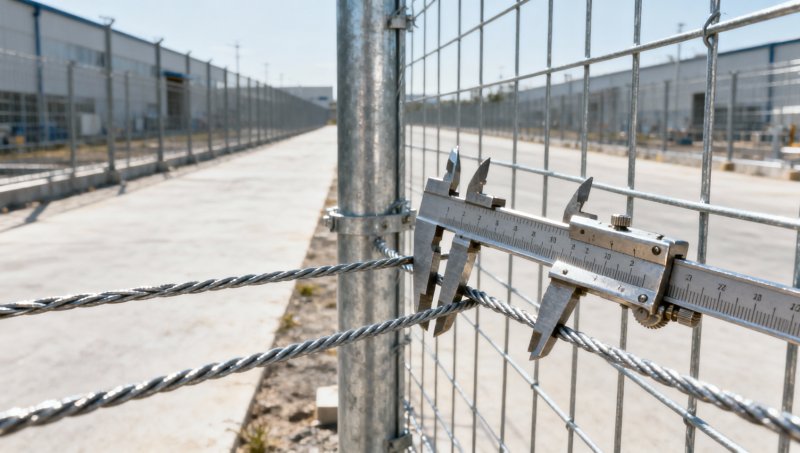
Measure received wire where doubt exists, especially when matching an existing installation. A caliper reading should be taken on an undamaged, representative section and interpreted against whether the published dimension is core or finished diameter. Do not measure over a burr, a thick coating buildup, a welded intersection, or a visibly flattened point. For coated products, cutting through the coating merely to verify diameter creates a corrosion initiation point and is rarely a sound field method.
The right steel wire gauge is therefore the one that matches the fence's governing load, construction, and exposure condition. Select it with the steel grade and coating, then preserve its capacity through suitable posts, tension control, compatible fittings, and inspection of high-stress locations. That approach prevents a nominally heavy wire from becoming the weakest part of the fence system.
Please give us a message


Please enter what you want to find