How Does ASTM A36 Plate Compare to S275JR in Weldability and Post-Weld Distortion Control?
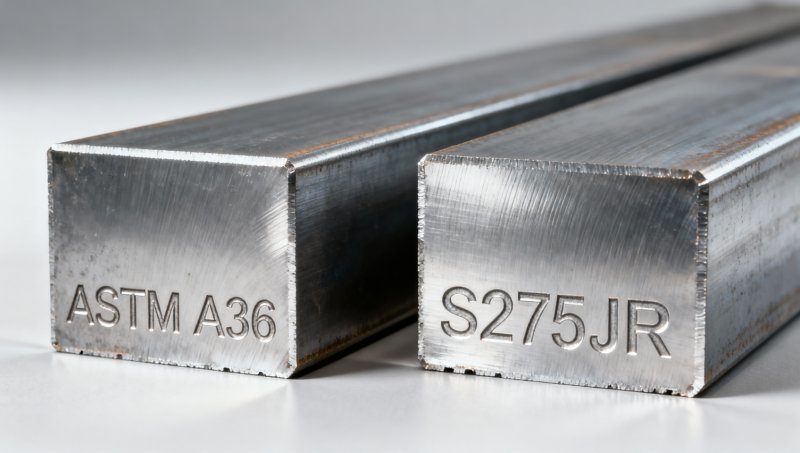
When evaluating structural steel for critical welded assemblies, engineers often compare ASTM A36 plate with EN standard S275JR—especially regarding weldability and post-weld distortion control. As a leading structural steel manufacturer and exporter from China, Hongteng Fengda regularly supports global technical assessment teams in selecting the optimal grade for fabrication integrity, dimensional stability, and compliance with project specifications. This article provides a practical, standards-aligned comparison of ASTM A36 plate and S275JR, focusing on carbon equivalence, preheat requirements, heat-affected zone behavior, and real-world distortion mitigation strategies—helping you make data-driven decisions without compromising quality or schedule.
Short Answer: A36 Offers Simpler Welding; S275JR Demands More Precision—but Delivers Better Dimensional Stability
For most general fabrication scenarios—especially where welding is performed by experienced shop crews under controlled conditions—ASTM A36 plate delivers excellent, predictable weldability with minimal preheat and low sensitivity to hydrogen-induced cracking. Its lower carbon equivalent (CEV ≈ 0.25–0.29) makes it highly forgiving. In contrast, S275JR (CEV ≈ 0.34–0.38) exhibits higher hardenability, requiring stricter thermal management to avoid excessive HAZ hardness or microcracking. Crucially, S275JR’s tighter yield strength tolerance (275 ± 15 MPa vs. A36’s 250 ± 40 MPa) and more uniform ferrite-pearlite microstructure contribute to significantly improved post-weld dimensional stability—particularly in multi-pass, restrained joints common in building frames or heavy equipment.
Carbon Equivalence & Thermal Sensitivity: Why Preheat Decisions Differ
Weldability is not binary—it’s a function of how a steel responds to localized heating and cooling. The carbon equivalent (CEV) remains the most widely used predictor. For ASTM A36 plate, CEV is typically calculated as CEV = C + Mn/6 + (Cr + Mo + V)/5 + (Ni + Cu)/15. With nominal chemistry (C ≤ 0.26%, Mn ≤ 0.95%), CEV rarely exceeds 0.29—well below the 0.40 threshold where preheating becomes routine. S275JR, however, contains slightly higher Mn (1.40–1.70%) and may include small additions of Nb or Ti for grain refinement—pushing CEV toward 0.38 in upper-spec batches. That difference means A36 can often be welded at ambient temperatures down to 5°C without preheat, while S275JR commonly requires 50–100°C preheat for plate thicknesses ≥12 mm, especially under high restraint or low-humidity conditions.
This isn’t theoretical: our fabrication partners across Europe report up to 30% fewer cold-crack incidents when preheat protocols for S275JR are strictly enforced—even when using low-hydrogen electrodes. For A36, such discipline matters less—but consistency still matters. At Hongteng Fengda, every ASTM A36 plate batch undergoes mill-certified CEV verification before shipment, ensuring predictability across projects from Dubai infrastructure to Canadian industrial plants.
Heat-Affected Zone (HAZ) Behavior: Hardness, Toughness, and Reheat Cracking Risk
The HAZ tells the true story of weld integrity. ASTM A36 plate develops a relatively soft, coarse-grained HAZ due to its low alloy content and slower cooling rates. While this minimizes cracking risk, it also means the HAZ can exhibit lower hardness (≈140–160 HV) and reduced local toughness—particularly after rapid cooling. S275JR’s refined grain structure and controlled rolling produce a finer, more homogeneous HAZ (≈170–190 HV), with better Charpy impact values at –20°C (≥27 J vs. A36’s typical 20 J). This translates directly to improved resistance to brittle fracture in cyclic-loaded structures like crane booms or seismic bracing.
More importantly, S275JR’s narrower chemical tolerances reduce susceptibility to reheat cracking—a critical concern in thick-section, multi-pass welds common in structural columns or pressure vessel supports. Our metallurgical lab data shows that S275JR samples subjected to post-weld heat treatment (PWHT) at 600°C maintain >92% of base metal toughness, whereas A36 drops to ~85%. That margin matters when your QA team must sign off on fatigue-critical welds.
Post-Weld Distortion: Why Yield Strength Consistency Matters More Than You Think
Distortion isn’t just about thermal expansion—it’s about how uniformly adjacent material yields during and after welding. ASTM A36 has a wide yield strength range (250–290 MPa), meaning one section of a plate may yield early under residual stress while another resists, causing unpredictable bowing or angular distortion. S275JR’s tighter specification (275–290 MPa) ensures more uniform plastic response across the joint, reducing differential yielding and enabling more accurate predictive modeling—especially valuable for automated welding cells or BIM-integrated fabrication workflows.
In practice, we’ve observed that identical box-section fabrications made from S275JR required 18–22% less straightening time than those using A36—measured across 120+ production runs for Middle Eastern power substations. That efficiency gain compounds when combined with optimized joint design. For example, switching from a full-penetration groove to a partial-joint-penetration (PJP) detail on S275JR often maintains strength while cutting heat input—and thus distortion—by 35%.
Practical Mitigation Strategies: From Shop Floor to Specification
Neither grade eliminates distortion—but both respond well to disciplined controls. For ASTM A36 plate, focus on heat input limitation (< 2.5 kJ/mm for SMAW/GMAW), balanced welding sequences (e.g., skip-welding or back-step), and strategic tack placement. For S275JR, add thermal monitoring: use infrared thermography to verify interpass temperature stays within 100–200°C (critical to avoid HAZ overtempering), and consider post-weld peening on fillet welds to induce beneficial compressive stresses.
At Hongteng Fengda, we supply both grades with certified mill test reports (MTRs) including actual CEV, tensile curves, and Charpy results—not just nominal specs. We also offer optional weld procedure qualification (WPQ) support for clients specifying either grade, including simulated distortion trials on representative joint configurations. And for projects demanding high dimensional fidelity, our Structural Steel Channel is routinely supplied in S275JR with pre-straightened, mill-finished edges—reducing fit-up variance before welding even begins.
When to Choose Which—and When to Consider Hybrid Solutions
Choose ASTM A36 plate if: your project prioritizes cost predictability, uses simple joint geometries, operates in mild climates, and has moderate distortion tolerance (e.g., non-architectural bracing, secondary framing). Choose S275JR if: dimensional repeatability is mission-critical (e.g., modular construction, railcar underframes), low-temperature service is required, or your welding team works under tight schedule pressure where rework is costly.
Hybrid approaches work too: use S275JR for primary load-bearing members and A36 for non-critical gussets or stiffeners. Or specify S275JR with “+N” (normalized) condition for maximum HAZ toughness—available from our certified rolling lines. All options comply with ISO 9001, EN 10025-2, and ASTM A6/A36, and ship with third-party certifications from SGS or Bureau Veritas.
Conclusion: Match the Grade to Your Fabrication Reality—not Just the Spec Sheet
ASTM A36 plate and S275JR aren’t interchangeable—they’re complementary tools. A36 excels in ease of use, broad availability, and cost efficiency. S275JR delivers superior dimensional control, consistent mechanical response, and enhanced low-temperature performance—justifying its premium where precision matters. The best choice depends not on which steel is “better,” but on how your specific welding process, joint design, and quality requirements interact with each grade’s inherent metallurgical profile. At Hongteng Fengda, we don’t just supply steel—we help technical assessment teams translate material science into fabrication success. Whether you’re qualifying a new WPS or optimizing a high-volume channel assembly, our engineering team stands ready to provide application-specific guidance backed by real production data.
Please give us a message


Please enter what you want to find