For quality control and safety managers, machine guarding is rarely a simple “install it and forget it” task. A guard must prevent access to hazardous motion, remain visible enough for operators to work confidently, withstand daily contact, and continue performing after exposure to oil mist, humidity, cleaning routines, and routine production traffic. In many industrial settings, galvanized mesh sheets offer a practical way to balance those requirements.
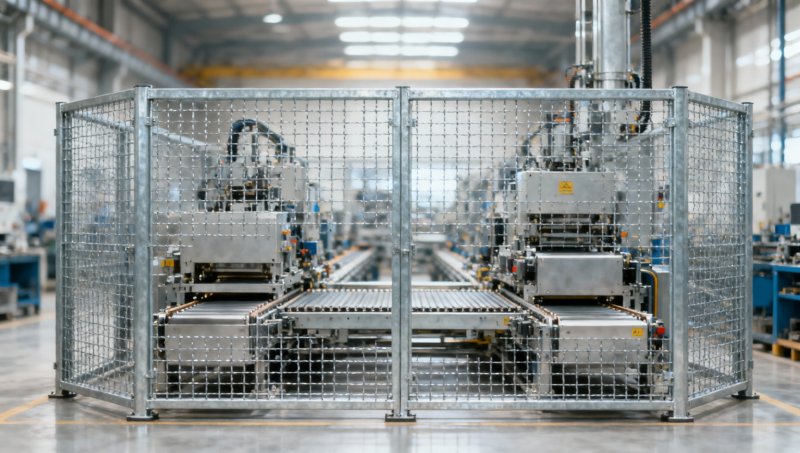
Used as infill panels for perimeter guards, robot cells, conveyor enclosures, belt-drive covers, and restricted-access partitions, galvanized steel mesh creates a physical barrier without turning the production area into a closed visual box. The open structure supports sightlines and airflow, while the zinc-coated surface provides a useful layer of corrosion resistance for demanding factory environments.
The result is not merely a fence around a machine. When correctly specified, supported, fixed, and inspected, mesh guarding becomes part of a safer operating system—one that helps people recognize hazards, respect access boundaries, and identify abnormal machine conditions before they escalate.
Why machine guarding needs more than a strong panel
A safety barrier can look solid and still be unsuitable for the risk it is meant to control. The key question is not whether a person can see the mesh; it is whether the guard prevents a hand, finger, arm, tool, or loose garment from reaching a danger zone during normal operation, cleaning, adjustment, or foreseeable misuse.
Machine guards are often installed around moving shafts, gears, chain drives, cutting heads, automated handling equipment, presses, welding cells, and conveyors. Each application presents different risks. A perimeter fence around a robot cell may need to define a protected zone and work with interlocked access doors. A close-fitting guard around a belt drive may need much smaller openings because workers can stand directly beside the hazard.
This is why safety managers should avoid choosing mesh based only on a general label such as “heavy-duty” or “industrial.” The opening size, wire diameter, panel rigidity, clearance from the hazard, frame design, mounting points, and door arrangement all affect the guard’s real protective performance. Galvanized mesh sheets are a versatile material, but they must be engineered into the right guarding design.
How galvanized mesh sheets contribute to safer guarding
Clear visibility supports safer behavior
Opaque sheet-metal guards can be appropriate where containment, noise reduction, or shielding is the main priority. Yet they can also hide jammed product, damaged components, accumulated debris, or unsafe operator behavior. Mesh panels maintain a visual connection with the protected equipment. Operators can check whether a conveyor is clear, supervisors can observe a robot cell from outside the boundary, and maintenance personnel can identify obvious issues before opening an access point.
Visibility is not a substitute for interlocks, lockout/tagout procedures, or trained supervision. It does, however, make day-to-day control easier. A guard that allows people to see the process is less likely to be bypassed simply because operators feel they are working “blind.”
Ventilation reduces enclosure-related problems
Motors, drives, welding systems, and processing equipment may generate heat, dust, vapor, or airborne residue. The open pattern of steel mesh allows air to circulate more freely than a fully enclosed solid panel. This can reduce heat buildup around equipment and help facility teams maintain effective ventilation without cutting additional openings into a guard later.
In dusty operations, mesh also makes housekeeping conditions more visible. That said, opening design should always consider the material being processed. Fine combustible dust, corrosive vapors, or splash hazards may require a more specialized enclosure strategy than standard mesh guarding alone.
Galvanizing supports durability in real factory conditions
Machine guards are frequently exposed to condensation, washdown splash, cleaning chemicals, metalworking fluids, humid air, and incidental impacts from carts or workpieces. Bare steel can develop surface corrosion that weakens appearance, complicates cleaning, and eventually affects structural integrity. A galvanized finish helps protect the steel substrate by adding a zinc coating that resists corrosion in many common industrial environments.
For quality teams, this matters because a guard that stays intact and presentable is more likely to remain in service as intended. Rust around cut edges, welds, fasteners, or damaged coating should still be addressed during inspection. Galvanizing improves resilience; it does not eliminate the need for condition checks or suitable material selection in highly corrosive settings.
Rigid panels define access boundaries
Flexible wire fencing may be useful in some temporary applications, but permanent machine guarding generally benefits from stable, framed panels. Galvanized mesh sheets can be welded, bolted, or captured within structural steel frames to create defined protective zones. When paired with properly designed posts, base plates, doors, and fasteners, the mesh helps establish a barrier that is difficult to casually move, lift, or deform.
For larger installations, the supporting structure is as important as the mesh itself. Angle steel, channel sections, cold-formed profiles, and fabricated frame components can be selected to suit panel spans, floor conditions, door loads, and required layout. A guard is only as reliable as its weakest connection.
Opening size and distance: the decision that deserves the most attention
One of the most common mistakes in machine guarding is assuming that smaller openings automatically solve every problem. In reality, protective effectiveness depends on the relationship between the mesh opening and the distance from the hazard. A larger opening may be acceptable when the guard is positioned sufficiently far away. The same opening can be unsafe when mounted close to a pinch point or rotating component.
Relevant machine safety regulations and standards provide guidance on safety distances and reach prevention. Depending on the project location and equipment type, teams may need to consider requirements associated with OSHA expectations, ISO machine-safety principles, EN standards, or local regulations. The applicable standard should be confirmed by the responsible safety professional, machine builder, or qualified risk assessor.
Before approving a mesh specification, ask practical questions:
- What body part could reasonably reach toward the hazard?
- What is the smallest opening dimension, including any gaps at panel edges, doors, posts, and floor lines?
- How far is the mesh surface from the danger point?
- Can the panel flex inward under normal force or impact?
- Does the hazard continue moving after a guard door is opened?
- Could a worker reach over, under, or around the barrier?
These questions often reveal vulnerabilities that are not obvious on a layout drawing. A well-made galvanized mesh sheet cannot compensate for an oversized floor gap, an unguarded cable penetration, or a door that opens without stopping hazardous motion.
Where galvanized mesh guarding works especially well
Automated production cells are a natural fit. Mesh perimeter panels provide sightlines around robots, palletizers, automated assembly stations, and material handling systems. Interlocked doors can be integrated at service locations, while fixed panels establish a clear restricted boundary.
Conveyor systems also benefit from mesh barriers where nip points, transfer zones, rollers, and moving loads create exposure risks. The guard should account for product flow, cleaning access, and any need for emergency access without permitting unsafe reach-in points.
Power-transmission guarding is another common use. Framed steel mesh can protect belt drives, sprockets, chains, couplings, and rotating shafts when the design maintains appropriate clearances and does not introduce snagging or maintenance hazards.
Welding, fabrication, and packaging areas may use galvanized mesh sheets to separate work zones, protect automated equipment, or control pedestrian access. Where welding arc flash, sparks, hot fragments, or process radiation are present, mesh may need to be combined with suitable screening or solid protective materials rather than treated as a complete solution by itself.
Specification details quality teams should verify before release
A purchase description that only states “galvanized mesh panel” leaves too much open to interpretation. Quality and safety teams should define the features that affect performance and inspection acceptance. This makes supplier communication clearer and reduces the risk of receiving panels that fit the drawing but not the intended application.
It is also worth distinguishing between welded mesh and other expanded or woven mesh forms. Each has different opening geometry, stiffness, edge behavior, and fabrication characteristics. For a guard requiring consistent panel dimensions and a stable grid, welded wire mesh is often selected; however, the final choice should follow the risk assessment and fabrication requirements.
Installation errors that can undermine a good design
Even correctly specified galvanized mesh sheets can lose their safety value through poor installation. Panels should not be fixed with hardware that can be easily removed from the hazard side. Mounting points must resist vibration and foreseeable impact. Where guards are removable for maintenance, fasteners and procedures should make it clear that the equipment must be isolated before removal.
Pay close attention to transitions: the point where a mesh panel meets a wall, machine base, floor, cable tray, or door frame. These are where reach-through gaps and bypass routes tend to appear. A protective boundary should be assessed as a whole, not as a collection of individually acceptable components.
Doors deserve special scrutiny. An access door may need an interlock that stops hazardous movement before entry is possible, particularly where people can enter a safeguarded space. If personnel can remain inside a cell, the system may also need provisions for preventing unexpected restart. These control measures sit beyond the mesh itself, but they are essential to a complete guarding solution.
Inspection should focus on condition and behavior
A guard inspection is most useful when it asks whether the barrier still performs its intended function. Check for bent panels, broken welds, corrosion at damaged coating areas, loose hardware, altered openings, damaged hinges, and unauthorized modifications. Look for evidence that operators are routing materials through the fence, propping doors open, or removing panels to speed up routine tasks. Such behavior often signals that the guarding design is interfering with the actual workflow and needs improvement.
Scheduled visual inspections can be combined with a more detailed review after equipment changes, relocation, collisions, or major maintenance work. Documenting the mesh type, panel location, fastener arrangement, and inspection findings gives quality managers a useful baseline for traceability.
Building a guard system around the application—not around a stock panel
Standard galvanized mesh sheets are valuable for straightforward guarding projects, but many facilities need panels cut to size, framed for a specific bay width, prepared for doors, or integrated with structural supports. A supplier capable of providing steel mesh together with angle steel, channel steel, steel beams, cold-formed profiles, or fabricated components can simplify coordination between the guarding layout and the supporting structure.
For global projects, material specifications should be communicated in clear technical terms: grade, dimensions, mesh pattern, coating requirement, drawing revision, fabrication details, packing needs, and the standard framework requested by the buyer. Manufacturers working across ASTM, EN, JIS, and GB-oriented supply chains can help align the product documentation with the project’s stated requirements, but final safety approval should remain with the responsible project and compliance team.
Galvanized mesh sheets support safer machine guarding because they combine a visible physical barrier with durable steel construction and adaptable fabrication options. Their greatest value appears when they are treated as part of a carefully assessed system: correctly spaced from hazards, securely framed, integrated with access controls, and inspected throughout their service life. For safety and quality managers, that approach turns a simple mesh panel into a dependable layer of protection on the factory floor.
Please give us a message


Please enter what you want to find