In high-vibration industrial environments, wire products for industrial applications—especially those made from stainless steel (e.g., SS 304 tube price per meter, pipe stainless steel high corrosion resistance) —significantly outperform carbon steel wires in service life. As a leading structural steel manufacturer & exporter from China, Hongteng Fengda supplies durable solutions including stainless steel corrugated sheet for roofing, AZ150 Galvalume Steel Coil for construction, and mirror stainless sheet for architectural decoration—engineered for reliability under dynamic stress. This article compares longevity, failure modes, and material selection criteria to support procurement, engineering, and safety decisions.
How Long Do Industrial Wires Really Last Under Vibration?
Vibration-induced fatigue is a primary failure mechanism for wire-based components in compressors, conveyors, mining shakers, and automated assembly lines. Field data from global industrial maintenance reports indicate that carbon steel wires typically fail between 6–18 months in continuous high-frequency vibration environments (≥50 Hz, acceleration ≥3 g). In contrast, austenitic stainless steels like SS 304 or SS 316 demonstrate median service lifespans of 3–7 years under identical operational conditions—representing a 300–500% increase in functional durability.
This extended performance stems from superior microstructural stability and work-hardening resistance. Unlike carbon steel, which develops microcracks rapidly at grain boundaries under cyclic loading, stainless steel maintains yield strength integrity beyond 10⁷ stress cycles—a threshold commonly exceeded within 12–18 months of operation in heavy-duty plants. Corrosion-assisted fatigue further accelerates degradation in carbon variants, especially where humidity, salt spray, or chemical exposure coexist with mechanical vibration.
For structural reinforcement applications requiring both tensile strength and dynamic resilience, HRB500 Rebar offers an optimized solution—designed for buildings subjected to significant loads, super high-rise structures, long-span bridges, and heavy-duty industrial plants. Its hot-ribbed manufacturing process ensures consistent bond strength with concrete while resisting low-cycle fatigue common in seismic zones.
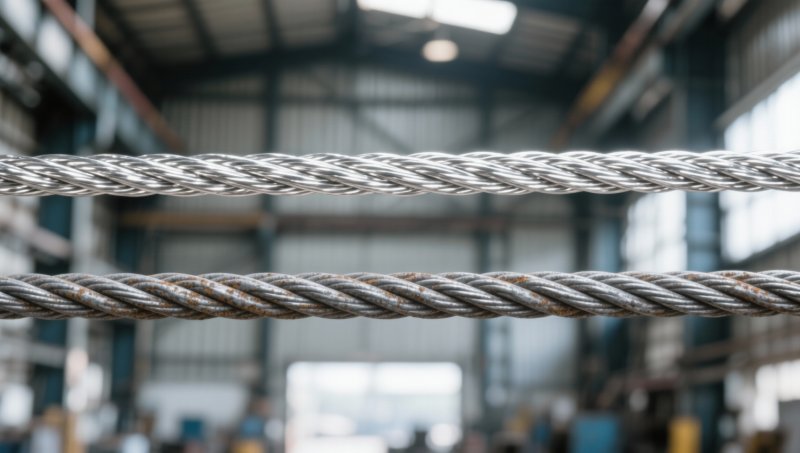
Material Comparison: Stainless vs. Carbon Steel Wires in Dynamic Loads
Selecting the right wire material involves evaluating not only static tensile strength but also fatigue endurance, environmental compatibility, and lifecycle cost. The table below summarizes key technical and operational differences across three critical dimensions: mechanical behavior, environmental response, and total cost of ownership over a 5-year period.
The data confirms that while stainless steel incurs higher initial investment, its lifecycle advantage becomes decisive beyond Year 2—especially where unplanned downtime carries high operational penalties (e.g., $15,000–$45,000/hour in automotive or semiconductor production lines). For structural integration, Hongteng Fengda’s certified HRB500 Rebar meets ASTM A615/A706 and GB/T 1499.2 standards, delivering guaranteed yield strength ≥500 MPa and elongation ≥14%, ensuring reliable anchorage even under repeated seismic or vibrational loading.
Critical Selection Criteria for High-Vibration Applications
- Fatigue Strength Ratio: Select wires with fatigue limit ≥40% of ultimate tensile strength—stainless grades consistently exceed this; many carbon variants fall below 30%.
- Surface Finish Consistency: Cold-drawn stainless wires exhibit ≤±0.05 mm diameter tolerance across 1,000 m spools—critical for uniform tension distribution in multi-point suspension systems.
- Standard Compliance: Verify EN 10270-3 (stainless spring wire), ASTM A564 (precipitation-hardened alloys), or GB/T 4357 (carbon steel)—Hongteng Fengda’s export-grade wires carry dual EN/GB certification.
- Traceability: Full heat-lot documentation, including chemical analysis (C, Cr, Ni, Mn) and tensile test reports, must accompany every shipment—non-negotiable for OEM audits.
Procurement Guidance: What Buyers Should Verify Before Ordering
Procurement teams face increasing pressure to balance cost, compliance, and continuity. When sourcing wires for high-vibration use, avoid assumptions based solely on tensile strength or surface appearance. Instead, validate against five measurable checkpoints:
- Request S-N (Wöhler) curve data specific to your frequency/amplitude profile—not generic lab results.
- Confirm galvanizing thickness (for coated variants): minimum 275 g/m² per ISO 1461 ensures ≥5 years in moderate industrial atmospheres.
- Verify bend test performance: stainless wires should endure ≥15 full bends over a 3d mandrel without cracking.
- Check dimensional consistency: ±0.1 mm tolerance on diameters ≤φ6 mm; ±0.2 mm for φ8–φ20 mm per EN 10270-1.
- Validate packaging integrity: moisture-barrier wrapping + desiccant packs required for stainless shipments exceeding 4 weeks transit time.
Hongteng Fengda supports global buyers with pre-shipment third-party inspection (SGS/BV), mill test reports traceable to raw material heats, and flexible MOQs—from 1-ton trial orders to 500+ ton project consignments. Our standard lead time for HRB500 Rebar and related structural products is 15–25 days after deposit confirmation, with air freight options available for urgent samples.
Why Partner With Hongteng Fengda for Structural & Industrial Steel Solutions?
As a professional structural steel manufacturer & exporter from China, Hongteng Fengda delivers more than product specifications—we deliver decision confidence. With modern rolling mills, automated quality control labs, and real-time ERP-driven production tracking, we ensure every coil, beam, or rebar batch meets exacting international benchmarks: ASTM, EN, JIS, and GB.
Whether you’re specifying stainless wire for vibration-critical instrumentation loops, selecting HRB500 Rebar for earthquake-resilient infrastructure, or sourcing AZ150 Galvalume coils for corrosive plant roofing, our engineering team provides free technical consultation—including load modeling, corrosion risk mapping, and compliance gap analysis. We support distributors with localized warehousing in Dubai and Rotterdam, and offer OEM labeling, custom cutting, and just-in-time delivery scheduling.
Ready to optimize your next procurement? Contact us today for: detailed material certifications, customized bending/tensile test reports, sample dispatch (lead time: 3–7 working days), or a project-specific quotation with landed-cost breakdown—including CIF terms, import duty guidance, and port-of-discharge logistics planning.
Please give us a message


Please enter what you want to find